
The literal translation of Schlachtfest is “Slaughter Festival”. A better translation might be “a country feast to eat the meat of a freshly slaughtered pig.” When we were stationed in Germany in the late 80s, our friend Wolfgang held a Schlachtfest about four times a year at his Gasthaus, Sportheim, in the village of Rheindurkheim.
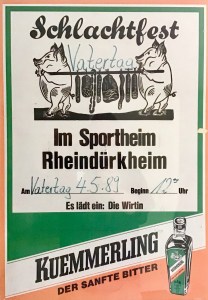
Wolfgang would order a whole pig from Adolf, our local butcher, and then prepare it 3 or 4 different ways. There were cutlets, different sausages, including bratwurst, currywurst and blutwurst (blood sausage), and the German equivalent of a roasted pig. He spent a couple of days butchering the meat and preparing it for the festival. The night before the fest, he and his wife, Vroni, rearranged the tables in the Gasthaus so they were connected together in long rows, like in a fest tent.
The big day arrived and Wolfgang and Vroni opened Sportheim around 10:30AM. Some of the regulars would gather at the bar for a Fruhshoppen (Early drink) and to harass Wolfgang as he was finishing up with the pig. Diners started arriving around 11:00 or 11:30 and the Gasthaus was filled wall to wall with people until early evening, or when Wolfgang ran out of meat, whichever came first.
The food was good. Actually, it was more than good – pardon the pun, but I was in hog heaven at his Schlachtfests. In addition to the meat, there was sauerkraut, spatzle (little noodles), roast potatoes, or potato dumplings (always made by Wolfgang’s father – I have his recipe…;-)…) depending on what you ordered. Of course, you washed it all down with bier or wein. Sportheim was packed, and you sat wherever you could find an open place at a table. You might sit next to a friend, a neighbor, or a complete stranger. If they were strangers, you’d be friends by the end of the meal. The clinking of glasses, along with “Prosit!” (toast!) or “Zum Wohl!” (to your heath!) were heard throughout the day.
Inevitably, Cath and I overate (as did many of the people there) and at the end of the meal you needed something to relieve the heaviness you were feeling. No problem. Vroni had the perfect cure, and a bottle of Malteser Kreuz Aquavit appeared at your table . A shot of the aquavit, and immediately you felt better. Cathy and I still say we drank a “bores a hole” for the magical way it seemed to relieve your stomach and clear the way for more food and drink.
One year at the fest, we were seated next to our neighbor, Wolfgang (not to be confused with Wolfgang, the owner of Sportheim) and his wife Karen. As we ordered our food and drinks, their food arrived. I happened to glance at Wolfgang’s plate and there was a perfectly round cut of meat with two small holes in the meat at the bottom of the circle. I hadn’t seen this cut before and asked Wolfgang what it was, and he answered “Die Schnute”. “Was?” (what?) was my reply. “Die Schnute… Die Schnute!” he repeated, while pointing at his nose. Oh – The snout! He explained how it was the very best cut of the whole pig, and how lucky he was they hadn’t run out. He offered a bite, which I took and agreed it was tasty (think pork belly), but I would stick with the meal I already ordered. Later, I was speaking with Wolfgang (Sportheim’s owner) and asked him about Die Schnute and using the whole pig. He laughed a bit, and then explained the dish was so popular, in addition to the pigs he ordered, he always needed to buy 4 or 5 extra snouts.
We attended our last Schlachtfest in May of ‘89, about a month before returning to the States. I always figured we’d make another one sometime along the way, but of course we never did. I get hungry and thirsty just thinking about those Fests, and the sounds of friends talking and laughing echo faintly in my head. I can almost see Vroni walking towards me with a smile on her face and the Aquavit in her hands.
Zum Wohl……
Discover more from Live Life Exuberantly
Subscribe to get the latest posts sent to your email.
 Live Life Exuberantly
One thought on “Das Schlachtfest und Die Schnute”