
I popped my second Zambezi about 9:30 that morning. We’d been on the road from Harare since 6AM, and were a little over halfway to Lake Kariba. The eight of us were in a van, with a small trailer.
Sinks, Roseanne and Marty had met the rest of us at 5:30AM, at the guesthouse where we were staying. We loaded our luggage, and the considerable number of boxes of red and white wine, gin, brandy, whisky, Amarula, tonic, limes and various other drinks into the trailer (Five days on a houseboat is a looooong time). A cooler of beer and water went into the van with us. The rest of the beer, club soda and water for the trip were already on our houseboat in Kariba.
Once we cleared Harare, the traffic lessened, while the road worsened. Potholes and rough road were the norm. Along the way, we passed several old abandoned tobacco houses with busted windows that were no longer in use and had been empty since the early 2000s. They were victims of the land reparation that took place in the late 1990s and early 2000s. What had once been fields of tobacco, corn and other crops were now mostly empty. Roseanne, who was sitting behind me , told a few stories of that transition. The most memorable was about her husband’s brother, Mike…
….Mike, as a 19 year old, had cleared and built his farm himself in the 1950s, in what was then Rhodesia. The farm was a couple of hours outside of Harare, and at the time, there was no electricity there. In fact, he originally lived in a cave on the land. In building the farm, he had the help of some men from Tanzania, who were walking to Johannesburg to find work. He told them he had work for them at the farm, and they agreed to stay. They sent one man back to Tanzania to bring their wives and families. Over time, they helped build the main house, build their own homes, and worked the farm. Mike added a school and a clinic to the property, and streams were dammed to increase the water supply. The children of the workers grew and started marrying locals. For years, this life continued. In the 1970s, Roseanne would always bring visiting friends to see the farm, as it was such a beautiful place.
The guerrilla war, or civil war, depending on your view, started in the ‘60s and became more and more violent in the ‘70s. After years of fighting, a peace agreement was reached, and the transition from Ian Smith to President Mugabe took place. Over time, one of the results of the transition was land reparation. Although Roseanne’s brother-in-law had helped Mugabe’s government during the transition, he eventually lost his farm in the late ‘90s, and had to leave it. He was given papers for future compensation, but two decades later, he has yet to receive anything for his farm….
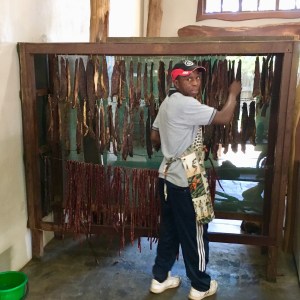
We drove on. About 9AM, we arrived at Lions Den, a well known break point that was halfway to Kariba. More importantly, it’s known for their homemade sausages and wurst, known in Zim as Boerewors and Biltong. Marty bought a few pounds for us to eat as snacks on the boat. We hadn’t left the compound before we greedily broke into the bags, sampling the several varieties he’d bargained for. All were delicious, and just salty enough to make a beer taste extra good. We climbed back in the van and I popped that second Zambezi. It’s probably my imagination, but it tasted better than the first one. I attribute that to the Biltong.
Fifteen minutes down the road, we felt a jolt. The driver slowed, and pulled off the road. We’d hit one too many potholes and shredded one of the trailer tires. Fortunately, we had a spare and twenty minutes later, we resumed our journey.
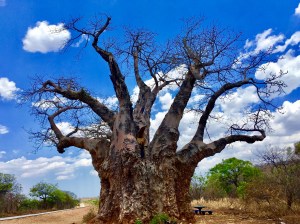
There was more beer and Biltong, and stories of previous trips to Kariba…flipped cars, elephants blocking the road, and a jumbo (elephant, not jet) blocking the runway once, when Roseanne piloted a small plane from Harare to Kariba. We also learned of Ghost Trees, Baobab Trees and other plants we saw along the way. Cathy, ever sharp eyed with regard to animals, saw a few monkeys in the trees.
The time passed quickly.
We pulled into Kariba town about 1230PM. Luggage and booze were transferred to our houseboat and we were underway. Fishing for bream, along with views of hippos, elephants, Cape buffalo, and crocodiles, were in our future.
*****
This is the second in a series of short blogs I will publish over the next several weeks, about our trip to Africa in September and October of 2018. I’m not trying to be exact in detail, rather, I’m trying to give a bit of the spirit or feeling of the various parts of the trip. Read at your leisure. Or not.
Related blogs can be found at:
Pink Gins (The trip is planned) – https://mnhallblog.wordpress.com/2018/04/13/pink-gins/
Zimbabwe (Just prior to departure) – https://mnhallblog.wordpress.com/2018/09/20/zimbabwe/
Harare (First Blog about the trip) – https://mnhallblog.wordpress.com/2018/11/02/harare-zimbabwe/
Discover more from Live Life Exuberantly
Subscribe to get the latest posts sent to your email.
 Live Life Exuberantly
Adventure encompassing food, drink, plants and animals! Doesn’t get better than that! Wondering what is comparable to Zambezi ? Guessing the Boerewors are made from some kind of pig or boar? How about the Biltong? Can’t wait to hear more!!
LikeLiked by 1 person
Tooooo manny questions! ;-). Zambezi is a lager and just seems to have the right balance – of all the beers we tried over there, I liked it best. Boerewors and Biltong can be made from just about any meat. I think the ones we had there were from beef and pork. I’ve also seen them made from wild animals (kudu, ostrich….)
LikeLike