It was 2:00AM when the satchel charges exploded and woke my Uncle Don. The date was January 31st, 1968 and the North Vietnamese Army and Viet Cong (VC) had just launched the Tet Offensive. Don had been in Vietnam since March of 1967. He was assigned to D Company, 52nd Infantry Regiment at Bien Hoa/Long Binh and had one month left before he was to rotate back home.
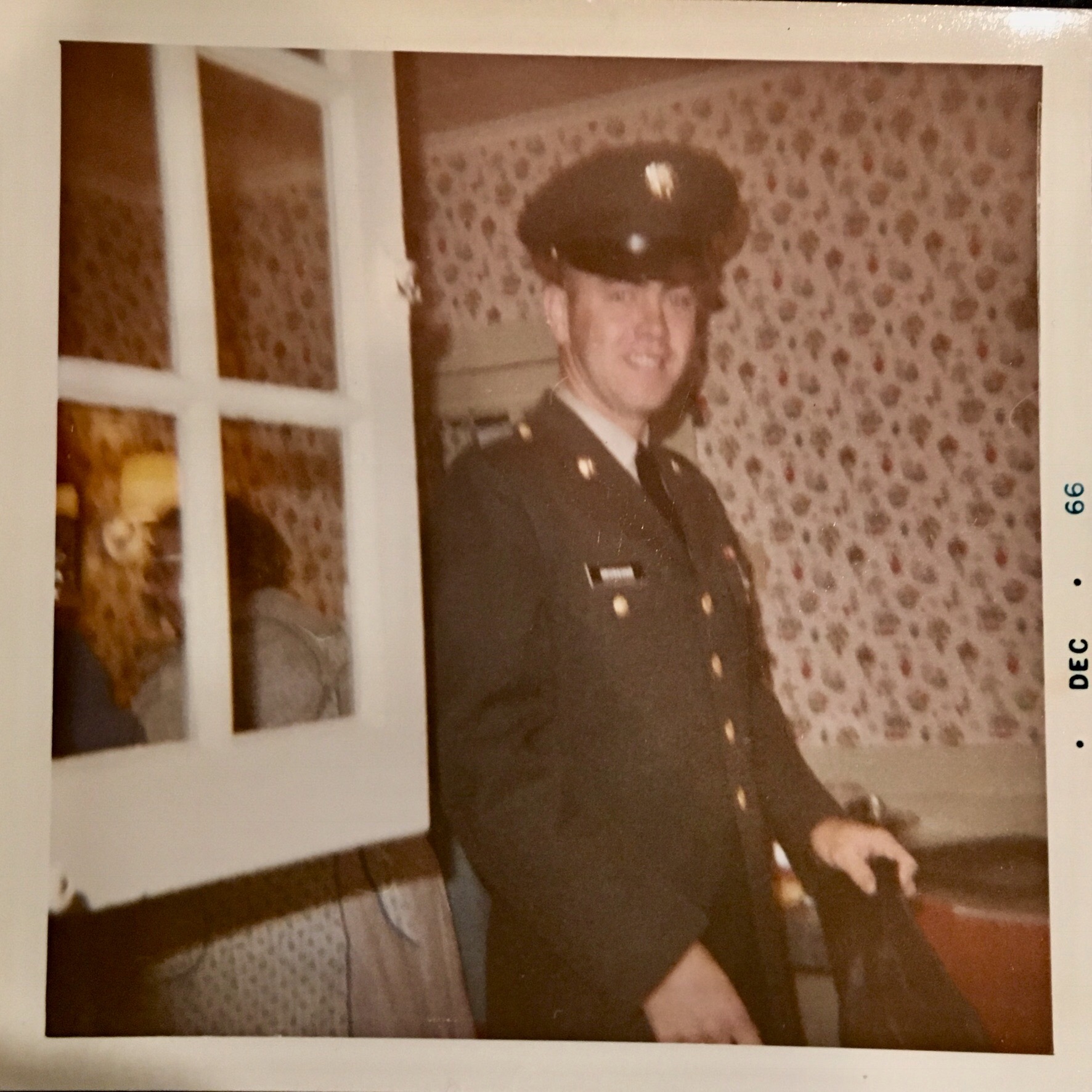
The explosion woke him, threw him around his bed, and projected a can of shaving cream violently into his collar bone. At first he thought he was wounded or had possibly lost his arm, as the arm was completely numb. After visually checking that his arm was still there, he grabbed his gear and headed to the Company HQ. There, he met the CO, and others who were gathering. Most of the command was already deployed for their normal evening duty, so there were only a few men left. They learned that a satchel charge had ignited a nearby ammunition pad. North Vietnamese mortar shells then started falling across the base.
The CO, First Sergeant and a LT were getting ready to leave in a jeep to investigate the explosion. The CO asked Don to go with them, and then changed his mind. Instead, he instructed him to lead a four man team from the HQ element to a nearby guard tower and form part of a defensive perimeter. The CO’s jeep drove away and a few minutes later, they heard an explosion. They didn’t know till later that the jeep was just destroyed by the VC. The LT was killed immediately, and the CO was wounded. The First Sergeant would die from his wounds about seven months later.
At this point, it was all-hands-on-deck. Uncle Don formed a team that included the company clerk, the armorer, and a cook. All were carrying M16 rifles and my uncle carried an M79 Grenade Launcher in addition to his rifle. They obtained an M60 Machine Gun from the armory and everyone was carrying as much ammunition as they could – both for their rifles, and the M60. They jumped in a jeep and headed to a nearby ammunition pad and then the perimeter. On the way there, my uncle showed the cook how to use the M60 – the cook had never fired one before.
As the team headed for the perimeter, they saw a VC with an AK47 setting a satchel charge near one of the ammo pads. Don fired and dropped him. They stopped and rolled the body over to ensure he was dead. The VC turned out to be the barber who had cut my uncle’s hair, and occasionally shaved him, for the past six months. It was the first enemy he killed that night.
The team raced to the nearby guard tower and proceeded to the top. From there, they had a commanding view. They could see VC and North Vietnamese regulars everywhere outside the perimeter, and there were already sappers inside the fence. They checked in on their radio, and then left the tower and moved to a location on the ground, as there was a concern that the enemy could easily place an explosive charge at the base of the isolated tower, killing them. On the ground, they established a fortified position and saw hundreds of dots of red light as the enemy approached.
The North Vietnamese crossed the first and then the second perimeter wires, setting off trip flares that illuminated the battlefield. The team requested permission to open fire, but were told to hold, as HQ thought there were friendlies in the area. Finally the enemy was crossing the last perimeter wire, which was constructed of concertina razor wire. They were still waiting for permission to return fire when the cook opened up with the M60. Soon, there was incoming fire from three different directions. They engaged the enemy and returned fire. The Vietnamese couldn’t penetrate the small perimeter they had formed.
The battle raged on. At one point Don raced across sixty yards of open ground and they retook two mortar positions that were previously overrun. The enemy was gone, but the mortars and ammunition were still there. They also encountered some of their own claymore mines that the Vietnamese had turned to face the US troops. Just before dawn, an ammunition pod exploded knocking Don to the ground. He got up and moved on. The enemy was then starting to breach the perimeter wire behind them. From their radio, he called in a Cobra gunship and passed the coordinates to the pilot. The first rocket was fired and when it passed, he could feel the heat of it, on the back of his neck. He elevated the range slightly and the Cobra let loose with a full complement of rockets, stopping the penetration at the wire.
As it was getting light, they received word via radio to stay put, stay off the roads, and stay under something with overhead cover. The Air Force was bringing in an updated “Puff the Magic Dragon”. Puff was a C-130 gunship used for close air ground support. It had two 20mm “Gatling guns”, along with two 40mm cannons on the ship and it could put a round into every square yard of a football field-sized target in less than 10 seconds. Puff arrived and circled the battlefield multiple, multiple times and that broke the back of the attack. The 11th Armored Calvary Regiment arrived in relief and most of the fighting ended about 1030 in the morning. Uncle Don had started the night with six bandoliers of M16 ammunition, with each bandolier holding seven magazines. Each magazine held twenty rounds, so he was carrying 840 rounds total. He also had six bandoliers of grenades with six M79 grenades in each bandolier. As the fighting ended, he had one magazine of M16 ammunition left and no grenades.
My uncle learned then that his CO was wounded and went to the 95th Evac Hospital to check on him. As he greeted the CO, a nurse approached (he says she looked exactly like Hotlips on the TV show MASH) and he realized how dirty he must look. He started to apologize to the nurse for his filth, when she cut him off. “I don’t care about your dirt, but you are bleeding on my floor.” That’s when he discovered he was wounded from the explosion that had knocked him down. There was blood running down both his arms. The nurse got a doctor, who took a look and there was shrapnel peppered in both arms from his elbows to his wrists. The doctor wanted to remove the shrapnel then, but my uncle said he needed to check on other men in his company. The doctor asked if he was coming back, and Don replied “probably not.” The doctor told him he would be picking shrapnel out of his arms for the next ten years. “You’ll be sitting at a bar and your arm will be hurting. Look for the blackhead – that’s where you can pull the shrapnel from.”
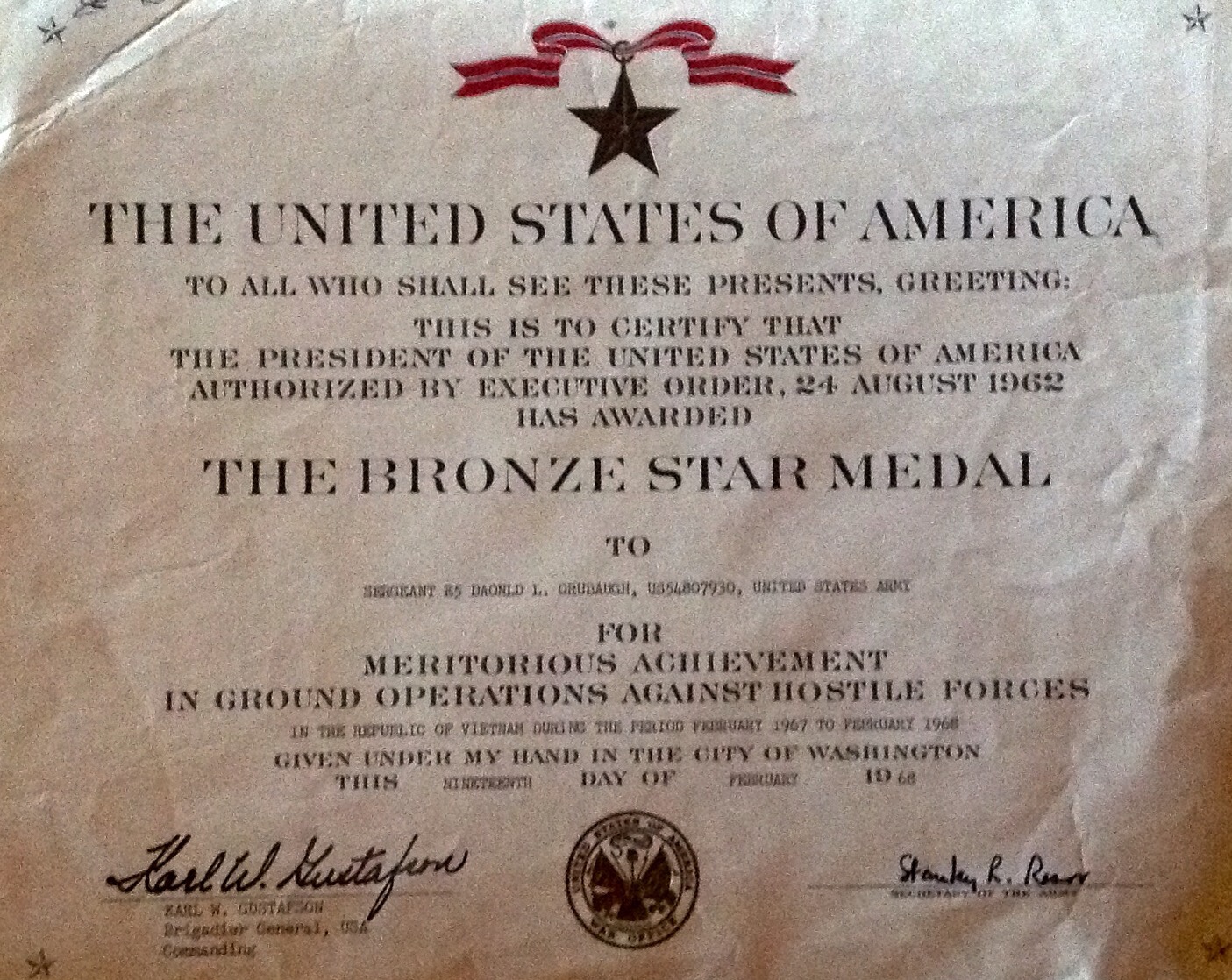 Uncle Don’s Bronze Star citation
A month later, he rotated home, after a year in country. He had been awarded both the Bronze Star, and the Combat Infantryman Badge. Because he left the hospital, his wounds weren’t recorded, and he never received a Purple Heart.
He and his wife, my Aunt Diane, reunited in the States and he left the Army about six months later. When he returned home to Ottawa he went back to his old job at the First National Bank, and life returned mostly to normal. Like many men who have experienced combat, he never said much about it. Except that occasionally, he would be sitting at a bar in a restaurant with my aunt and she would see him picking at his forearm. She would hear the “klink, klink, klink” of him dropping the shrapnel on the bar….
***************************
This year is the 50th anniversary of the Tet Offensive In Vietnam. On January 30/31, 1968, North Vietnamese troops and the Viet Cong launched the largest battle of the Vietnam War, attacking more than 100 cities simultaneously with more than 80,000 fighters. After brief setbacks, U.S. and South Vietnamese forces regained lost territory, and dealt heavy losses to the North. Tactically, the offensive was a huge loss for the North, but it marked a significant turning point in public opinion and political support here in the United States. It was the beginning of the end of the war in Viet Nam, although it would go on until 1974, resulting in another 37,000 US deaths.
***************************
Discover more from Live Life Exuberantly
Subscribe to get the latest posts sent to your email.
 Live Life Exuberantly
Quite a story. I did not know any of his history in the army. I knew him from the bank and McKinley school. Most of what I remember is that he and Diane raised three pretty neat kids.
LikeLiked by 2 people
I knew Don from day one, but did not realize what he had gone through —- thank you for this story !!!
LikeLiked by 1 person
I worked with Don at first national bank for a few years and he was friends with my brother, Tom Lock. So sorry for your loss. Don told me one thing when I was first training that I’ve always remembered and lived by, Don said to always know why you are doing something, just don’t do it because you were told.
LikeLiked by 1 person
Thanks for sharing!
LikeLike
Where does America find such brave men and women. If you contact your Congressman & Senator they can help you through the process of getting your uncle the Purple Heart he earned while serving his country valiantly in Vietnam. Good luck. 💜
LikeLike
Dennis – thanks for your comment and thanks for the recommendation. I will look into it.
LikeLike
Also, if you succeed in getting him the award, you can have his name entered into the National Purple Heart Roll of Honor Museum located in New Windsor, NY. It is truly a beautiful and solemn museum dedicated to those Americans that shed their blood for Liberty and Freedom.
LikeLike
Thanks for writing Dons story. I had never heard it in such detail. He is a hero. Brian and I were in the AirForce at the same time as Don was in the Army. I remember driving Diane and Don to San Francisco before he left for Vietnam. We were station in California.
LikeLiked by 1 person
Shirley – thanks for the comment. I was unaware of that part of his story. Where were you stationed in California?
LikeLike
Thank you for writing this about my dad. It took him years to share this story with us as and we were probably mostly grown before we heard almost anything from him about his experiences in Vietnam. Only once did I ever see slides of his time there and he was very emotional after. A rarity for him as we were growing up.
I remember him yelling out with nightmares as a child and I was fascinated when those peices of shrapnel came out of his elbows. Though it would take me years to understand the significance.
This past March he returned to Vietnam as a tourist and landed in country almost 50 years to the day that he had arrived as a soldier. He had many wonderful stories to share on his return and has also shared many more of his experiences during the war. I am grateful for this first hand glimpse into history.
I am deeply proud of my dad and his service. He is a hero to me in many more ways than his bronze star represents. If you ask him he will adamantly insist he is not a hero. He will say he was simply in the wrong place at the the wrong time and survived. I’m grateful every day that he did.
LikeLiked by 1 person
Amen Dawn.
LikeLike
I moved to Ottawa in 1990. I didn’t know your Uncle Don well, but I always knew who he was. Wow!
LikeLiked by 1 person