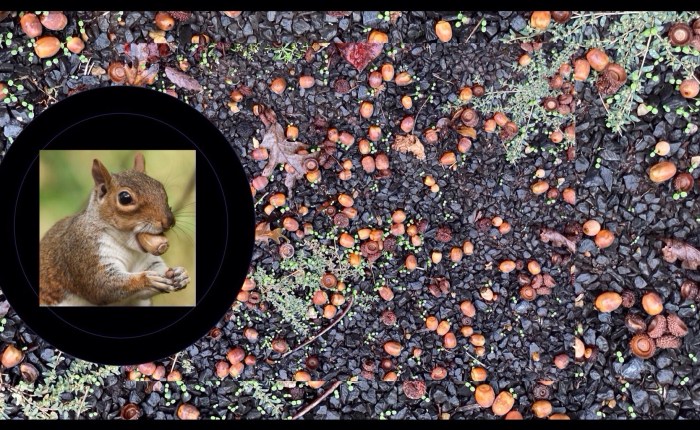
This is a good month to be a squirrel at the farm. Acorns are falling like rain and the ground is covered. You hear them hit our metal roof day and night. It is so loud, it sounds as if the trees threw the acorns at the roof. Old wive’s tales say all these acorns are a prediction of a bad winter to come.
I may not hate January, but I don’t exactly love it. After the fun and festivities of Thanksgiving, the Christmas holiday season, and New Year’s Eve, January arrives like a fat dose of reality, cold and hard. When I was at West Point, it was the start of what we called “Gloom Period”*.
The weather, reduced daylight, post-holiday debt, broken resolutions, and springtime nowhere in sight all combine, making January a demanding month. Additionally, living on a farm in the country makes January more “real”, or at least more of a challenge than living in the city or the ‘burbs. All of the daily chores go slower, or take longer to do. It’s just a fact of life here on the farm.
There are of course good things about January – a couple of holidays; the fresh start of a new year; skiing, sledding or skating if you are into those and nature collaborates; all of those wonderful soups, stews and casseroles we make and eat in winter; seeing a bright red cardinal framed against the white of the snow; sitting by a fire, while looking out a window at the beauty of the falling snow…
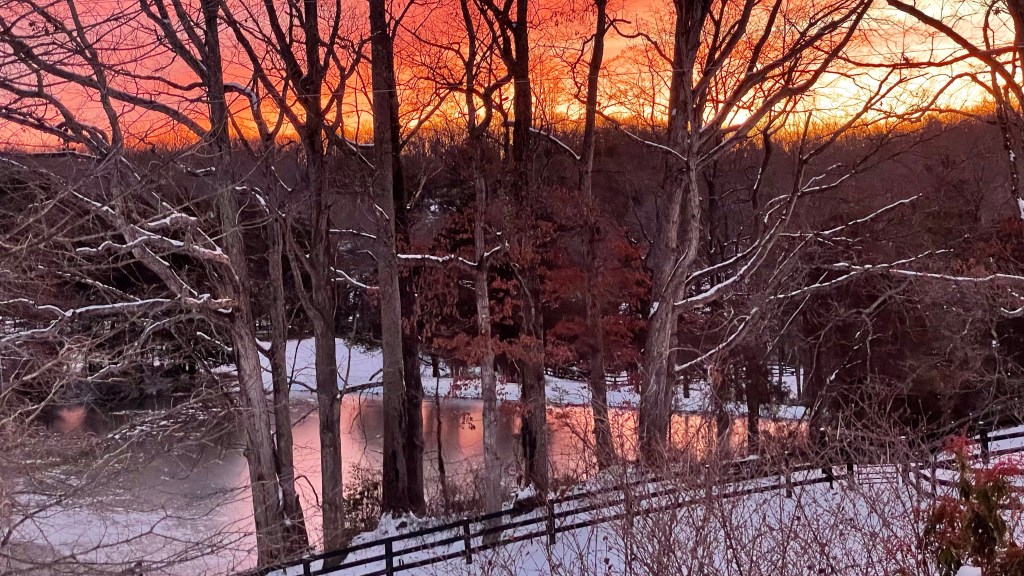
Beauty of the New Fallen Snow.
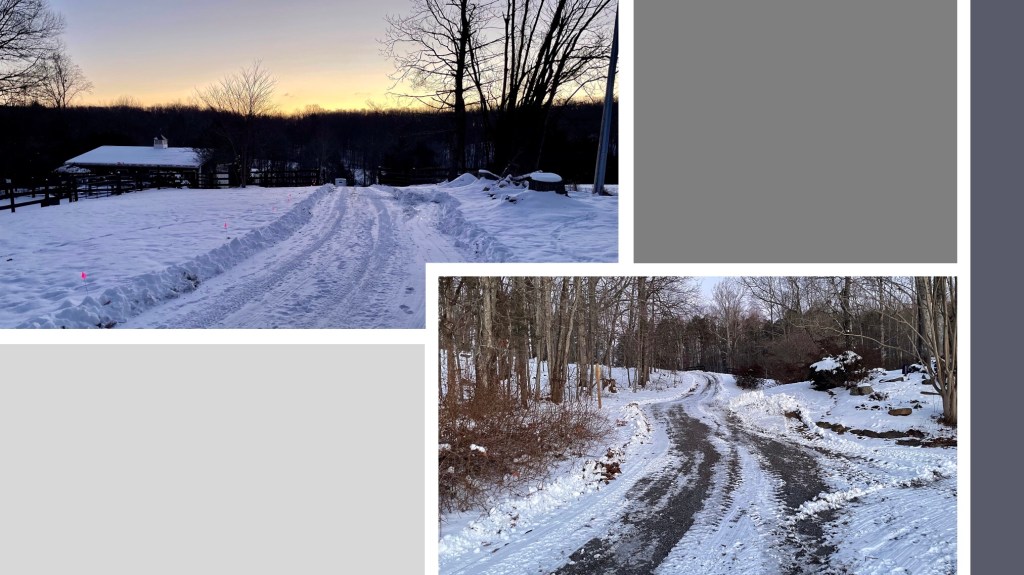
Looking out a window at the beauty of the falling snow… and knowing I had to get my butt out there ASAP and plow the drive from the barn to the house to the road. This year, after over 700 days of no measurable snow in the Virginia Piedmont, Mother Nature reminded us she is boss. This January, two storms gave us 10 inches of snow and I plowed after each of them. I also plowed an elderly neighbor’s driveway so she could get up and down the hill at her home.
Plowing the Drive From the Barn to the House to the Road.
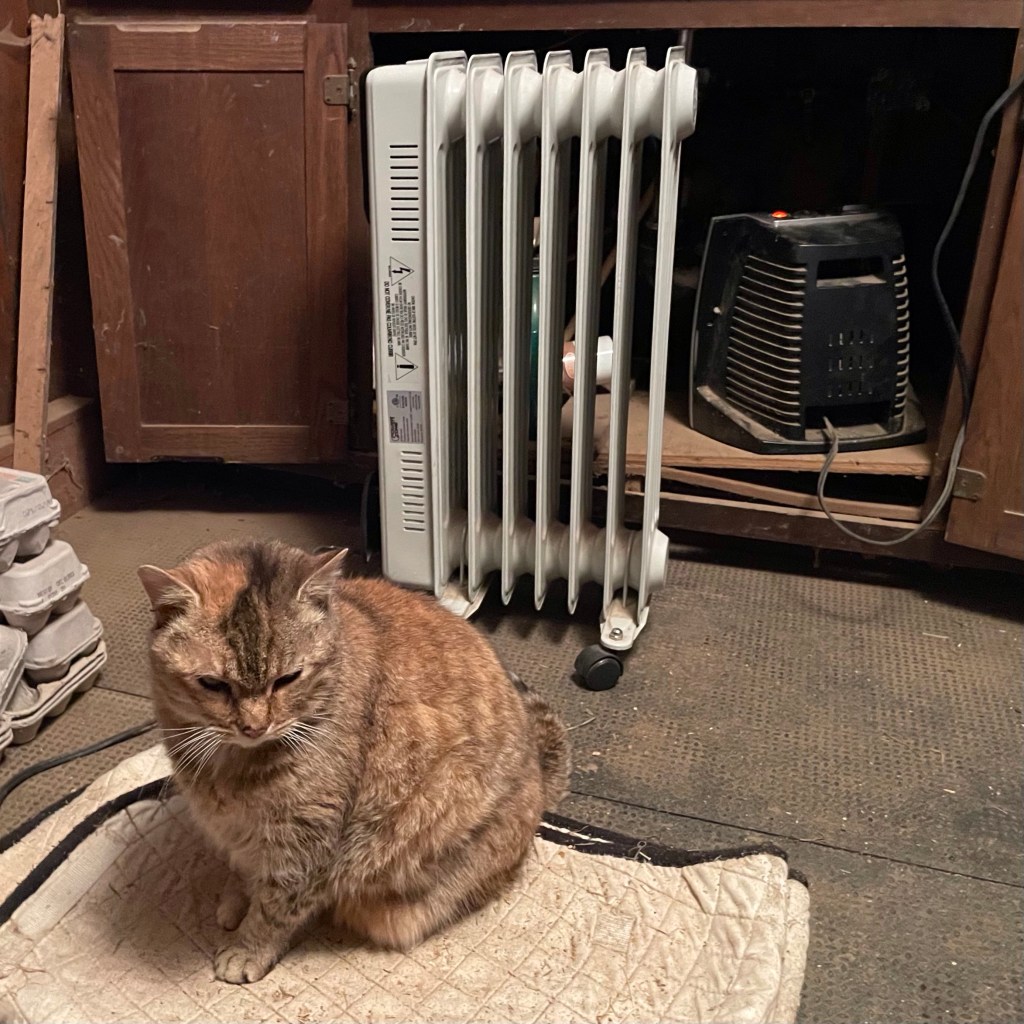
After the snow, the temperature dropped into the low teens and single digits. This meant placing an extra space heater in the barn tack room to keep the pipes from freezing. We also moved the barn cats into the tack room at night to keep them from freezing. Extra hay was provided for the horses, as well as giving them a fresh bucket of unfrozen water just before bed each night.
Trying to Keep Both Pipes and Cats Protected.
The state and county plowed the roads and then plowed them again. With high winds, the dry snow drifted back over a couple of our country byways, making them nearly impassable. Additionally, a couple of friends ended up with frozen pipes. The pretty white snow wasn’t quite so pretty by then.
Of course I realize compared to friends and family in the midwest, this weather has practically been balmy and the snowfall not so bad. Maybe I’ve grown soft over the years away from home.
This being Virginia, you can count on frequent weather changes, which did happen last week. The snow, ice and freezing temperatures gave way to a day of misting rain and then temperatures first in the 60s, and then the mid 70s the next day. The snow disappeared and the ground turned to mud. This week as the month is ending, the temps are dropping again. So goes January in The Virginia Piedmont.
In the poem, The Wasteland, T.S. Eliot famously said “April is the cruelest month…”. I’m not smart enough to argue with ol’ T.S., so let’s just call January a challenging month and let it go at that. I don’t hate January, and I don’t hate winter. I enjoy our four seasons and have no plans for relocation to a warmer climate. Still, I’m ready for February’s arrival. Yes, it remains winter, but January will be over, and we’ll have Valentine’s Day on February 14th. The 14th is important for another reason as well. The National’s pitchers and catchers report that day, as sure a sign of spring’s approach as anything I know of, and certainly more reliable than a groundhog’s musings.
Enjoy the season as best you can, my friends.
Addendum:
* If interested, here’s a blog I previously published about Gloom Period at West Point. “The United States Military Academy at West Point can be a beautiful place, just not in the middle of winter. We called the time from January through early March, Gloom Period. It was a combination of the blahs, a lack of color, a lack of light, and coldness. There was a pervasive grayness to life […] Continue here – https://mnhallblog.wordpress.com/2018/01/21/gloom-period/
In 1988, Cath and I enjoyed a ski vacation in the village of Ischgl, Austria, known for both its skiing, and its Après-ski activities. It also presented the opportunity to ski from Austria to Switzerland, as long as we brought our passports. As is usual, Cathy had the last word after we completed the run.
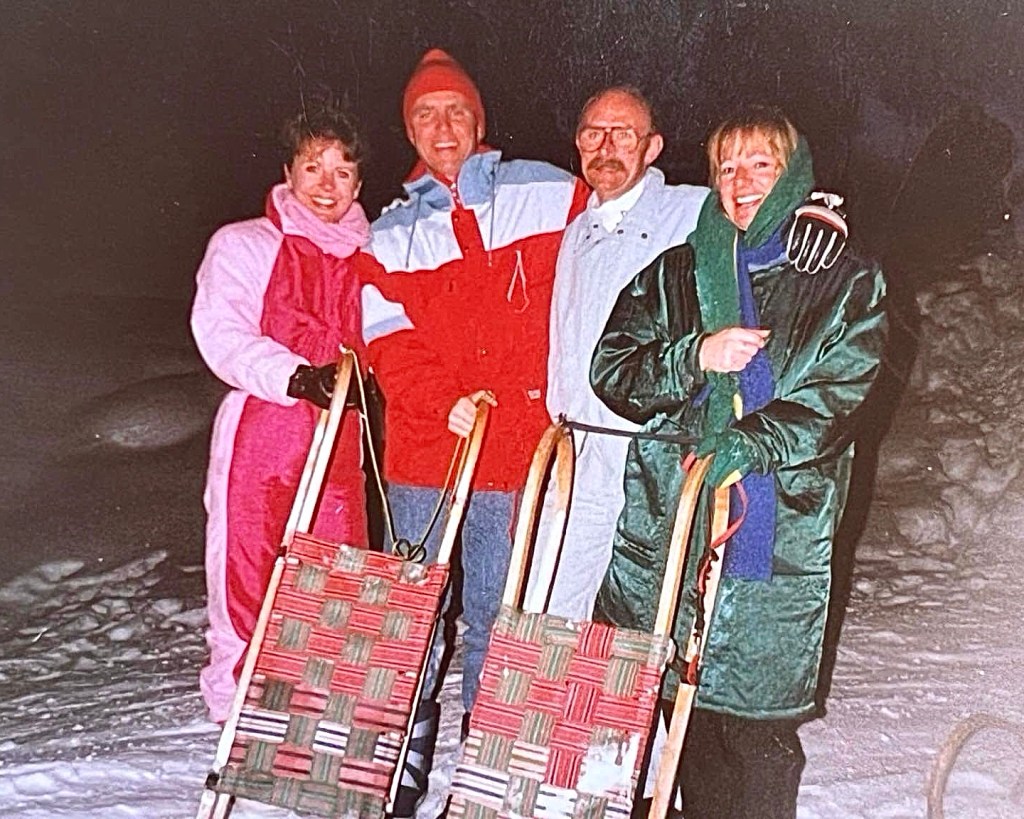
While stationed in Germany in the ‘80s, we took many ski vacations to Austria, sometimes for a long weekend, sometimes for a week. We often went with our friends Jim and Res to the Austrian town of Nauders on the Italian border. The skiing was great there and we enjoyed many fun trips with them.
Good Times With Jim and Res on One of Our Ski Trips.
In ‘88, Jim and Res couldn’t get away, so we decided to go on our own and try a new location. We eventually settled on Ischgl, a village in Austria’s Paznaun Valley with nearly 150 miles of groomed downhill trails. It’s also known as something of a party town with a multitude of Après-ski bars, clubs and restaurants.
We had a great time that week and the town lived up to both its ski and Après reputation. We would ski in the morning, have lunch and a bier at a restaurant on the mountainside, and then ski all afternoon. Eventually, we skied our way back to town and stopped at different places for a drink. Afterwards, we walked to our Gasthaus, cleaned up and went out for dinner, and maybe dancing later. Finally, we’d make it to bed, sleep like the dead, and then do the same thing the next day. It was wonderful, and an easy thing to do when in your early thirties.
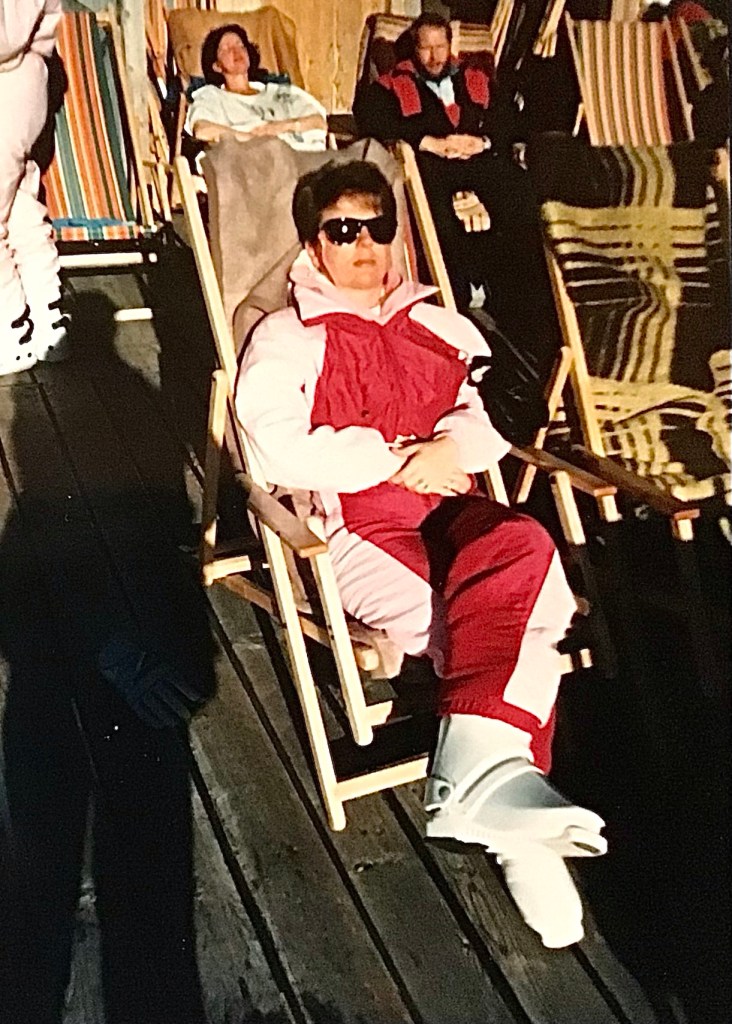
Cathy Catching Some Rays on the Slope at Lunch One Day
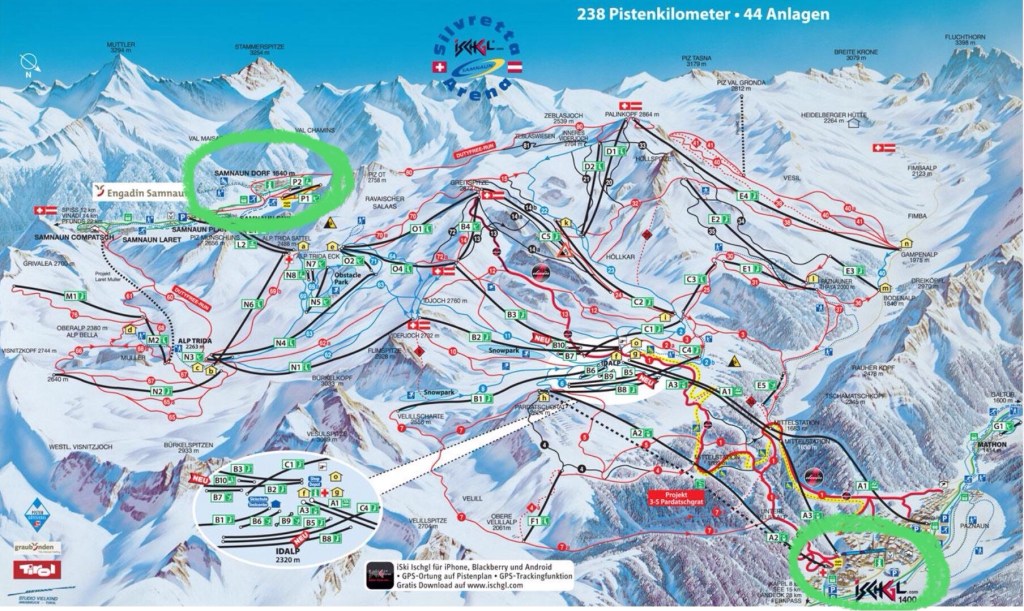
We learned we could ski from Ischgl, across the border and into the duty-free town of Samnaun, Switzerland. As the crow flies, about 10 kilometers separate the two towns, but It’s farther when skiing. Looking at the map, the route was a combination of ski lifts and Blue and Red trails. (in Europe, Blue are considered easy and Red are intermediate trails). Although we didn’t need passports to enter Switzerland, we would need them to re-enter Austria. We decided to give it a go the next day and have lunch in Samnaun, before returning to Austria.
Ischgl on the Right. Samnaun on the Left.
It was a perfect day with a blue sky as we started towards Samnaun. Through a combination of skiing and a couple of chairlifts, we arrived at the red trail heading into Switzerland. As we descended, it was nice skiing, but then we came upon an icy, relatively steep cat-track, connecting on its far side to a steep descent to the village of Samnaun. Several people stopped there gathering their breath, before continuing. The mountain was on the right side of the track. On the left side, the ground dropped rapidly away into an unskiable valley. As we were watching, many people had problems on the ice and were falling, so some caution was warranted. We were about ready to go when someone came zooming down the slope from above, cut his skis into the snow and ice to turn onto the cat-track and… the skis didn’t grab the ice. Instead of turning, he shot off the side of the mountain, traveled through the air for about 40 feet, and then landed 20 feet below the trail in the snow. Hmmmm.
That caught our attention, particularly Cathy’s. The guy was OK, but now needed to find one of his skis and then climb back up the side of the valley to reach the trail. He couldn’t ski out from where he was.
We watched awhile longer, and then I said to Cath it was time to go. She disagreed and wanted to wait a little longer. More time went by and Cathy still wasn’t quite ready. Finally, I said something like “We can’t stay here, and we can’t go back up. The only way out is down the cat-track.” Eventually we started and slowly made our way. Cathy reverted to snow-plowing and her edges grabbed on the ice. After what seemed like forever, but in reality was probably two or three minutes, we made it past the cat-track. A few people were crashing and burning around us, but we had nary a fall. All that was left was the final descent.
We stood there congratulating ourselves and I pulled out my flask for us to share a short shot of brandy. I filled the cap about half full and handed it to Cathy. She looked in the cap and said, “Really? Do you think I could have a double?!” We both laughed and I filled the cap to the brim. She shot it down, handed it back, and took off on the final descent into Samnaun. After pouring myself a short one, I put away the flask and tore after her, eventually catching up. While the slope was a little steep, the snow was good and we arrived in town without mishap.
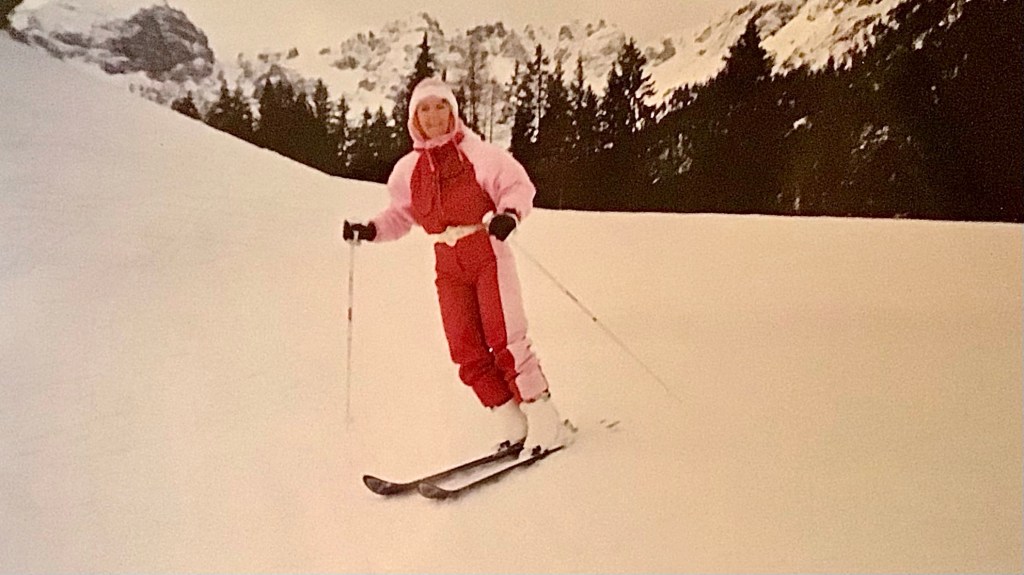
Cathy on the Slope.
We took off our skis and found a nice looking Gasthaus. I don’t remember what we ate, but the bier we drank with lunch tasted awfully good. After lingering a while and doing a little shopping, we took a cable car back up the mountain. Following a short ski, and then an additional chairlift ride further up, we arrived at the border crossing into Austria, where we dutifully presented our passports.
Once through customs, we skied down the slope into Austria. We made a couple more runs, and decided to call it quits. It had been a tiring day.
We skied into town to a bar/restaurant we discovered earlier in the week, and after stacking our skis outside, walked in. The place was quite crowded. We found a small table, settled in, and ordered biers along with a couple of Poire Williams*, a French eau de vie (we called them Poor Willies).
As we sipped our biers, the band began playing and their first song was The Stones’ “Satisfaction”. We, along with half the crowd, jumped on the dance floor and started dancing in our ski boots. As we were dancing, the crowd, a mishmash of Austrians, Germans, French, Dutch, Italians and others from who knows where, were all singing at the top of their lungs “I CAN’T GET SNOW… SATISFACTION!” It was one of those perfect moments you can never replicate, but forever remains clear as a bell in your mind’s eye. To this day, I feel my boots hitting the floor in time with the music, hear the crowd singing to “Satisfaction” and see the look of laughter and love in Cathy’s eyes.
Eventually it was time to leave. We went outside to find our skis and make our way home. As we were standing there, Cathy grabbed her crotch with one hand and started pulling at her clothes. I burst out laughing and said, “What the hell are you doing?!” She looked me straight in the eye and answered, “I am adjusting my balls. I kicked that slope’s ass today!” With that, my wife threw her skis over her shoulder and started walking home.
Addendum:
Poire Williams is the name of a French eau de vie (literal translation – “water of life”), a clear brandy made from pears. Poire is the French word for pear, while Williams is the type of pear. In Germany and Austria, they make an equivalent bottling called Williams Birne Schnaps. Both are strong, and nothing like the peppermint schnapps we know here in America. Depending on the quality, you might either sip or shoot it.
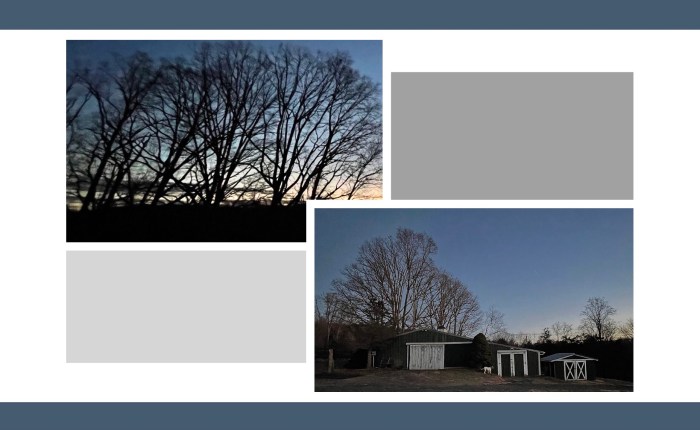
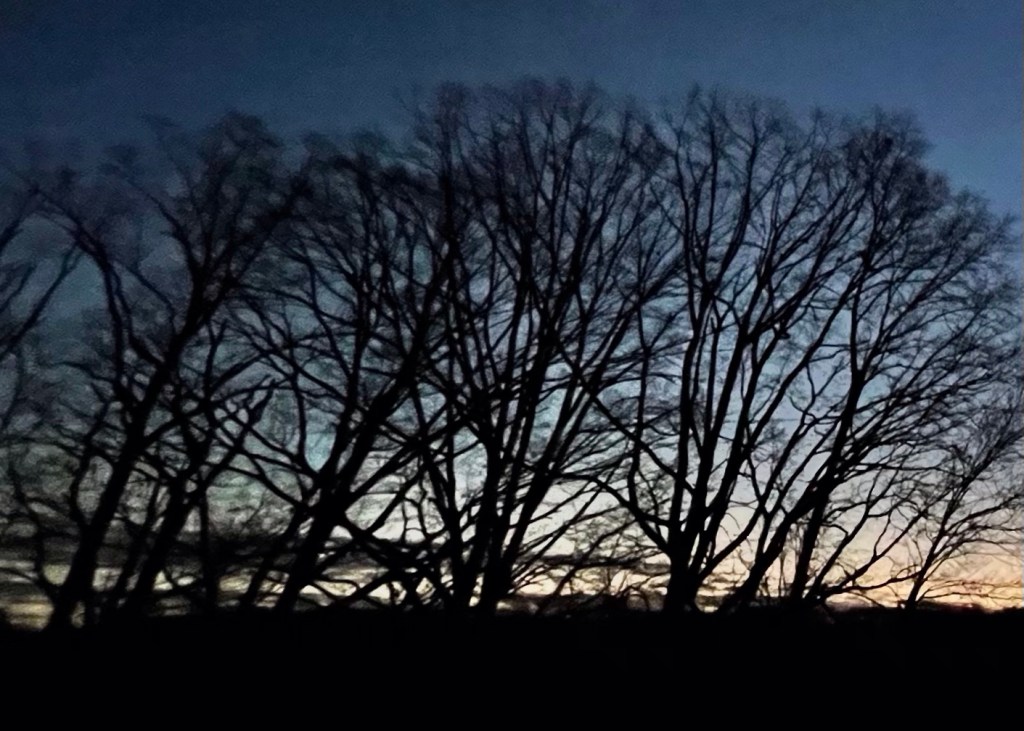
It was an early winter morning a little before sunrise – that liminal period of time between darkness and light. When I left the house to feed the horses, it was so quiet, the silence felt deafening. I soon discovered the opposite was true. In that cold predawn stillness, sound was everywhere, once I started listening.
That Liminal Period Between Darkness and Light.
I have to admit on most mornings, I’m on autopilot as I walk to the barn. Typically, I’ve only been up about ten or fifteen minutes and haven’t yet had my coffee. It’s pretty rote – walk to the barn, feed the cats, feed the horses and return to the house to make coffee.
I suppose I have the sudden snorting of a buck to thank for my change on this particular day. I stopped and tried to pinpoint his location in the paddock, but couldn’t see him. The question of whether he was sounding an alarm, or merely indicating curiosity was soon answered – I heard muffled footfalls, and then saw six deer leaping our fence before clamoring into a neighbor’s field. Our dog Carmen and I were both so startled, neither of us did anything except watch them go, their white tails vivid in the half-light. I have no idea why Carmen didn’t chase them – it was the first of three unusual non-actions on her part that morning.
The deer must have disturbed some nearby turkeys, as two of them started “gobbling” in the woods by the pond. I looked for them as well, but couldn’t tell if they were on the ground, or the low branches of a tree. Carmen, for the second time that morning, did nothing.
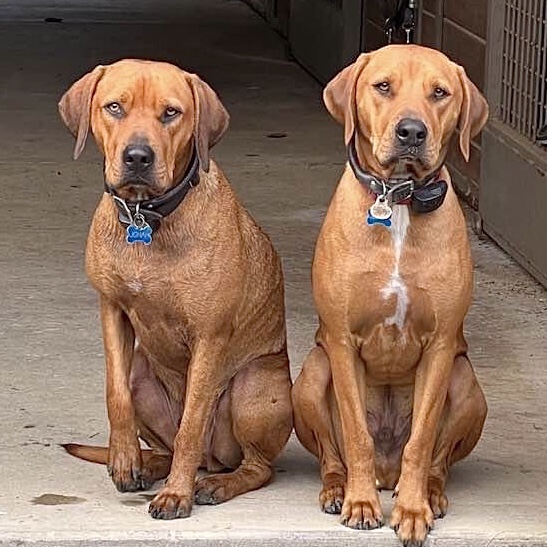
By now, my ears were evidently alert, as I heard a woodpecker tapping near the side of the house. A few footsteps later, the whinnies of our neighbors’ horses came from about 100 yards away. That was unusual for them at this time of the morning. Perhaps something was about, as they were joined by the barking of our friend’s dogs, Jonah and Jebson, about a quarter mile down Swains Road. Carmen’s ears pricked up. Much like the dog telegraph in the movie, 101 Dalmatians, the two frequently start a message that circulates among the other dogs in the neighborhood. This morning, Carmen must have decided they were just gossiping – after listening for a second, she trotted to the barn, with nary a bark.
Jonah and Jebson Trying to Look Innocent
It was chilly in the barn and there was a skim of ice on the water buckets. Our cats, Ollie and Mama Cat, stared silently at me, waiting for their breakfast. The horses weren’t so quiet. Stella and Katie nickered, snorted and pawed the ground. They too wanted their breakfast, but made a much bigger demonstration than the cats about it.
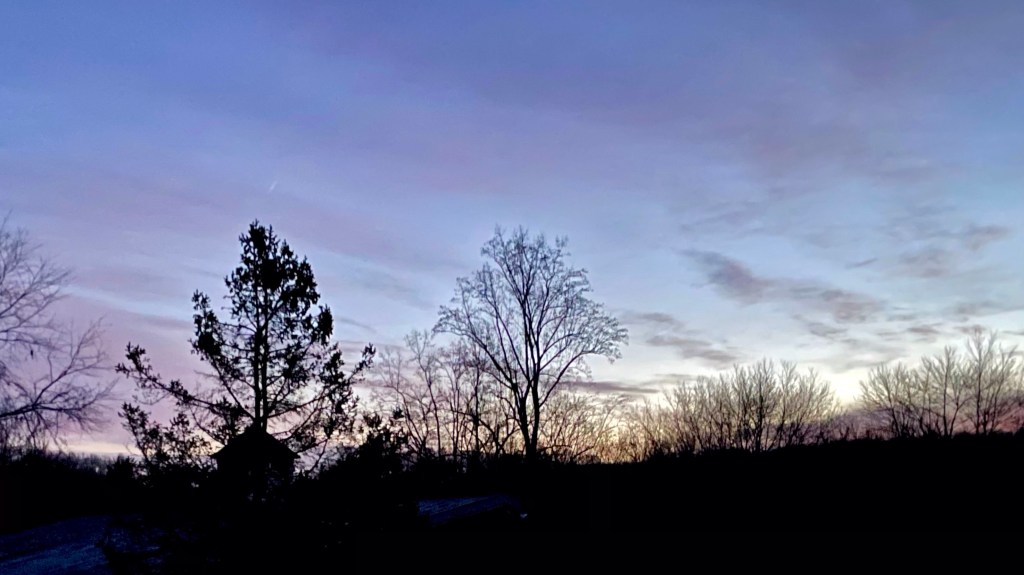
I fed the cats and then the horses, left the barn and started making my way back to the house. It was nearing sunrise now and there was some color in the eastern sky. Carmen and I stopped for a moment just outside the barn and looked to the east. We disturbed a couple of crows who scolded us with their caws, but the cardinals in the nearby evergreen didn’t seem to mind our presence and continued to sing their song of CHEER, CHEER, CHEER ,,, PRETTY, PRETTY ,, PRETTY, PRETTY!
Color and Light in the Eastern Sky.
I thought about the birds and animals, both tame and wild, who were there to greet Carmen and I that morning. It brought to mind one of my favorite quotes from Maya Angelou – “Listen to yourself and in that quietude you might hear the voice of God.” While watching the sun rise that morning, I had an additional thought – In the quietude of a winter’s morning, hear the voices of God’s creatures and feel blessed, for we are all God’s creatures.
It’s nice to have constants in your life, even when they are little ones. Something you can count on. Something that gives you comfort. Something you can look at and say, “Yep, it’s still there.” For me, one of those constants is my old friend Orion in the winter night sky.
I suppose my interest in space and the constellations started with Mrs Finkeldey, my first grade teacher. On February 20th, 1962, a little over halfway through our school year, astronaut John Glenn became the first American to orbit the Earth. Mrs Finkeldey talked about Glenn, and taught us about the solar system and the (then nine) planets. Combining current events and science for first graders – who knew?
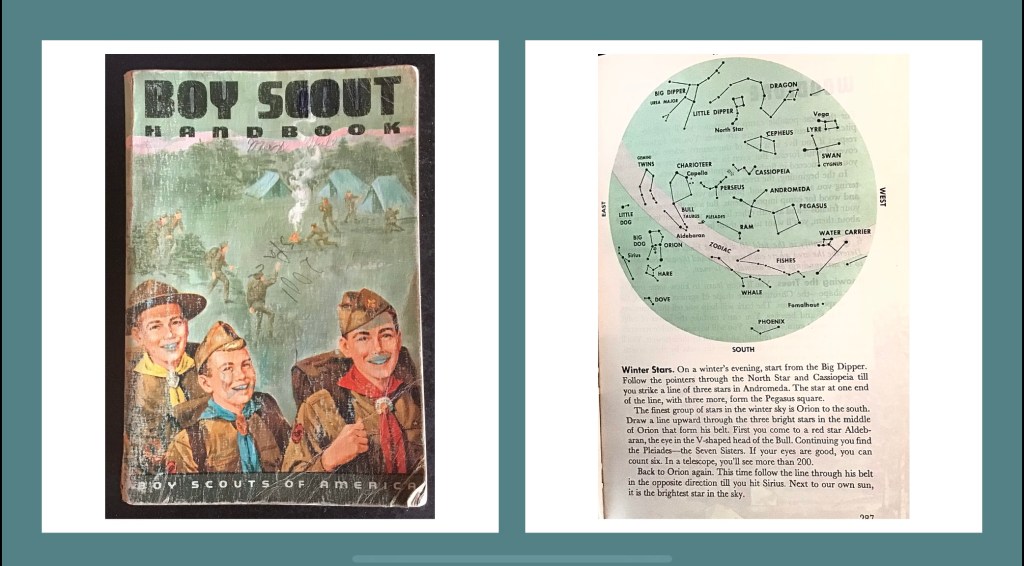
Later, in Boy Scouts, I began learning about the constellations. It started with the Big Dipper pointing to the North Star in the Little Dipper. Suddenly, and amazingly, you always knew what direction north was (unless it was a cloudy night). That was just the beginning. With my Boy Scout Handbook, I began to learn how to identify and locate the constellations – Cepheus and Cassiopeia; Canis Major, along with Sirius, the brightest star in the sky; Gemini the Twins; Taurus the Bull; the Pleiades (the Seven Sisters) and many others.
Knowledge of the Constellations in My Old Boy Scout Handbook
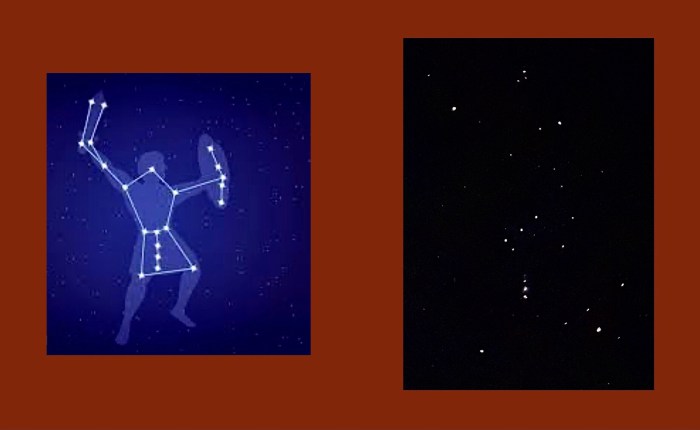
I’m not sure why, but my favorite was always Orion, The Hunter. Orion is one of the more identifiable constellations and has been mentioned by Homer and Virgil, and is even in the Bible*. According to Mythology, Orion was a great hunter and the son of Poseidon. He was killed by the sting of a large scorpion after possible misdeeds. Later, Zeus put both Orion and the Scorpion (Scorpius) in the sky as constellations.
Orion, The Hunter.
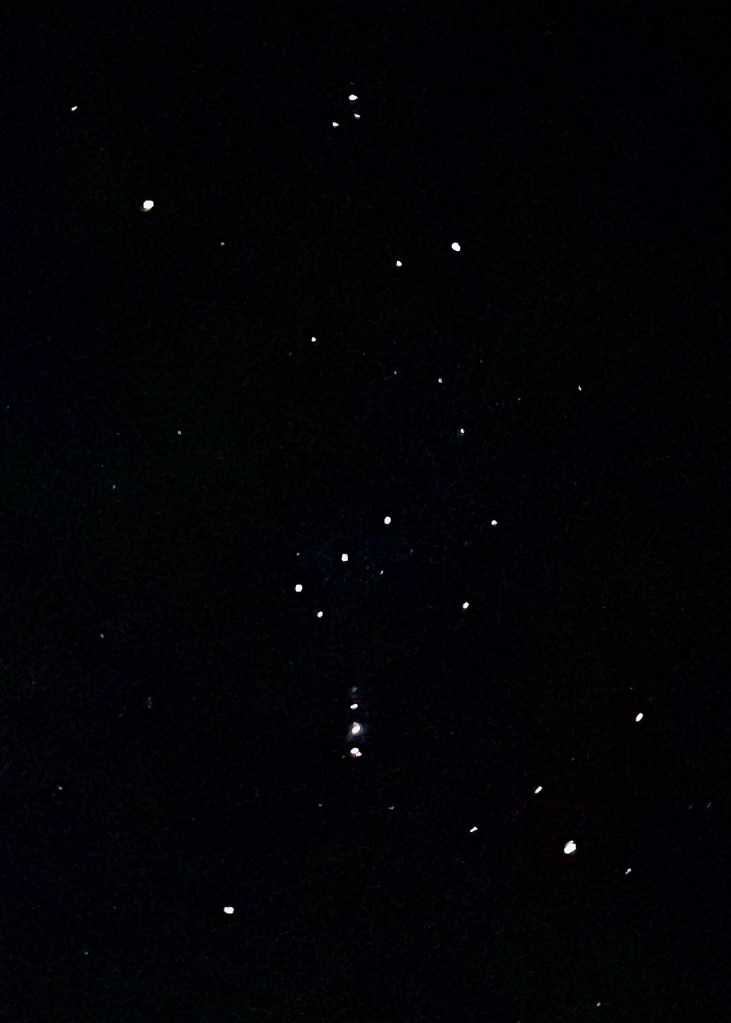
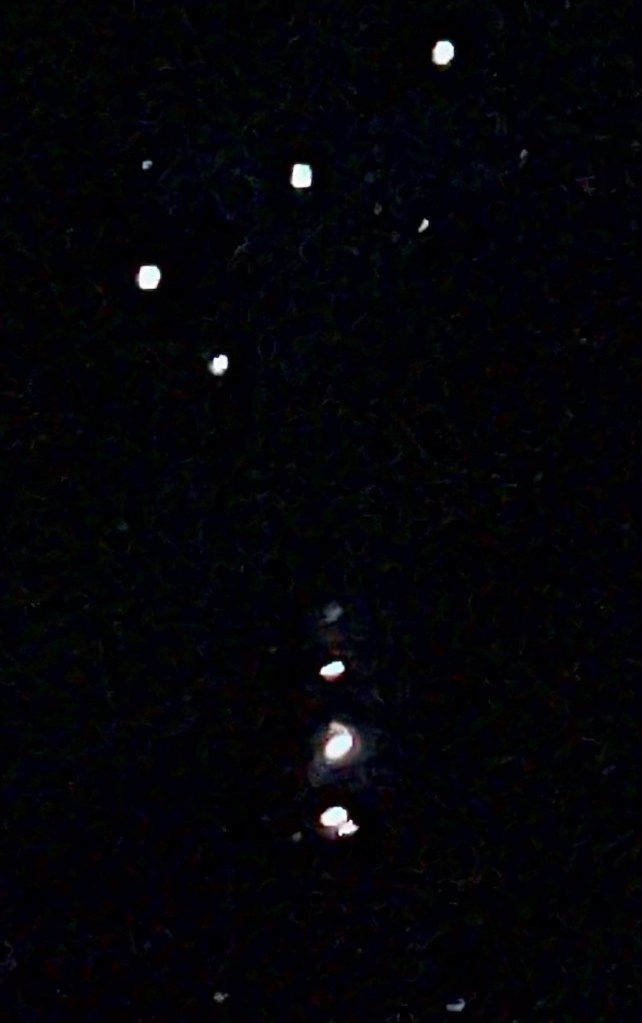
Orion is easy to see and easy to recognize, but here in the Northern Hemisphere, only viewable in winter. Starting in November, I watch him traverse the sky. Every night when I take Carmen out for her last walk, there he is overhead. If I take binoculars with me, or bring out my telescope, I can see the the Orion Nebula in his sword with greater detail. It’s no matter though. Knowing he, and it, are there are comfort enough.
Photo of Orion Taken With My iPhone 12 at Home in Virginia
I’ll observe him until March or so, and then he disappears from the night sky. The good news is he will reappear in late Fall, as he always does. He’s a bit more reliable than many of the unstable things in our lives.
Photo of the Orion Nebula,Below Orion’s Belt. Taken With My iPhone 12.
It’s not just here at home where I see him. Because of his location in the sky, he is visible in both the Northern and Southern Hemispheres. He was with us when we lived in Germany in the ‘80s. Over the years, I’ve seen him on vacations around the world, including this week in Grand Cayman. He has been a reliable travel companion.
iPhone 12 Picture of Orion With his Shield From Grand Cayman This Week.
Take a look one of these nights around 10PM. This time of year, he is high overhead, and slightly south of the center of the sky. You will find him easily enough. Look for his belt, and the rest will come with it. Know that I will probably be gazing on him around that time of night as well. I spend a few quiet moments with him almost every evening.
It is perhaps strange to think of a constellation as a touchstone, but that is what Orion has become for me. He is a constant I can count on and my eyes are drawn to him on starry winter nights. For me, he provides calmness and serenity, if only for a few moments. For most of us, there aren’t many things that do so. When you find one, it’s good to hold onto it.
… Silently, one by one,
in the infinite meadows of heaven,
blossomed the lovely stars,
the forget-me-nots of the angels…
Henry Wadsworth Longfellow.
Job 9:9. Who makes the Bear, Orion and the Pleiades, And the chambers of the south;
Job 38:31. Can you bind the chains of the Pleiades, Or loose the cords of Orion?
Amos 5:8. He who made the Pleiades and Orion And changes deep darkness into morning, Who also darkens day into night, Who calls for the waters of the sea And pours them out on the surface of the earth, The Lord is His name.
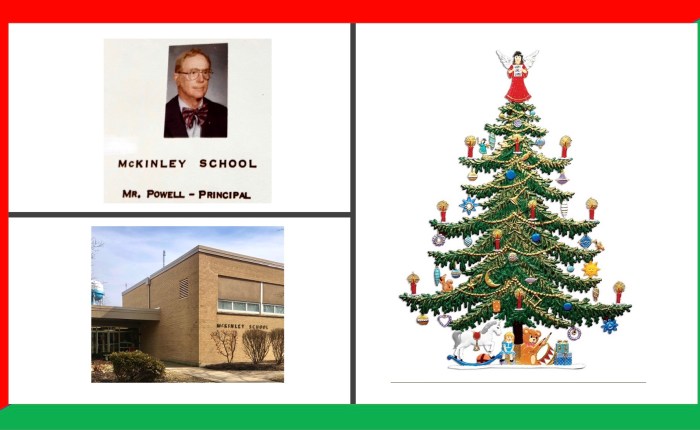
It’s funny what sparks a memory. For me, the Christmas song Up on the Housetop, with it’s chorus of “Ho ho ho, who wouldn’t go, Up on the housetop, click, click, click, down through the chimney with good Saint Nick…”, instantly floods me with holiday memories from my youth. I fondly remember McKinley Grade School in Ottawa, and our Principal, Mr Powell.
‘Tis the season. Don’t we all really remember the Christmases from our childhood? I know I do. The Christmases at McKinley, on the southside of Ottawa, Illinois were special. We ALL remember them.
McKinley was originally a small two story wooden school house. Eventually, in the late fifties, it was replaced with a large, one story brick building. The new school included an indoor gymnasium, with a small elevated stage on one side. Both would figure prominently in the school’s Christmas celebrations.
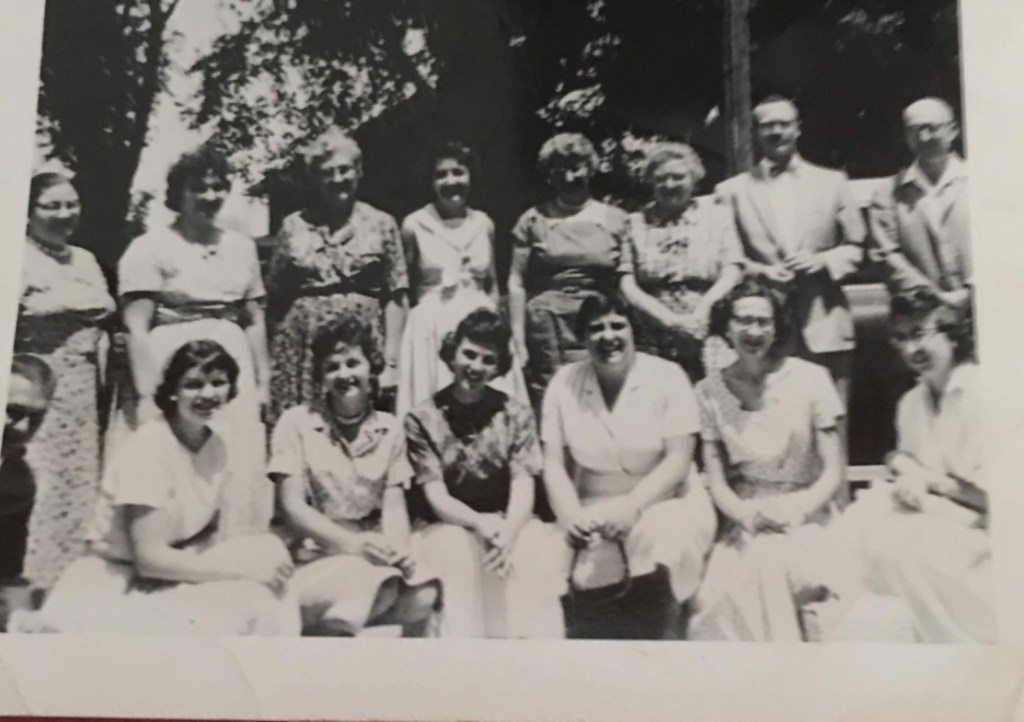
McKinley School Teachers for 1959/60. Mr Powell is second from the right in the second row. The photo is probably from about two years after the new school building opened.
Our excitement started sometime in early December. Christmas was approaching, which of course meant an upcoming break, and if we were lucky, the chance to go sledding, or maybe skating on the pond at Varland’s pasture. Almost as exciting was the Christmas Show the school presented, just before the break. The teachers told us about the upcoming show, and each class was assigned a song to sing. We stared practicing on a daily basis.
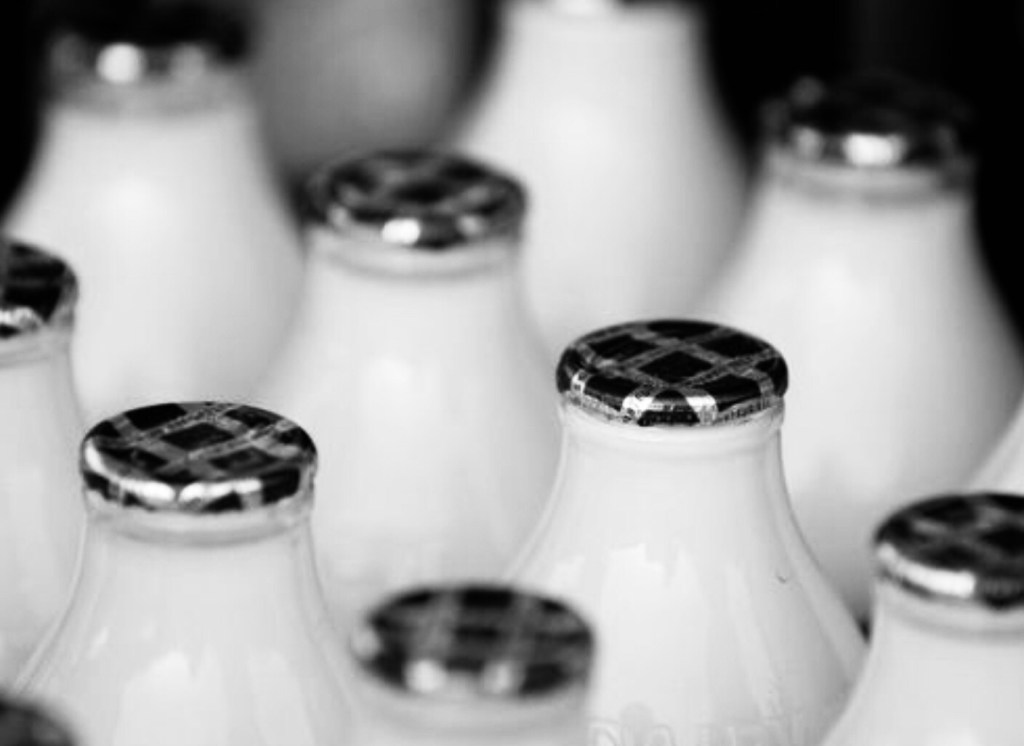
A large evergreen tree eventually arrived at the school and was placed prominently on one side of the gym. Of course, it needed decorating. Where did the ornaments come from? They were handmade by the students. Yes, there were the obligatory construction paper chains from the younger classes, but another source of ornaments proved a favorite memory for many. Milk, in individual glass bottles was delivered to school each day. Those bottles had blue or silver foil caps. We collected the caps and then made stars, ornaments, or strings of ornaments from them. Oh how they shined and sparkled in the reflected light on the tree.
Foil milk bottle caps similar to these made perfect tree ornaments
The excitement grew, and a few days before our break, there were gift exchanges in each of the classrooms. The gifts weren’t big of course, but it was still fun and increased our anticipation.
As the date of the show approached, we kids practiced our songs. The week of the show, the entire school gathered in the gym a few times to practice, and also to sing “songs of the season” together. Those daytime sessions were great fun. All of the kids marched by class to the gymnasium, and then we’d sit on the floor facing the stage. Everyone was in a giddy mood with much laughter, yelling and barely contained excitement. Each class practiced their songs, but in between, Mr. Powell would lead the entire school in Christmas and Holiday songs. He stood in front of us near the tree, wearing a holiday bow tie. I think he was as excited as we were.
When leading the songs, he also acted some of them out. One example several friends remember was singing the song Up on the Housetop*. As the chorus was sung, Mr. Powell would stick his belly out and while placing both hands over his stomach, sing in his deep baritone “Ho ho ho, who wouldn’t go, ho ho ho, who wouldn’t go…”. When the next line “Up on the housetop, click, click, click, Down through the chimney with good Saint Nick” was sung, he clicked his fingers three times instead of actually singing “click, click, click.” Of course, all of us kids quickly caught on, and did the same thing – imagine a couple hundred kids all clicking in time with the chorus, and you get the picture.
The songs we sang at the time included both religious and secular Christmas songs. One student who is Jewish, remembered feeling special because we would inevitably sing one or two Hannukah songs. It was a simpler time.
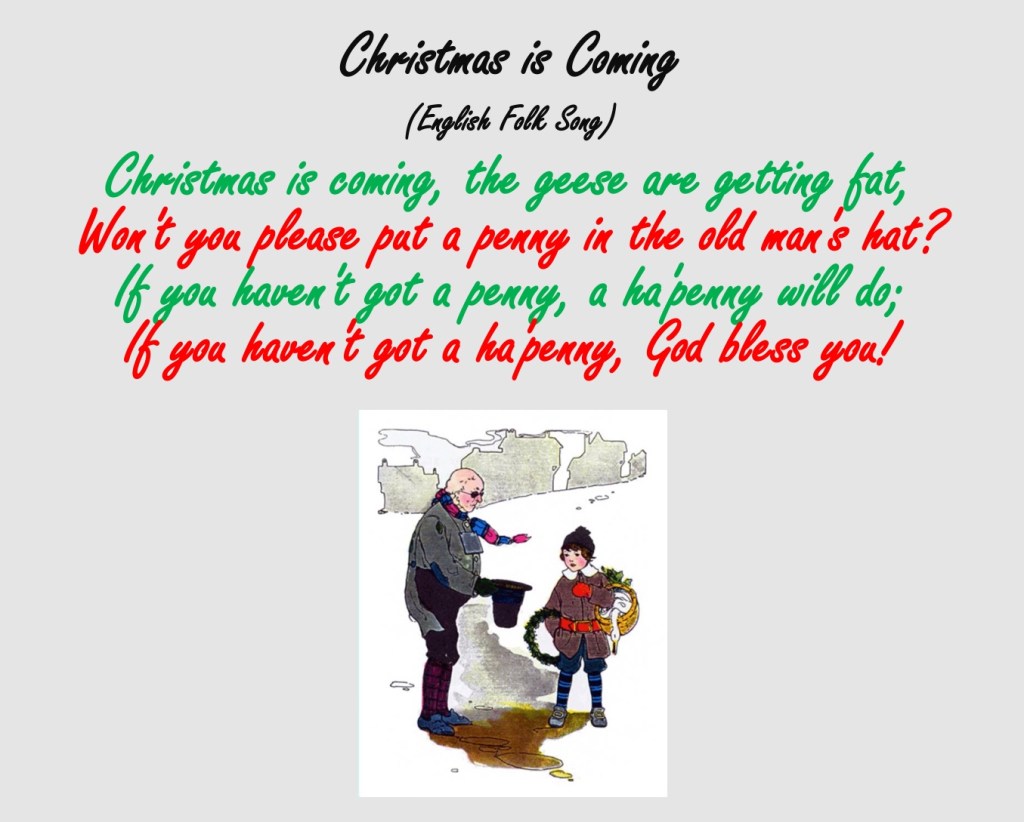
Eventually, it was time to return to our classrooms, but the singing wasn’t quite over. Mr. Powell would start us singing an old English folk song Christmas is Coming, with the opening line “Christmas is coming, the geese are getting fat…” The song is meant to be sung as a round, which is exactly what we did. I believe we were divided into thirds, with each group starting one line after the previous group started. Once we had sung “around” a couple of times, the classes were dismissed, one grade at a time, with each class singing the song all the way back to their classroom.
For the younger kids, there was often a bit of confusion on the lyrics. Instead of “…if you haven’t got a ha’penny, God bless you…”, they heard “if you haven’t got a hay penny God Bless a shoe…” What was a Hay Penny? Why were we blessing shoes? It could all be a bit confusing, but the fun and good spirits made up for it.
Finally it was the big day of the Christmas Show. It was also the day before Christmas break started. Excitement was at a fevered pitch.
The evening program was a bit more formal than our daytime singalongs. It wasn’t quite the Christmas Show from the movie Love Actually – McKinley School was a bit more primitive, but we did have a stage, and the adults sat on folding chairs set up on the gym floor itself. As kids, we dressed in our “good clothes” for the big night. Our parents brought treats and cookies for the classrooms.
While the adults found their seats in the gymnasium, we kids walked to our classrooms, waiting for our turn to sing. My friend Joy remembers sitting at her desk eating cookies and coloring (after smelling) the newly mimeographed Christmas pictures. For the younger grades, there were also games that some of the parents (moms) helped with in the classrooms. Everyone wanted to make sure we kids were entertained, focused and staying out of trouble.
Finally the show started, with the Kindergarten classes singing first. My friend Lynn remembers “The big curtain opening was our cue to start singing. It was quite intimidating to see all the people “out there” sitting on folding chairs looking at us. We sang Away in a Manger and the little stage seemed huge.”
One of the classes always sang Oh Christmas Tree, Oh Christmas Tree in German (Oh Tannenbaum, Oh Tannenbaum…). How cool was that? Singing a Christmas song from another country!
The show eventually ended and parents picked up their children from the classrooms. Cookies were finished, and newly colored Christmas pictures served as visual reminders of the fun that night. During the short drive home, we were still animated. I suppose the stimulation from doing the show, along with the sugar rush of the cookies combined and kept us amped up for awhile.
As with all things, time passed and the world changed – not for better or worse, but changed none-the-less. Mr Powell retired. The huge tree was replaced with two smaller artificial trees for fire safety. Eventually, the festivities changed from a secular Christmas celebration to a Holiday celebration, which was the right thing to do.
One teacher later reminisced “We teachers loved the singing almost more than you kids! We continued the tradition after Mr. Powell retired, but it was never quite the same.”
I’ve been gone from Ottawa for many years now, and to be honest, I don’t know if they have the Holiday celebration in the gym anymore. What I do know is I have wonderful memories from my youth that I wouldn’t trade for anything.
I’ll be home for Christmas, if only in my dreams… Christmas is coming, the geese are getting fat, Please put a penny in the old man’s hat…
Addendum:
There is some question/controversy among my friends about whether the title of the song is Up on the Housetop or Up on the Rooftop. Folk seemingly remember singing it both ways. For what it’s worth, the song is referenced in Wikipedia as Up on Housetop. It was written in 1864 andis the second-oldest secular Christmas songafter Jingle Bells, which was written in 1857.
I had some memories from those special times at McKinley, but of course forgot lots too, until reminded by others about some of the activities. My thanks to the many who contributed memories to this blog, including: students Lisa Palmer Braley, Brenda Brown, Karen Williams Miller, Robert Cavanaugh, Linda Baker, Dorey Renee, Glenda Boettcher, Laurie Sargent Kinken, Mary Cunningham Heider, Kelly Nagle Shanley, Barbara Charlier Houston, LeeAnn Slack Niemann, Lynne Galley Robinson, Becky Ann, Roberta Sherman Schwandner. Jan Butler, Robert Cross, Linda Gerding Bergman, Joy Starjak Algate, Jessica Burress, Roberta Gourley, Tanya McCambridge, Tim Stouffer, and Howard Johnson, along with teachers Charlean Grobe and Sylvia Eichelkraut.
Thanks to Mrs Charlean Grobe for the photo of the McKinley School Teachers in 59-60! Charlean was my Kindergarten Teacher, one year later! She is second from the left in the second row in the picture.
This winter sucked. We didn’t have much snow, but the three ice storms we did have, made travel treacherous, even if just walking to the barn. Of course, I’m not only talking about the weather.
A Long Cold Lonely Winter …
Covid and Covid isolation continued to hold sway over most of us. Then, as the vaccine became available, we were all scrambling to find some way, any way, to receive a shot. They even had a name for us: We were Vaccine Hunters. The slow pace of the rollout was maddening.
We also had that failed, inept insurrection thing back on January 6th. THAT didn’t cheer anybody up. In fact, it made many of us despair for our country.
To top it all off, we have several good friends dealing with serious health challenges. Some, with life and death health issues.
All of these matters combined to cast a pall over this winter. There was a hint of melancholy, at least at our house. The Winter of our Discontent, indeed.
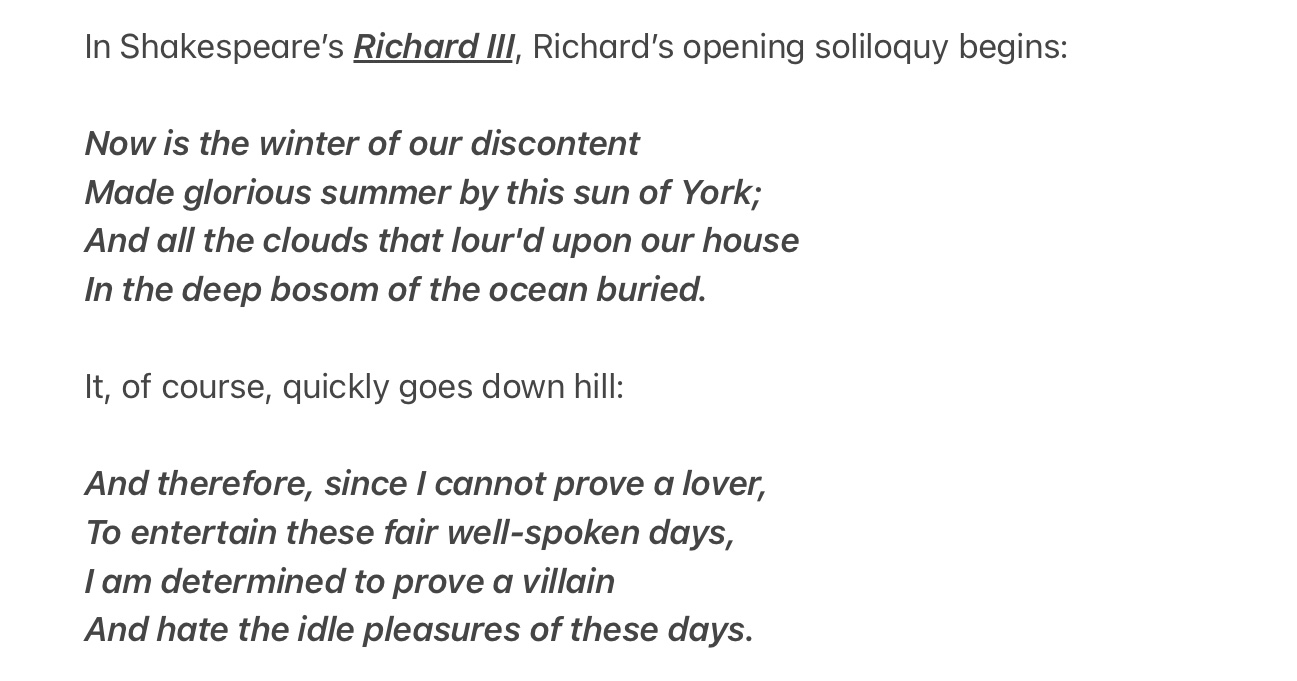
Whether the opening line of Shakespeare’s Richard III, or the title of the 1961 John Steinbeck book, the words “The Winter of our Discontent” aren’t promising. Neither the play, nor the book are particularly cheery. Richard III is of course filled with political and familial intrigue, death and murder, while Steinbeck’s book “The Winter of our Discontent”, examined moral decline in America. Both have more than a little in common with this past winter.
So, how do you fight against a winter of discontent? It could have been all too easy to just try and survive – stay cooped up, become cheerless, and drink too much.
One of the ways we fought it was with Comfort Food. And more specifically, comfort food in the form of soups and stews.
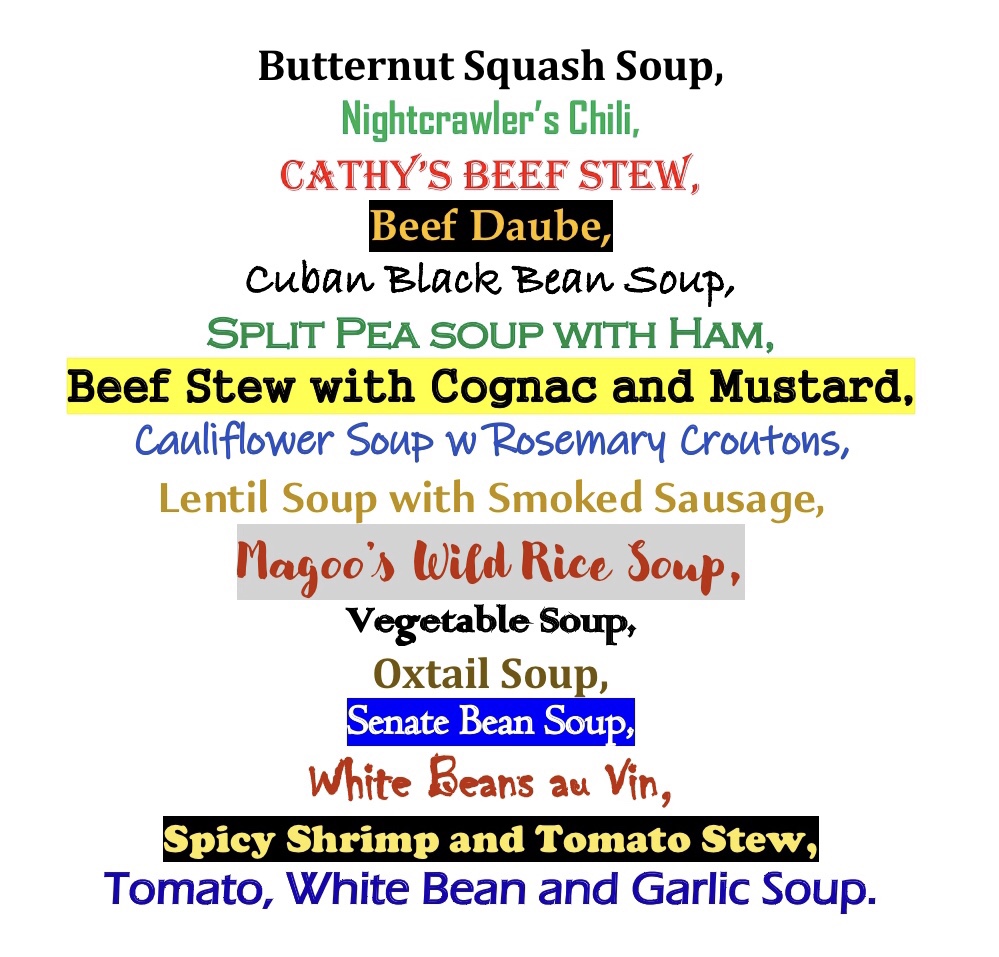
We made and ate more stews and soups than usual this past winter. Actually, I think we had them a couple times a week all season long. Several were old favorites. Others, we made for the first time, and some of those quickly became new favorites. We warmed ourselves with our meals, as much as with the wood stove in the family room. Here’s a list of the assortment we had:
Those soups and stews provided comfort in many ways. Certainly there was the warmth they gave in the bowl and the simplicity of eating a one pot meal. There was also the ritual and pleasure of making them. For me, that brought a bit of relaxation. A few hours in the kitchen, surrounded by the wonderful smells from the simmering pot, along with the warmth of the stove itself, is not a bad way to spend a cold day. I also think their bursts of flavor and color countered the grayness of the season. They furnished a bit of light in the darkness of midwinter, if you will.
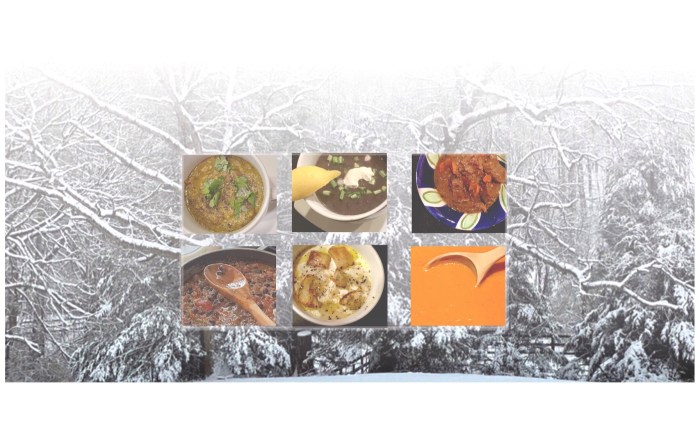
Winter Warmth, Clockwise from upper left – Cuban Black Bean Soup, Butternut Squash Soup, Cauliflower Soup with Rosemary Croutons, Split Pea Soup with Ham, Beef Stew with Cognac and Mustard, and NightCrawler’s Chili
This winter, like all winters, will end. Saturday, March 20th, is the first official day of spring. Although I know we still have some cold, and possibly snowy, days ahead of us, the weather is already turning. Additionally, Cathy and I have both received our Covid shots, and it appears the distribution floodgates are finally opening for all who want the vaccine. Soon, we will all get there.
Among our friends with health issues, some have improved, and others are holding their own. They too are getting Covid vaccines and we hope to see them soon. Unfortunately, two classmates, one from West Point, and one from high school did pass away. We are “at that age” now, where death happens more frequently, but it doesn’t make it any easier.
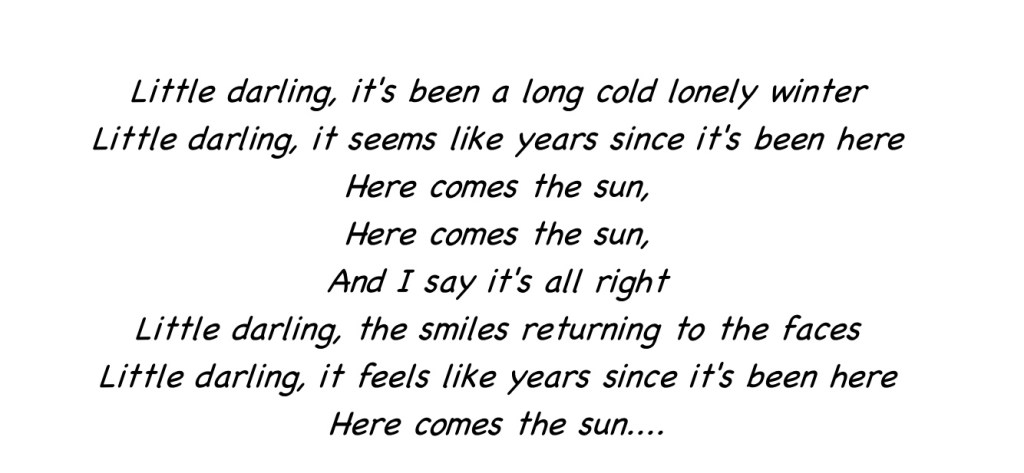
I’m sure we will have a few more warming winter soups and stews over the next several weeks. And while I’m happy for the sustenance they provided over the past four or five months, my mind is already turning to lighter dishes and meals. The days are growing longer and are not so dark. This winter of our discontent is ending. Spring, and the promise of renewal beckon and I am ready to embrace them. In the immortal words of George Harrison:
Addendum:
– Cathy and I had the good fortune to see the play several years ago at the Shakespeare Theatre here in DC. As with many Shakespeare tragedies, there was plenty of death, murder, political mayhem and family intrigue. If you get a chance to see it, I hope you do so.
– The Winter of Our Discontent was John Steinbeck’s last novel, and published in 1961. He borrowed the title from Shakespeare. It too tells the story of a family, with themes concerning the effects of social pressure, deceit, lying, corruption and death. Steinbeck stated that he wrote the novel to “address the moral degeneration of American Culture during the 1950s and 1960s.”






 Live Life Exuberantly