We invited our neighbor Bill over for dinner last night. We were looking forward to catching up, and hearing about his recent travels. The menu? Soft shell crabs and sweet corn. It’s summer and we are on the Eastern Shore of Mary’s Land. What could be more perfect for July?
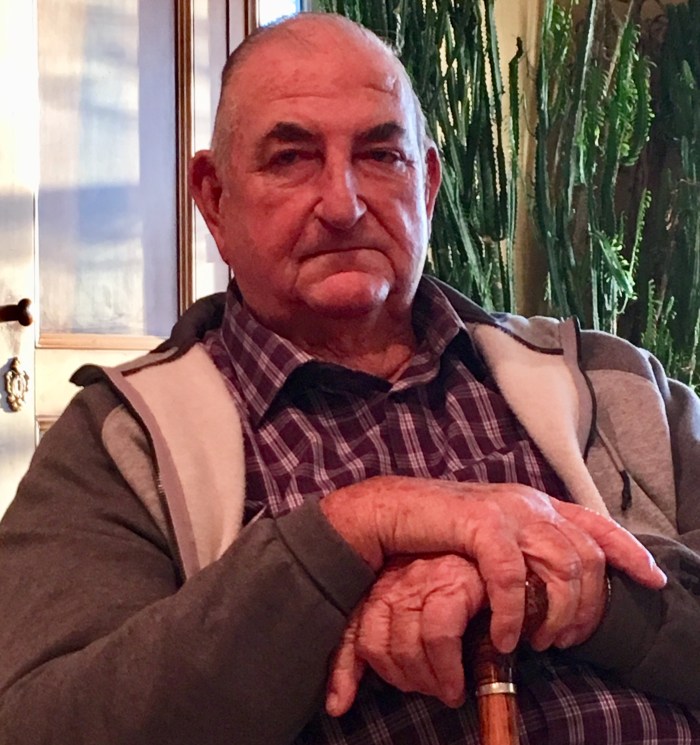
The recipe is from our neighbor on Tilghman, Captain Stanley, who was a skipjack captain. If a skipjack captain gives you a seafood recipe, you damned well better pay attention and write it down. Captain Stanley is in his 80s. He’s spent the better part of his life as a waterman on the Bay, crabbing, and oystering. The recipe is totally minimalist, but that makes perfect sense. As Captain Stanley says, “why add anything else and take away from the flavor?” He worked on the Bay for over 60 years and knows a thing or two about crabs. I’m going to listen.
Captain Stanley Larrimore
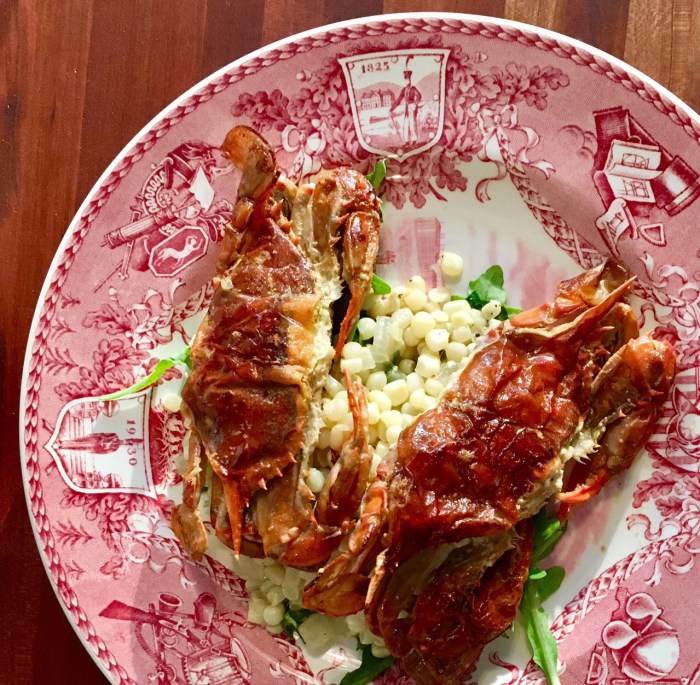
Cathy added to the meal by sautéing the sweet corn in butter and olive oil with some onion and jalapeño. The final dish? A spread of arugula topped with the sweet corn sauté. Put the soft shells on the top of the corn, with a bit of tarter sauce on the side. We served them with a Pinot, but beer would also go with the dish pretty well.
Soft shells sitting on a bed of sweet corn and arugula
Captain Stanley’s Soft Shell Crabs:
Cleaning the soft shells:
1. Cut off face
2. Take off apron (male or female) (and any inner extension that comes with it).
3. Turn over. Lift top edge and scrape out the “dead men” on each side (the lungs). Put edge back down
4. If female, flip back over. Make slits on the two sides of the crab and take out the two white, dime sized objects (the ovaries). Some people (including me) leave the ovaries in.
To cook:
1. After cleaning, salt and pepper them.
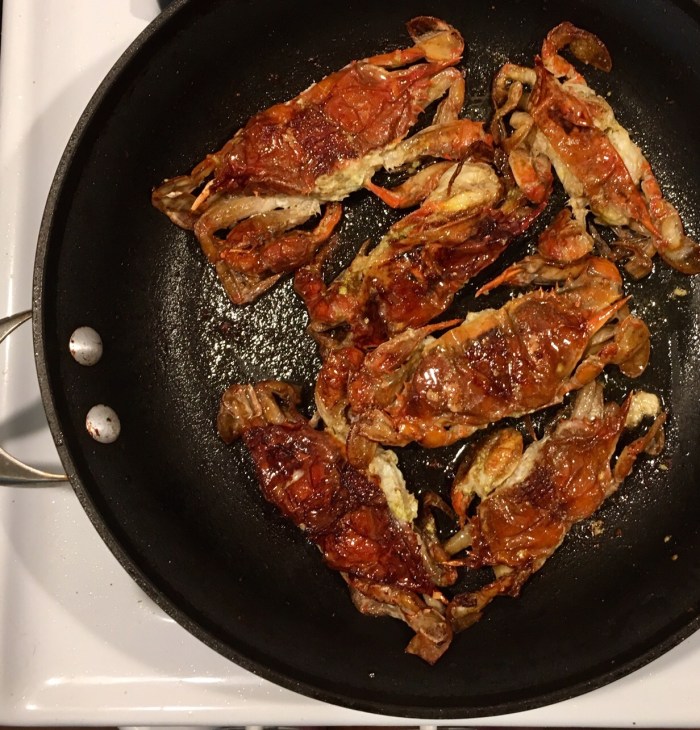
2. Sauté in butter (use ghee or clarified butter if you can; if not, combination of oil and butter) about 3, 3 1/2 min per side.
3. Pull off and eat.
4. Have a little tartar sauce if you want.
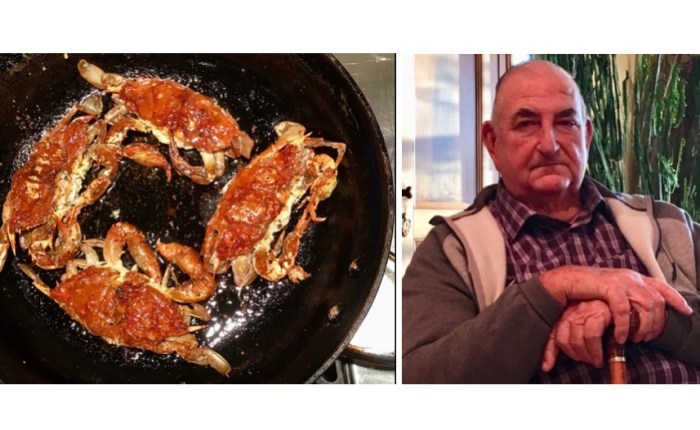
Sautéing soft shells
Addendum:
I borrowed the phrase “Mary’s Land” from Mary Chapin Carpenter, who wrote a song about Maryland with that same title. It’s a great tribute to the state of Maryland.
If you want to learn more about Captain Stanley, or watermen in general, I highly recommend the Book Skipjack by Christopher White. It’s a wonderful book about a lifestyle that is slowly dying away here on the Eastern Shore of Maryland.
“Maknassy” – I can still hear Dad say the word, although he died in 2010. It wasn’t quite a snarl, but it was close. The battle, in March and April of 1943, was vicious. The Germans were slowly getting backed into a corner in Tunisia, and they knew it was either kill or be killed.
General Patton took over II Corps on March 6th, after the debacle at Kaserine Pass. On the 12th of March, Patton detached the 60th Combat Team, Dad’s unit, from the 9th Infantry Division and attached it to the First Armored Division. As a part of his upcoming operation at El Guettar, and the British Army actions under Montgomery to the south, the First was assigned a series of missions aimed at Maknassy Pass. Patton never liked to deploy armor without supporting infantry, and the 60th was given the task. Dad was a 19 year-old Sergeant, with 2 1/2 years in the army.
March 17th was the beginning of what became known in history books as the “Twenty Days of Maknassy”. According to Dad, the rain had poured for days turning the ground and roads into deep mire and mud. The Tanks were ineffective and couldn’t move. It would be up to the Infantry to get the battle started. They were directed to attack a small junction town, Station de Sened “The place everybody fought for, and nobody wanted”.
Dad explained “we started in the grass and mud to the front of the German positions. You couldn’t raise your head without getting shot, plus there were minefields in front of us. After darkness came, we moved”.
Move indeed. The 60th circled the town and climbed the backside of a steep hill, Djebel Goussa, that was to the side of Sened. Djebel Goussa was 600 feet above the valley floor and looked directly down onto Sened. They attacked on the night of the 19th. It was a brutal fight, with individuals, squads and platoons moving slowly up the hill until, by the afternoon of the 20th, they had displaced the Germans. As they now held the high ground, this also forced the enemy to evacuate Station de Sened.
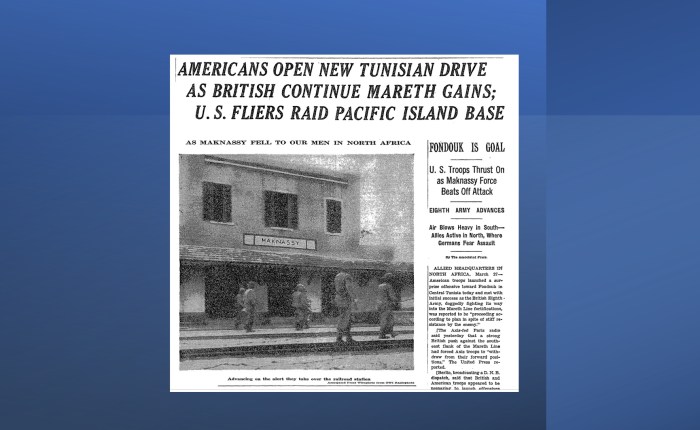
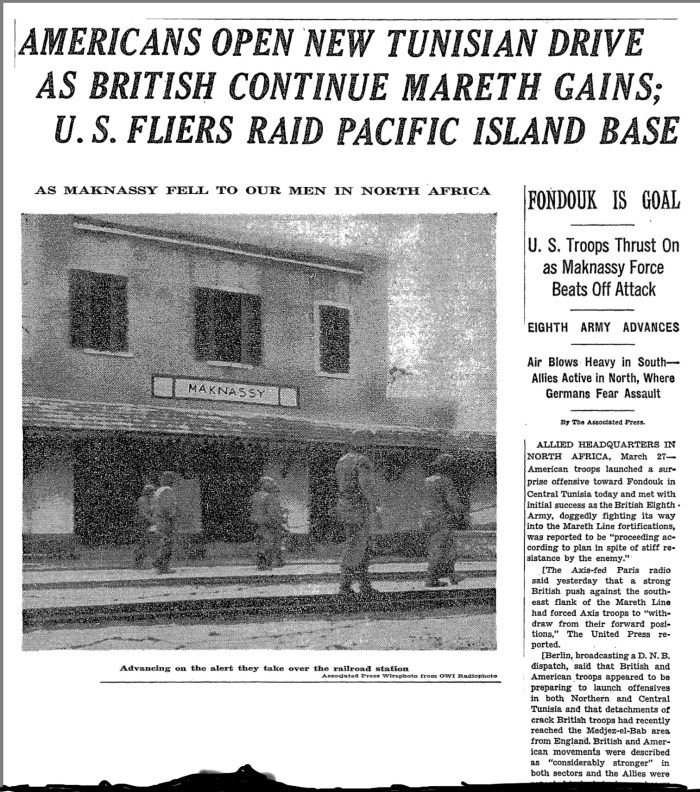
The Germans retaliated with heavy shelling. Undaunted, the 60th moved and attacked again a day later, entering the town of Maknassy itself on the morning of the 22d. The Germans left sometime during the night, and the 60th entered without firing a shot. The New York Times headline back home featured a picture of the unit entering the town near the Railway Station. The easy part was over.
The 60th Combat Team enters Maknassy
They now moved on Maknassy Pass, 5 miles past Maknassy, their ultimate objective. The Germans were dug in on hills in the pass, including Hill 322, which was guarded by Rommel’s personal Guard. The tanks couldn’t go through the pass with the Germans controlling the heights, so naturally, the task again fell to the Infantry.
The 60th attacked a series of hills on the nights of the 22d and 23d with mixed success. As dad explained “we always attacked at night, but the Germans were well dug in. And they had mines on many of the approaches. The Germans used mines everywhere. The going was very slow.” They did take several of the hills, particularly on the north side of the pass, but the Germans still controlled the south side. Hill 322 was attacked many times but never taken. The advance bogged down, but the US Forces acted forcefully enough to cause the Germans to deploy reserve units, keeping them from engaging with Montgomery and the British, further to the south. Dad said that from where they were, they could actually see the open land on the other side of the pass, even though the Germans still controlled the south side of the pass. That open ground was what the tanks needed.
The history books tell us that the battle fell into a stalemate, with the Germans occupying some of the hills, and the US the others for the next several days. On 31 March, the commander of the 1st Armored Division ordered the 60th into another attack. According to one source, “Most of the unit (the 60th), had defended their limited gains east and north of Maknassy against unremitting pressure from the Germans, for the last four days. They had little relief or rest, and many casualties, and their performance during the attack reflected their poor condition.” The attack failed.
Dad talked with me about those days as well. They were dug in on the side of mountains with deep foxholes. Deep because of the continual shelling from German artillery. You didn’t show yourself during the daytime because of snipers. The same went for the Germans, and they also generally stayed undercover. One day Dad was looking across the valley with binoculars and saw a German outside his foxhole improving his positions. Dad said “You son of a bitch…” and took aim and fired. The bullet hit a rock about 6 inches behind the German, and he jumped back in his foxhole. One of Dad’s buddies in a neighboring foxhole called out “You missed him, Bill….”
On the 2nd and 3rd of April, the 60th received over 240 replacements for the men who had been killed or wounded. This translates to roughly a 25-30% casualty rate over the preceding 2 weeks. The new recruits arrived none too soon, as the Germans mounted a massive attack on the night of the 4th. The attack lasted all night, but the 60th held and the Germans retreated in the early dawn hours.
On April 7th, although the men of the 60th didn’t know it yet, the enemy had withdrawn. It was quiet all day and then something happened. Dad and his foxhole mate, Boggs, saw something just outside the valley. It was a vehicle approaching from the south. Suddenly, the vehicle stopped. As dad watched through binoculars, two guys got out of the vehicle and…..started making tea. It was a British scout vehicle. The Brits, along with the rest of the US forces attacking at El Guettar had broken through and were driving north. Dad and Boggs came down from the hills and approached the Brits. They spoke together for a while and traded some cigarettes for biscuits. The Brits then packed up their kit, and headed north. It’s not recorded in any history book, but I believe that was the first link up between Montgomery’s Eighth Army coming from the south, and the US 1st Armored Division driving East from Maknassy. The Twenty Days of Maknassy were over.
I love it when small history is a part of big history. Dad told these stories of Maknassy, with the mud, the minefields, and the night attacks in piecemeal fashion. The stories of the “missed shot” and the Brits having tea were always shared with a laugh. I remember listening to Dad as a kid. He never told stories of either the heroics, or the butchery, of war. It was always more about the humor of the situation, or some particular hardship they went through. It was only later when I read the details of some of the battles, that I was able to overlay dad’s stories onto the actual events of the battle. Greatest Generation indeed.
Addendum:
1. If you ever watched the movie, “Patton”, the tank battle shown in Africa is at El Guettar, of which the actions at Maknassy were a part of. The movie projects it as a single day battle, but the actual events took place over nearly three weeks, and was in support of Montgomery’s attack coming from the south.
2. In addition to my conversations with Dad, I was able to piece together many of the larger details of the battle from three other sources: The New York Times (editions from March and April of 1943); the book “Eight Stars to Victory, a History of the Veterans Ninth U.S. Infantry Division” (published in 1948); and this site on line: https://www.ibiblio.org/hyperwar/USA/USA-MTO-NWA/USA-MTO-NWA-28.html – “Northwest Africa, Seizing the Initiative in the West”, by George F Howe.
3. Over the past couple of years, I’ve written several blogs about Dad’s time in the Army. They were never posted in any particular order. If you are interested in reading more about dad’s life during WWII, you can get some glimpses in the following blogs, listed here in chronological order:
The weather had finally turned cold(er) here in the Virginia Piedmont and they were calling for snow over the next two days. This was the perfect time to make a Beef Daube and I was on a mission.
Daube is a French word that translates to stew. All daubes are stews, but not all stews are daubes. To me, daubes are thicker and richer, and are almost like a stew “sauce”, if that makes sense. I loved my mom’s beef stew, but this beef daube is something else.
This particular recipe is for a Three Day Beef Daube. It’s from a book my old friend Tim lent me called “Duck Season”. The book is about the Gascony region of France, and if you enjoy reading about other countries, particularly their food, drink and culture, I highly recommend it. The dish takes three days to make, although the steps are pretty easy. Day one – marinate the beef; day two – make and cook the daube for 2-3 hours and let it rest over night; and day three – gently simmer the daube for a couple of hours and then eat. That’s all there is to it.
Last Thursday, I pulled the chuck roast out of the freezer to thaw, and made up my shopping list. On Friday morning, I went shopping for the few things I still needed – a leek, some parsley and thyme. We had everything else at home. After a quick lunch, I cut up the beef and added it to a bowl which already included smashed garlic, sliced leak, a bouquet garni, and a bottle of red wine. Day one was done, with plenty of time left to take our dog Carmen for a walk, and in anticipation of the snow, to bring more firewood into the house.
Day two started grey and cold. When I went to the barn in the morning to feed the horses, there was a skim of ice on the pond and the air had that “pregnant with snow” feeling you sometimes get right before a storm. Predictions for snow amounts rose from 2-4” to 3-7”.
I continued with the daube around noon and day 2 was only a bit more work than day 1. I browned the beef; chopped up and sauté garlic, onions, celery, carrots and tomato; added the beef back to the pot with the vegetables, along with a new bouquet garni; and added the strained and reserved wine marinade to the pot. Once that was done, it simmered on low heat for about 3 hours.
I’ve found it’s best to take your dog for a walk while the stew is simmering, so you don’t drive yourself mad with the wonderful smells coming from the kitchen. After returning from your walk, you are faced with the most difficult part of day 2. You don’t eat the daube on day 2, no matter how good it smells or tastes. Instead, you remove it from the heat, cool it to room temperature and let the daube rest overnight in the fridge. Remember, don’t eat the daube at this point in time.
Sunday, Day 3, greeted us with a blanket of snow. About 7 inches had fallen, with more expected over the course of the day. After feeding the horses in the morning, and then having my own breakfast, I plowed our drive and around the barn, and then plowed the drives of several elderly neighbors. I made it back inside for lunch, and then some playoff football.
During the afternoon, I started reheating the daube. After removing the congealed fat from the top of the daube, the pot went back on the stove for a gentle three hour simmer. Now the smells were truly driving me crazy and the football was barely a distraction. I took one more walk with Carmen and could see that we had another 3-4 inches of snow today. It was still snowing at dusk as we finished our walk, and I may need to plow again tomorrow, but that will wait.
About a half hour before dinner, I threw a baguette in the oven to warm up, and finally it was time. We served the daube over egg noodles and had it with the bread and a bottle of wine. I breathed in the aroma and took my first bite. What a great ending for a snowy weekend…
_____
Addendum: Here’s the recipe. It’s from the book “Duck Season”, by David McAninch.
Not everyone can get kicked out of a walled city twice in one night, but dad found a way….
In February of ’43, after relieving the 1st Infantry Division at Kasserine Pass, the 9th Infantry Division spent the next several months in combat across Tunisia. I remember dad telling some stories of those times and the names don’t role across the tongue lightly – Maknassy, Jefna, the Sedjenane Valley, Mateur, Bizerte…. Forgotten names in history books now, but deadly important then. I think the great WWII columnist Ernie Pyle got it right in his description of the Infantry in North Africa:
“IN THE FRONT LINES BEFORE MATEUR, MAY 2, 1943…..
There is now a thin line of men. For four days and nights they have fought hard, eaten little, washed none, and slept hardly at all. Their nights have been violent with attack, fright, butchery, and their days sleepless and miserable with the crash of artillery…..The men are walking. Their walk is slow, for they are dead weary, as you can tell even when looking at them from behind. They are young men, but the grime and whiskers and exhaustion make them look middle-aged…..There is an agony in your heart and you almost feel ashamed to look at them. They are just guys from Broadway and Main Street, but you wouldn’t remember them. They are too far away now. They are too tired. Their world can never be known to you, but if you could see them just once, just for an instant, you would know that no matter how hard people work back home they are not keeping pace with these infantrymen in Tunisia.”
They kept at it and on May 9th, the enemy surrendered In Africa. By then, they had fought and beaten the French, Italians, and Germans and were feeling pretty good about themselves.
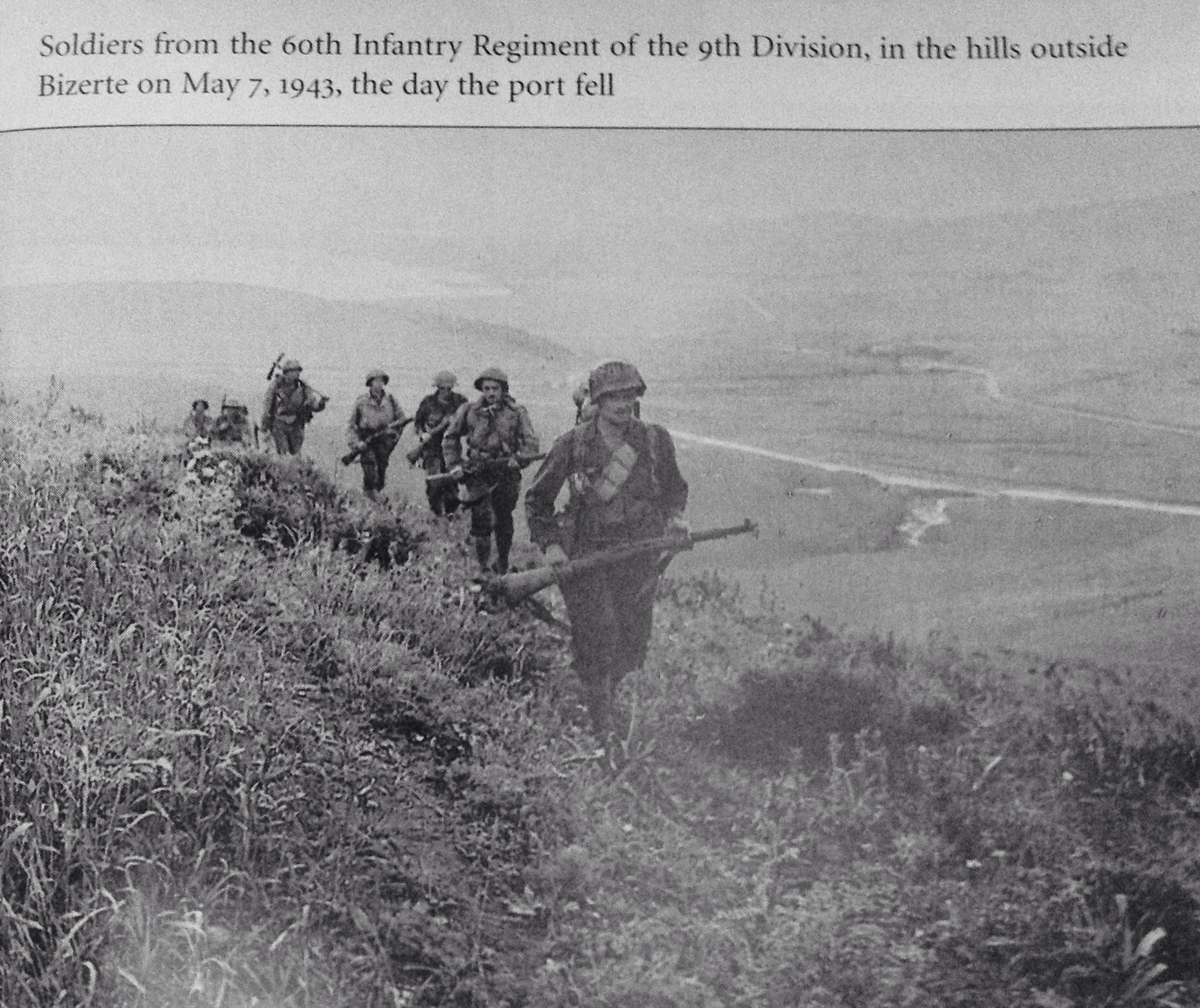
Dad’s unit, on the date Bizerte fell (from “An Army at Dawn”, by Atkinson)
At the end of May, the division was in bivouac and had almost seven weeks of light duty and downtime. The nearest town was a walled city, Sidi bel Abbes, about 30 miles away. The Army, in it’s generosity and wisdom, was giving day passes on a quota system. They’d truck the GIs there during the day, and bring them back to the encampment at nightfall.
Over the course of June, Dad made it there multiple times and drank wine, ate French food, and visited a couple of houses of ill repute. Not a bad way to spend time in your 19th year of life.
In any case, he eventually returned one time to often to Sidi bel Abbes. Towards the end of June, dad and a buddy got a pass and caught the truck ride to town, where they spent the day partying, drinking, and committing other questionable acts. They missed the truck back to the camp and kept partying until they were caught by the MPs who were patrolling the town. The MPs actually cut them a break and didn’t arrest them. They just kicked them out of the walled city, meaning they would have to walk the 30 miles back to camp. They knew they were already in trouble at this point, so they said the hell with it and climbed the wall and went back into the city.
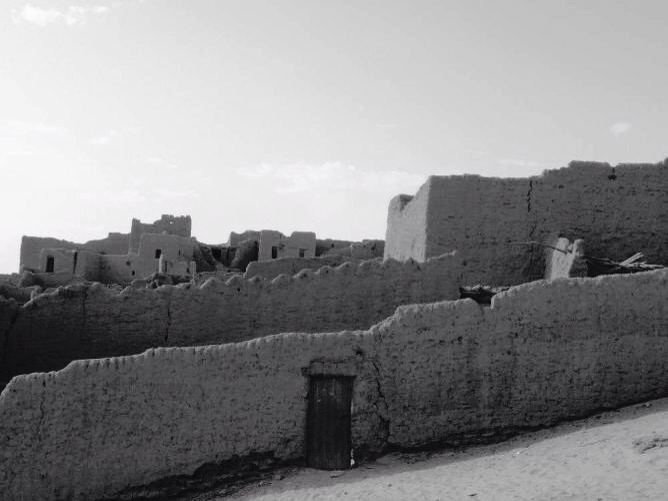
Part of the wall around Sidi bel Abbes
More partying ensued and they were trying to find a particular address they had been given. The MPs saw them again and gave chase. With the wine they had consumed, they were in no real shape to get away, and were caught a second time. This time, rather than just depositing them outside the gate to the town, the MPs drove them back to the encampment, and turned them over to the company First Sergeant.
The next day, dad reported in to the CO. “Sir! Sergeant Hall reporting as ordered”.
The CO looked up from his desk, then looked back down. “That will be all Private Hall”.
And so, dad, who entered North Africa as a Sergeant, departed as a Private. In his words, “Hell, what were they going to do to you for acting up? Short of murder, Or armed robbery, no one went to the stockade, especially if you were an Infantryman. Combat veterans at that point were of incredibly high value, so maybe you got busted, but you stayed with your unit.”
Dad left Africa on July 24th, on a ship bound for Sicily. They landed at Polermo on August 1, while being bombed by the Germans. He didn’t know it yet, but his time with the 9th Infantry Division would be over on August 8th when he was severely wounded. In fact, his buddies thought he was probably going to die. He survived, and was in the Army for two more years, but never did rejoin the 9th…

 The 60th attacked a series of hills on the nights of the 22d and 23d with mixed success. As dad explained “we always attacked at night, but the Germans were well dug in. And they had mines on many of the approaches. The Germans used mines everywhere. The going was very slow.” They did take several of the hills, particularly on the north side of the pass, but the Germans still controlled the south side. Hill 322 was attacked many times but never taken. The advance bogged down, but the US Forces acted forcefully enough to cause the Germans to deploy reserve units, keeping them from engaging with Montgomery and the British, further to the south. Dad said that from where they were, they could actually see the open land on the other side of the pass, even though the Germans still controlled the south side of the pass. That open ground was what the tanks needed.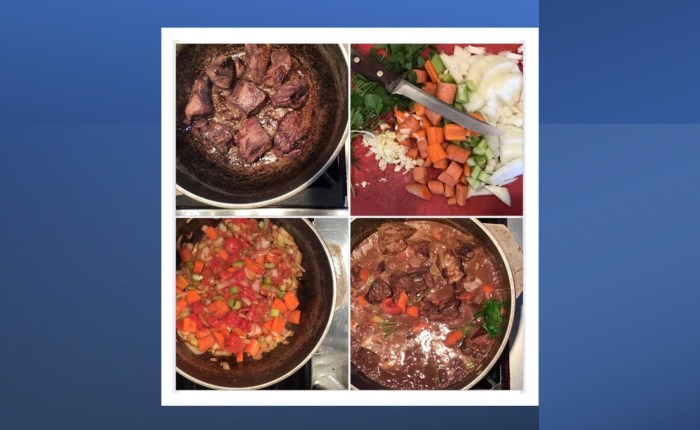
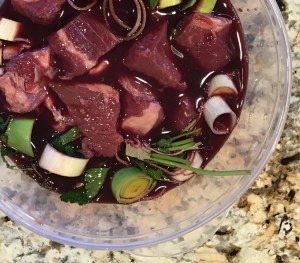 Last Thursday, I pulled the chuck roast out of the freezer to thaw, and made up my shopping list. On Friday morning, I went shopping for the few things I still needed – a leek, some parsley and thyme. We had everything else at home. After a quick lunch, I cut up the beef and added it to a bowl which already included smashed garlic, sliced leak, a bouquet garni, and a bottle of red wine. Day one was done, with plenty of time left to take our dog Carmen for a walk, and in anticipation of the snow, to bring more firewood into the house.
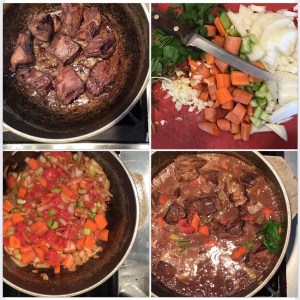 I continued with the daube around noon and day 2 was only a bit more work than day 1. I browned the beef; chopped up and sauté garlic, onions, celery, carrots and tomato; added the beef back to the pot with the vegetables, along with a new bouquet garni; and added the strained and reserved wine marinade to the pot. Once that was done, it simmered on low heat for about 3 hours.
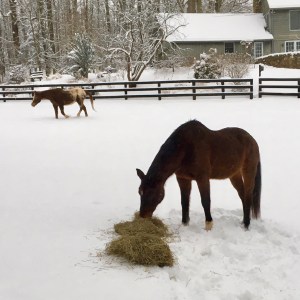 Sunday, Day 3, greeted us with a blanket of snow. About 7 inches had fallen, with more expected over the course of the day. After feeding the horses in the morning, and then having my own breakfast, I plowed our drive and around the barn, and then plowed the drives of several elderly neighbors. I made it back inside for lunch, and then some playoff football.


 Live Life Exuberantly