My sister, Roberta, created a fun family cookbook of recipes and stories a decade ago. She recently resent her “intro” to me and I love it. She talks of how our five senses link us to those wonderful memories from our past. I urge you to give this a read and I guarantee it will make you smile.
The words are strictly Roberta’s. I’m just sharing them.
Last Christmas Eve, I was talking with our nephew Casey. He mentioned a visit to our home as a young boy, and then asked “Do you remember making cheese fondue at the cabin? That was so cool!” The memories of that weekend, and our ‘70s era burnt orange fondue pot came flooding back.
Last July we received one of those phone calls that shifts your world. Our niece, Bre, let us know she was diagnosed with stage 3 breast cancer. Thirty-eight years old, this started her on a new and unexpected journey that still continues.
I still see the chunk of tractor-trailer tire flipping end-over-end in slow motion towards us. Growing bigger and bigger, it slammed into the front of our car and bounced off the hood, before disappearing in a flash. The actual elapsed time was perhaps one second from start to finish, but it was enough, and the damage was done.
Cath and I recently saw “A Christmas Carole” at Ford’s Theatre, our 12th year in a row. I always find it renewing and every year, a different character or part of the play touches me. Not just Scrooge, or Tiny Tim, or the Ghosts, but sometimes a minor character like Old Fezziwig stays with me and provides inspiration.
R_____ looked at me and was on the verge of tears. “Oh Max, thank you so much. You are making me cry.” That wasn’t my intent. All I’d done was tell her that if she ran into problems, call me and I would help. It’s a shame what we have come to as a nation, when a person feels threatened by some of those around her.
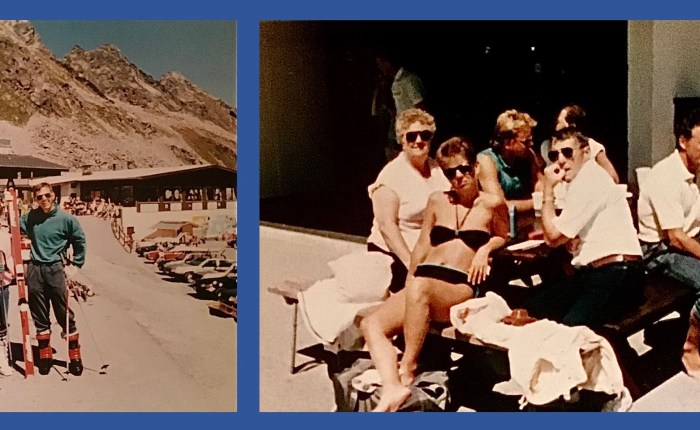
In the summer of ‘87, my folks visited us in Germany. We had a grand time touring Germany, Austria, Northern Italy and Switzerland. One of the highlights was Glacier Skiing at Sölden, Austria and then afterwards, hanging at the Lodge drinking bier, while Cathy worked on her tan.
On our first tour in Germany from ‘79-83, Mom and Dad visited once for a vacation in the summer of 1982. I was a Company Commander in the 34th Signal Battalion at the time and the day we were to leave on vacation with them, the phone rang about 4AM. Cath said, “Don’t Answer it”. I said, “I have to.” She answered back, “Don’t answer it.” I answered the phone.
The call came from Battalion Headquarters and we deployed on an alert for the next three days. While I was in the field, Cath showed Mom and Dad around Southern Germany and the Black Forest. When I returned from the alert, we travelled the next ten days together. Dad understood what happened with the alert and why I had to go, but I’m not sure Mom did.
When we moved back to Germany in ‘85, we didn’t think Mom and Dad could afford another visit. Airline travel was expensive, as was the trip itself. Then, fate intervened. Dad hit 5 out of 6 numbers on a lottery ticket and won several thousand dollars. Never ones to let extra money go to waste, they scheduled a visit with us in Worms in the summer of 1987.
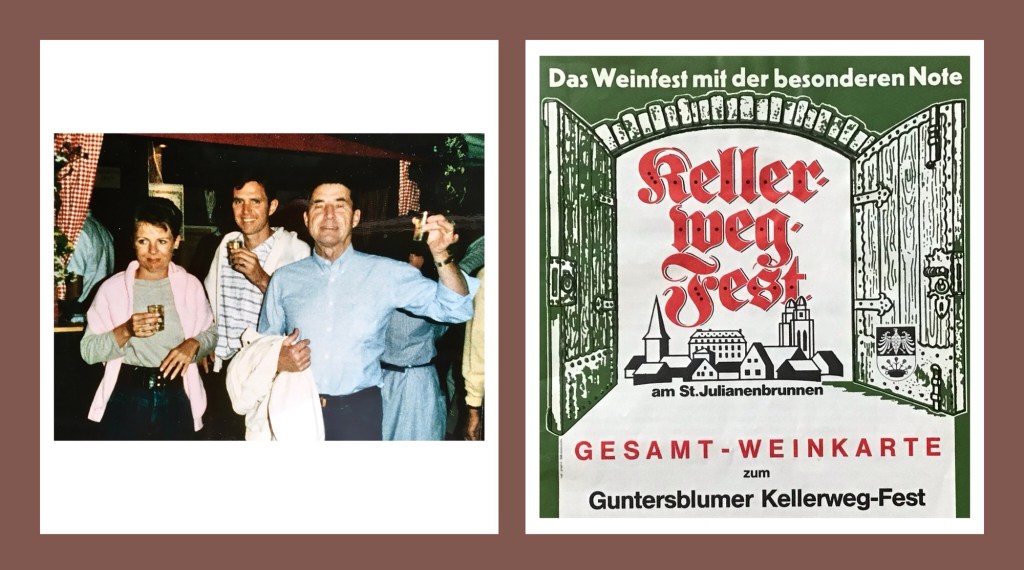
When they arrived, we spent the first few days near Worms and the village of Rheindurkheim, where we lived. In addition to introducing them to local friends, we spent an evening at one of our favorite Weinfests. Everyone enjoyed themselves, or at least that’s what the photos seemed to indicate.
Prost!
Eventually, we left Rheindurkheim and headed South for the main part of the vacation. I’m not sure why, but Cath and I decided to take our skis along and get some Glacier skiing in, something we’d never done before. Looking back now, it seems an odd decision. Mom and Dad wouldn’t ski, but I’m sure we talked with them about it. In any case, off we went down the Autobahn with the skis strapped on the roof rack of our Saab.
After visiting good friends Jim and Res in Stuttgart for a night, we made our way to the Alps. We planned a drive through Austria, Northern Italy and Switzerland, but started with Sölden, Austria where we would ski. In the 1980s, you could still ski Sölden virtually all year long*.
Glacier skiing is a bit different from regular skiing. You have to hit the slopes early, and most people only ski in the AM. By late morning, the sun has warmed the slope and the glacier starts turning to slush. Also, as the morning wears on, the snow/ice on the glacier tends to become gravelly, not quite ice and not quite snow.
That first night at Sölden, we ate dinner in the little Gasthaus where we were staying. We discussed skiing the following morning. Cathy was thinking about skiing in her bikini and I was up for wearing a pair of shorts. Ultimately, we decided to ski in sweats and jeans. If we fell, the gravelly snow would scrape us up pretty good.
The next day, after an early breakfast of Kaffee, Brotchen, Wurst und Käse (Coffee, rolls, sausage and cheese) we made our way to the slope and were skiing by 7:30AM. We’d told Mom and Dad they could hang at the Gasthaus, but they insisted on coming with us to the ski lodge. Dad took a photo as we headed to the lift.
Cath and I spent the next three hours skiing the glacier and it was wonderful. The piste (ski trail) wasn’t crowded, the snow was in great shape and we were skiing well. Occasionally, we’d check on Mom and Dad who were drinking Kaffee on a picnic table outside the lodge. Dad snapped some pics of us skiing, but for the life of me, I can’t find them. Around 10:30 the snow started getting slushy. By 11, we were through. We started getting wet from the knees down and were tired from the morning’s activities. In the additional good news department, we hadn’t fallen all morning.
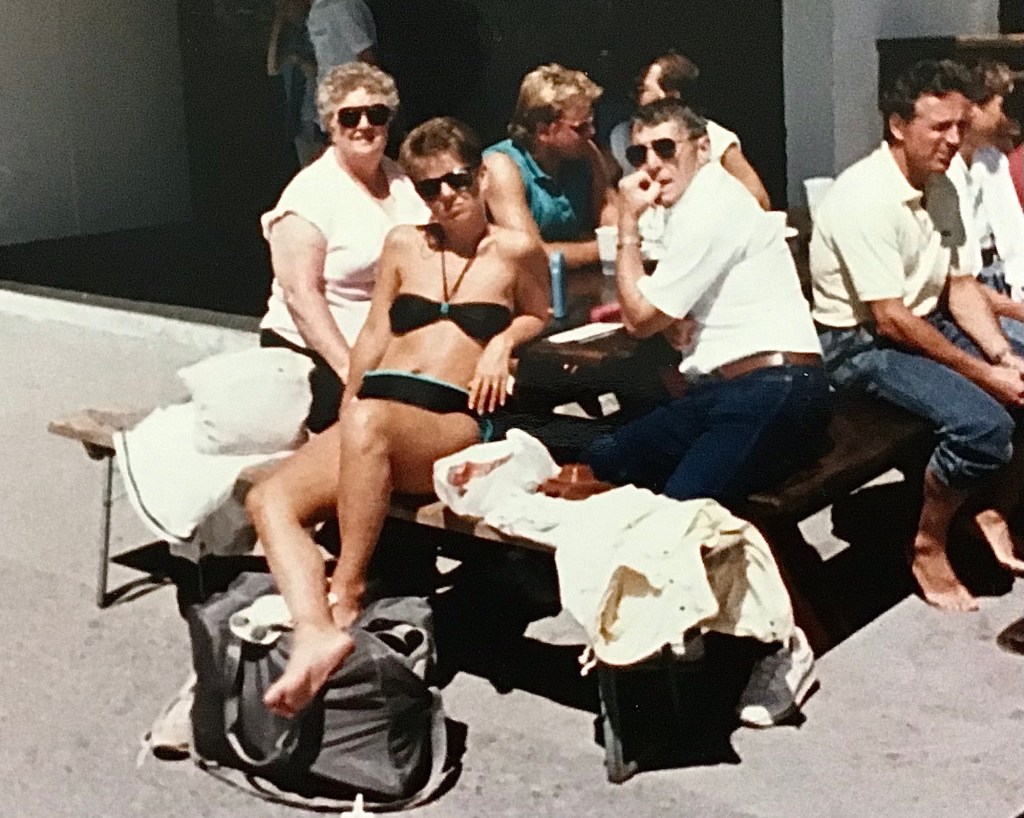
We stacked our skis in a rack, joined Mom and Dad and ordered some biers. Cathy stripped off her sweater and jeans, revealing the bikini she wore underneath. In the photo I took of Cath with Mom and Dad, I love the bored/sullen Euro look she adopted. Just another ho-hum day skiing the Alps and catching rays.
Cathy Working on Her Tan after Skiing in the Morning.
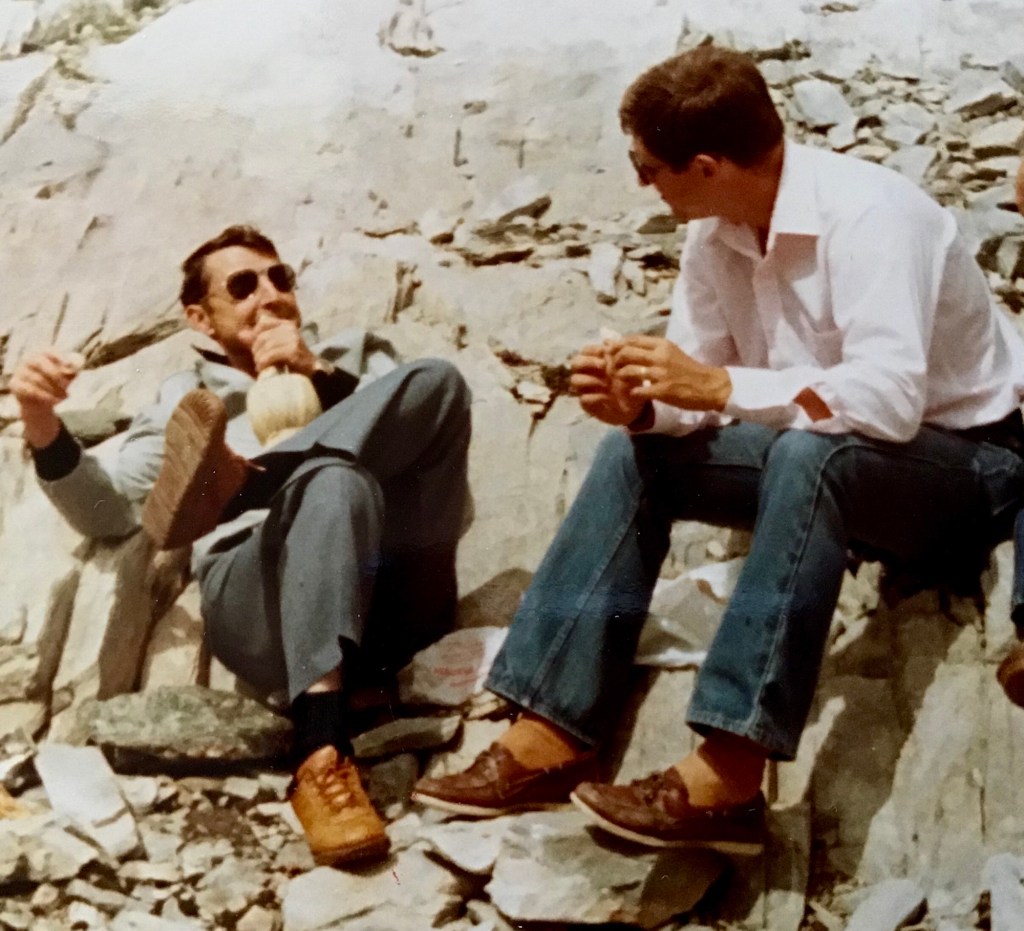
We spent one more night in Sölden, before heading for Nauders, Austria right on the Italian border. We’d previously skied a couple of winters there. After a couple of days seeing friends, we eventually crossed into Italy and then Switzerland, having an occasional roadside lunch of bread, cheese and wine. One day we forgot glasses, but that didn’t stop us. ;-).
No Glass? No Problem!
We worked our way to Davos, where we enjoyed a multi-course 5-Star meal at a restaurant just outside of town. At our hotel that night, we saw fireworks going off in the mountains across the valley. It was the celebration of the Swiss National Day, their equivalent to our 4th of July and pretty amazing. At the time, we had no clue about the importance of Davos or the World Economic Forum. All we knew was that we ate a great meal that evening and then saw a cool light show in the Alps.
Eventually, we returned to Rheindurkheim and other adventures, before Mom and Dad flew home.
It’s funny, I remember many parts of that vacation**, but for some reason skiing the glacier at Sölden stands out. It was only a small part of the trip, but remains firmly in my mind. Maybe it was the fun of the day. Maybe it was the skiing. Maybe it was just the remembrance of my wife soaking up sunshine in a bikini at the ski lodge after a morning of good play. All our days should be so happy.
Addendum:
I should point out that there were MANY women sunbathing in bikinis, not just Cathy. She’s the only one I took a picture of ;-).
* These days at Sölden, due to Global Warming the glacier is receding. Skiing stops sometime in May, and picks back up in September.
**When people visited us in Germany, we gave them atypical tours of Germany and Europe. We weren’t big on Churches and Museums, and instead, focused on local activities off the beaten path. On this particular vacation with Mom and Dad, we really wanted to show them parts of the Alps we’d grown to love in both the winter and summer months. I doubt we saw another American the entire time.
Last week it rained pretty heavily one day. Late at night I took Carmen out to do her business and it was still raining. I grabbed one of our umbrellas and as I opened it, thought of Grandma Grubaugh. We’d given her the umbrella as a young man. It returned to Cath and me when she passed away.
I remember as a child, we kids would give Grandma and Grandpa Grubaugh some sort of homemade Christmas gift, or Mom would buy something and put a tag on it, saying it was from the three of us. When Grandpa died in 1968, it transferred over to just getting something for Grandma.
At some point in time, maybe in High School, or when I left for West Point, I started buying Christmas gifts for Grandma on my own. I don’t really remember much about what I bought her. I mean, what do you buy for a woman who pretty much had everything she needed or wanted? Inevitably it was some knick-knack or something else she didn’t really need. When at West Point, it might have been a pin or brooch related to West Point. Of course she always acted as if it was the most precious thing in the world when she opened the gift on Christmas Day.
Grandma and I at my West Point Graduation.
Later, when Cathy and I married and were living in Germany, we typically sent her some German chocolates or something similar. Or, would have Mom and Dad pick up some steaks for her. We’d learned over the years it was better to give her food she could actually enjoy rather than yet another gift she didn’t really need.
Eventually Grandma passed away in 1996. It fell to Mom and my Aunt Pauline to go through her things and get her house ready for sale. Most of it was straight forward. The aunts and uncles claimed the items they wanted to remember Grandma by, and then we grandkids were offered a choice of remaining items. That’s how I ended up with the pink monkey and blue elephant glasses. I always remembered them from my childhood – drinking milk at Grandma’s kitchen table while eating her homemade date-nut bread.
Blue Monkeys and Pink Elephants
One day during all of this, I received a call from mom. They’d come across a chest and when they opened it, they were a bit shocked. It was full of Christmas and Birthday presents Grandma had received over the years and never used. Each item had a tag saying who gave her the present. There were plates and bowls, and even unopened packages of brassieres (Grandma would never have used the word bra).
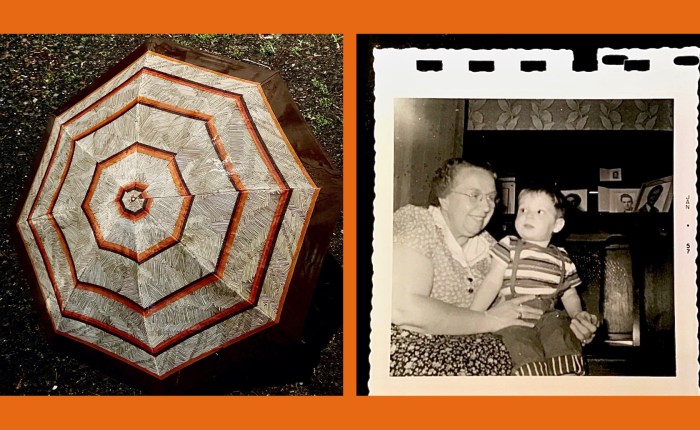
Among the items was an umbrella, with mine and Cathy’s name on it. The plastic box was still unopened. Mom gave it to us the next time we were home visiting.
I have to say, it’s a bit of an ugly umbrella. I suppose sometime back in the ‘70s the color combo might have been considered the height of good taste. No plain black or blue or red – it’s an in-your-face design with shades of brown and orange. Color-wise, it’s a perfect match for our 1970s era crockpot. It also turns out it is an incredibly durable product. Made in the ‘70s and first used in the late ‘90s, it’s still functional and going strong in 2024.
‘70s Colors in Full Bloom.
It currently resides in a storage stand in the mudroom, along with a basic black umbrella, a couple of walking sticks and some snowshoes. It’s only used a few times a year – usually late at night when I’m taking Carmen out to do her business and there’s a driving rain. Still, it never fails to make me smile and think of Grandma Grubaugh, a truly treasured gift.
80 years ago this week, my “Uncle” Noble and the 9th Infantry Division sealed off the Cherbourg Peninsula eleven days after D-Day during WWII. I was thinking about him while watching the Band of Brothers on TV. When Easy Company jumped into Normandy for their first wartime engagement, Noble and the 9th had already been in combat for over 1 1/2 years.
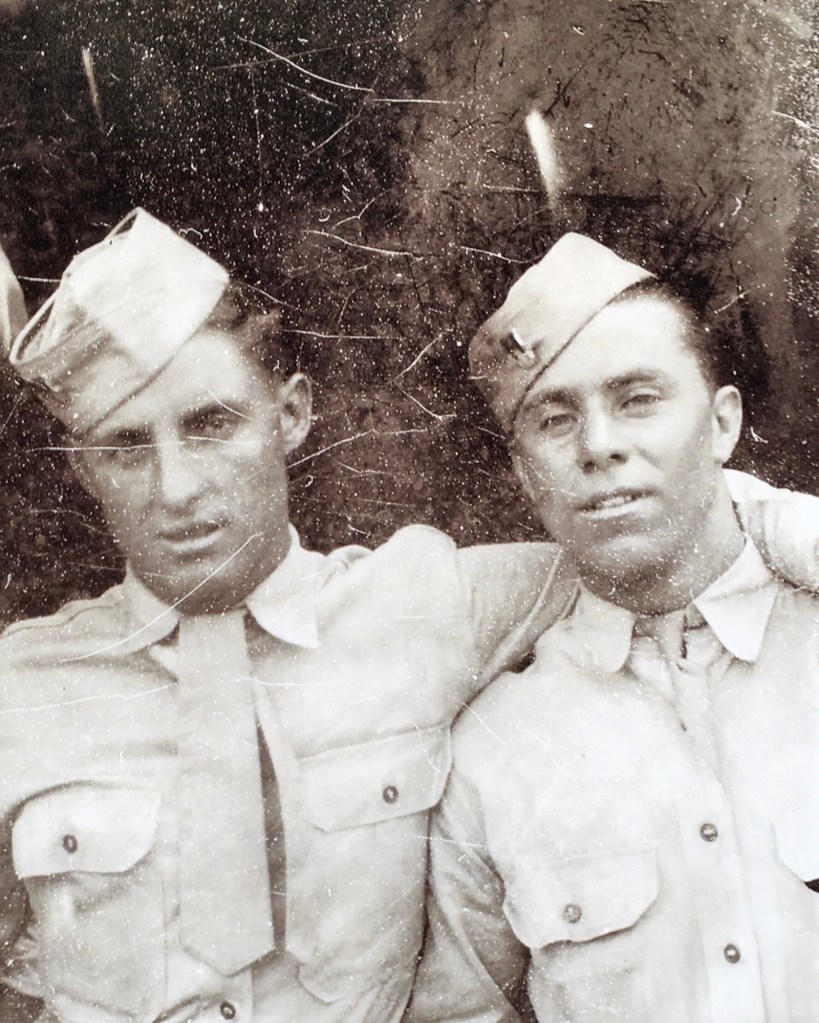
Noble was Dad’s best friend, after his brothers, Mick and George. Both he and Dad joined the Army when underage in 1940, over a year before WWII started. They were in B Company, 60th Regimental Combat Team (RCT), of the storied 9th Infantry Division.
Dad and Noble in ‘41 or early ‘42.
Mom, Dad, “Uncle” Noble and “Aunt” Myra were great friends through the years and got together several times a year. The four of them had a close friendship that lasted a lifetime. I learned a lot about life, and about enjoying life from all of them, but particularly Dad and Noble. They told stories from their time in the Army – almost always funny stories of things that happened. The serious stuff? The stories of death and destruction? Those didn’t make it to the kitchen table where folks gathered, drinking coffee and listening, as these two combat veterans told their tales.
Noble’s actual WWII story is interesting. It’s one you can’t really tell without also telling the story of the 9th.
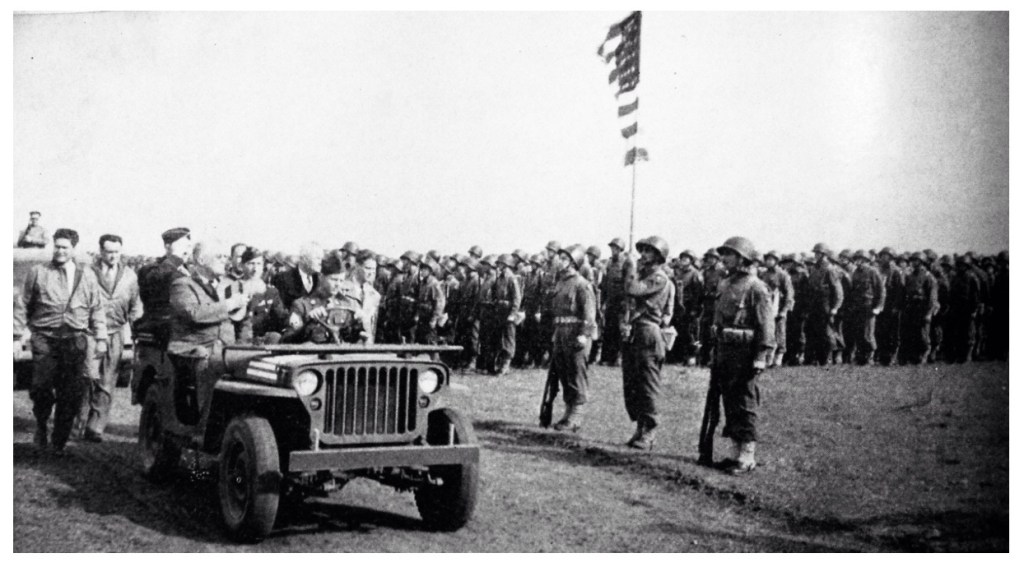
Dad and Noble’s wartime experience started on November 8th, 1942, when the 9th took part in the Invasion of North Africa. Until D-Day happened, it was the largest wartime amphibious assault ever. After three days of battle, they took Port Lyautey, Morocco and the Vichy French surrendered. After some downtime, in January of ‘43, the 60th RCT was the only unit selected to take part in a review for President Roosevelt who was at the Casablanca Conference. Dad and Noble were both there and told us funny stories of the comments in the ranks as Roosevelt passed their unit in a jeep for the review. “Hey Rosie – who’s leading the country while you’re over here?” “Hey Rosie – Who’s keeping Mamie warm while you’re over here?”
Roosevelt Reviewing the 60th RCT During the Casablanca Conference
Things got tough again after that. Starting in February, they fought their way across Algeria and then Tunisia. Station de Sened, Maknassy, Bizerte – forgotten names now, but deadly locations in the spring of ‘43. The Germans eventually surrendered at Bizerte, on May 9th, 1943, just over a year before D-Day.
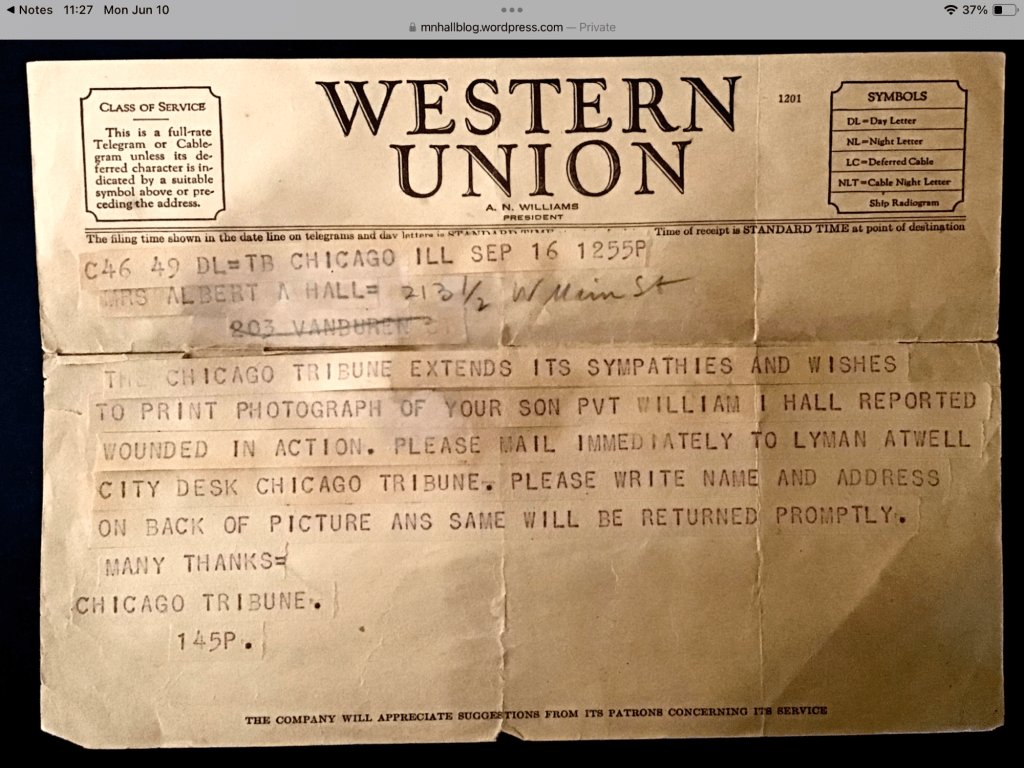
The 9th wasn’t finished though. A little over two months later, in July of ‘43 they took part in the invasion of Sicily. The 60th conducted the famous “Ghost March” through the mountains of Sicily, which the Germans originally thought were impenetrable. Dad was shot three times there, and almost died. It took them a few days to evacuate Dad to an aid station, and then a hospital. The war was over for him and they eventually sent him back to the States.
Chicago Tribune Asking for a Picture After Dad was Wounded.
In fact Dad’s wounds were so severe, Noble thought he had died, or would die shortly. As they evacuated him, Noble and the 60th continued the fight. 38 days after the invasion began, Sicily fell on August 20th. Noble was there when Patton addressed the Division on August 26th, congratulating them for their efforts.
In September of ‘43, the 9th deployed to England for rest and refitting. With just over nine months until D-Day, the 60th had already fought in four countries on two continents.
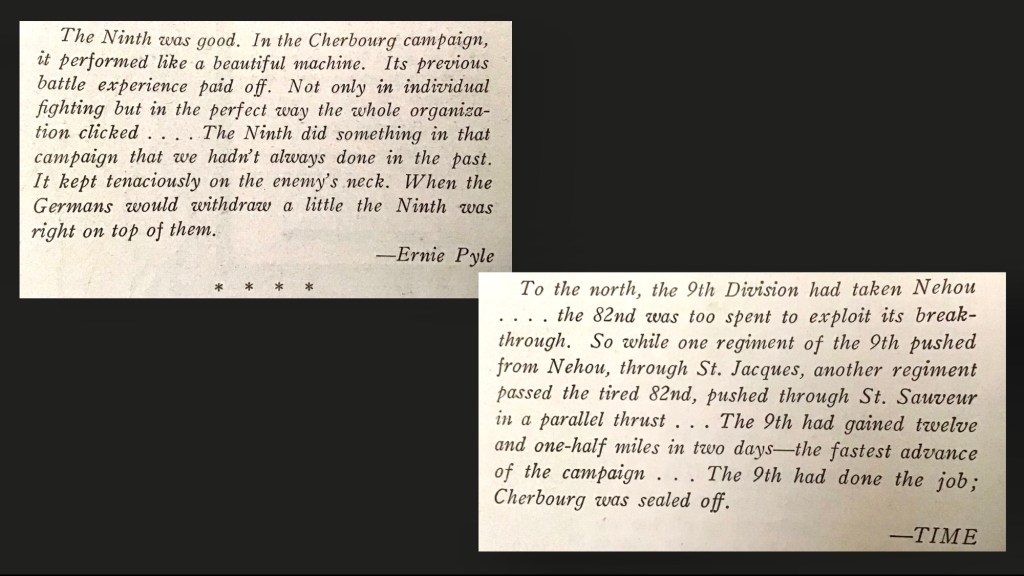
On June 10th, D-Day plus 4, Noble and the 9th landed on Utah Beach. Their mission? Attack towards Cherbourg and cut off the peninsula. This they did and on the 17th of June, reached the ocean on the other side of the peninsula, and eventually, captured the port of Cherbourg itself. If you’ve forgotten your history, Cherbourg was critical for the allies to establish a port on the Atlantic Seaboard. Back home, the news singled out the 9th for their efforts.
Ernie Pyle and Time Magazine Talking About the 9th on the Peninsula
From there, they started on the great chase across France. The 9th advanced over 600 miles by the end of September thru France and into Belgium. In 3 1/2 months they were engaged in three major campaigns and were only out of action for a total of five days.
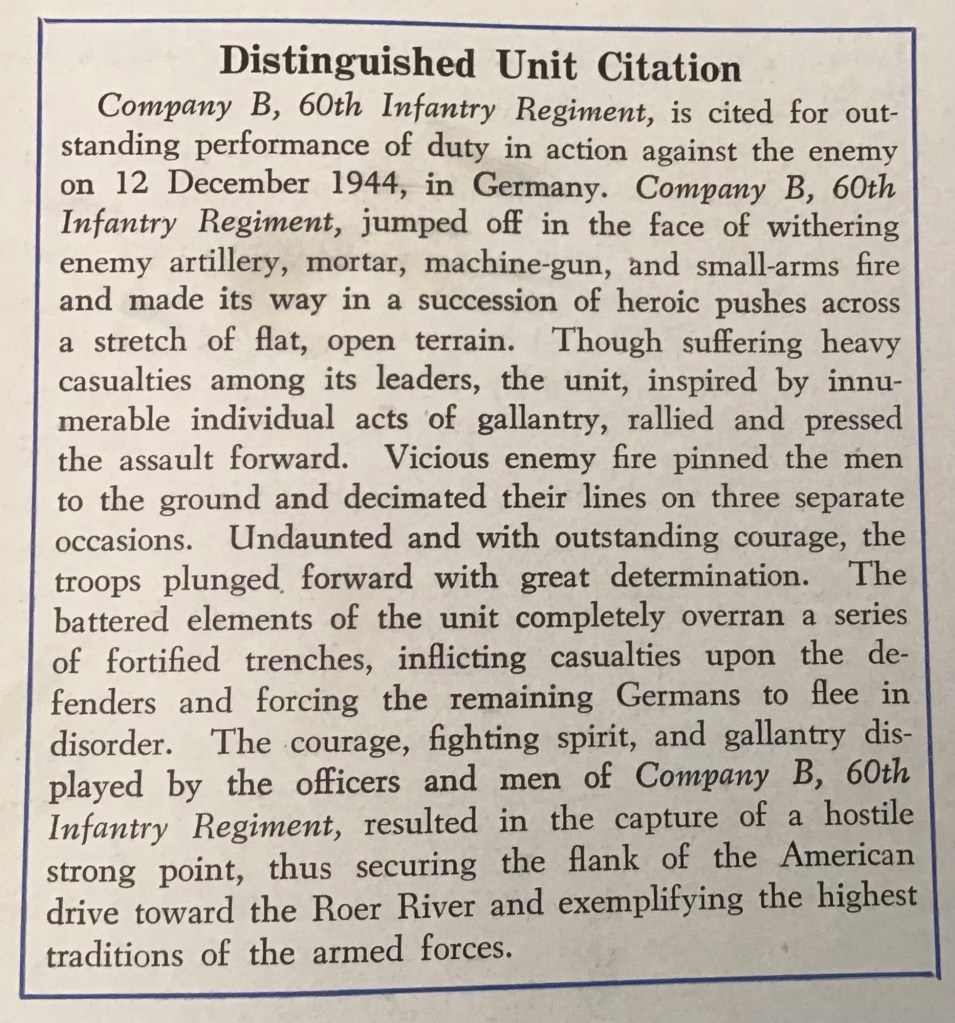
The 9th was among the first units entering Germany itself. For actions on December 12th in the Hurtgen Forest area of Germany, Noble’s unit, B company 60th RCT, received a Distinguished Unit Citation for combat actions in Germany. At the time, the company probably had around 80 or so men.
Noble and B Company, in Action Just Before the Bulge
Just after the 12th, The 9th was pulled out of the line due to the heavy casualties they had sustained. It was “resting” in the Monschau Forest area of Belgium, when on December 16th, 1944, the German winter offensive, the “Battle of the Bulge” started. Thrown back into combat, the Division beat back the enemy at the northern edge of “The Bulge”.
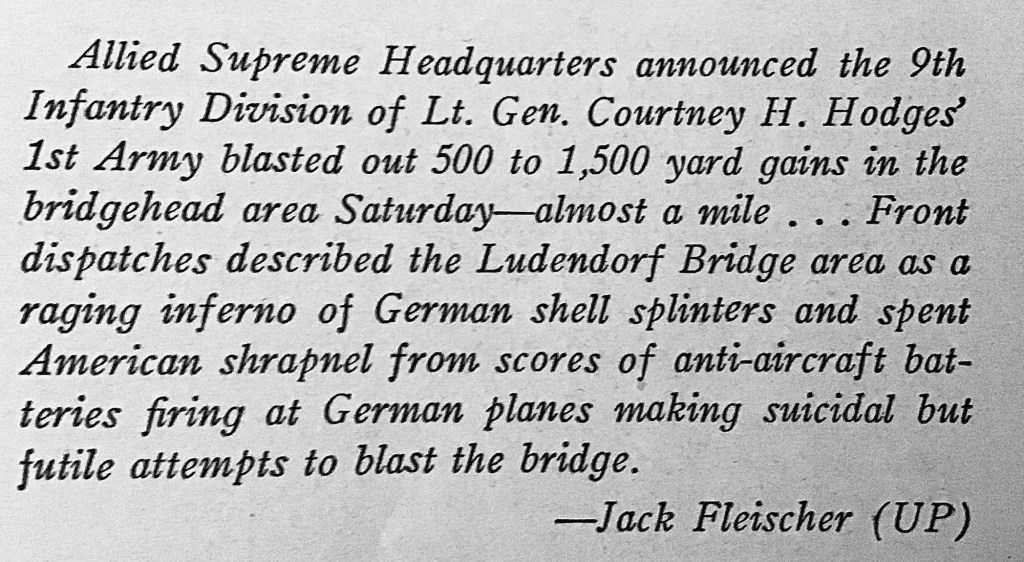
The Battle of the Bulge, The Ardennes, the fight across Germany to the Rhine River – Noble saw all of that. On 7 March, when the American 9th Armored Division captured the bridge across the Rhine River at Remagen, Noble and the 60th RCT were among the first Infantry units to cross under heavy fire and defend the bridgehead from the East side of the Rhine.
The 9th at Remagen
On across Germany – The Ruhr, The Hartz Mountains… On April 26th, 1945, a patrol from the 60th RCT linked up with the Russians at the Elbe River. The war in Europe officially ended on May 7th.
Noble spent 2 1/2 years in combat, fought in seven countries and survived without a scratch. Miracles do happen.
In 1950, a minor miracle also happened.
In July of that year, a knock came at my parent’s door and Mom answered. A young couple was standing there and wanted to know if William Hall lived there. Mom said yes and called Dad. All of a sudden there was yelling, and exclamations, and hugging, and dancing and back pounding – it was Noble, and his new wife Myra.
It turned out Noble and Myra were traveling from a vacation in Wisconsin back to Southern Illinois where they lived, when they passed our hometown – Ottawa. Noble thought Dad had died in Sicily, and then remembering he was from Ottawa, decided to stop in and see if he could find Dad’s parents and offer his condolences. He looked the name William Hall up in the phone book, and stopped off at the local VFW to see if anyone knew of Dad or his relations. They then drove to the address from the phone book, assuming it was my grandfather’s home. Instead, he and Dad saw each other for the first time since August of 1943 in Sicily.
I was born in ’55 and named Max Noble Hall in honor of Noble. I always enjoyed seeing him and Myra over the years during their visits. Later, at West Point, and then while spending my own time in the Army, I often asked myself if I was measuring up to these men from B Company of the 60th RCT.
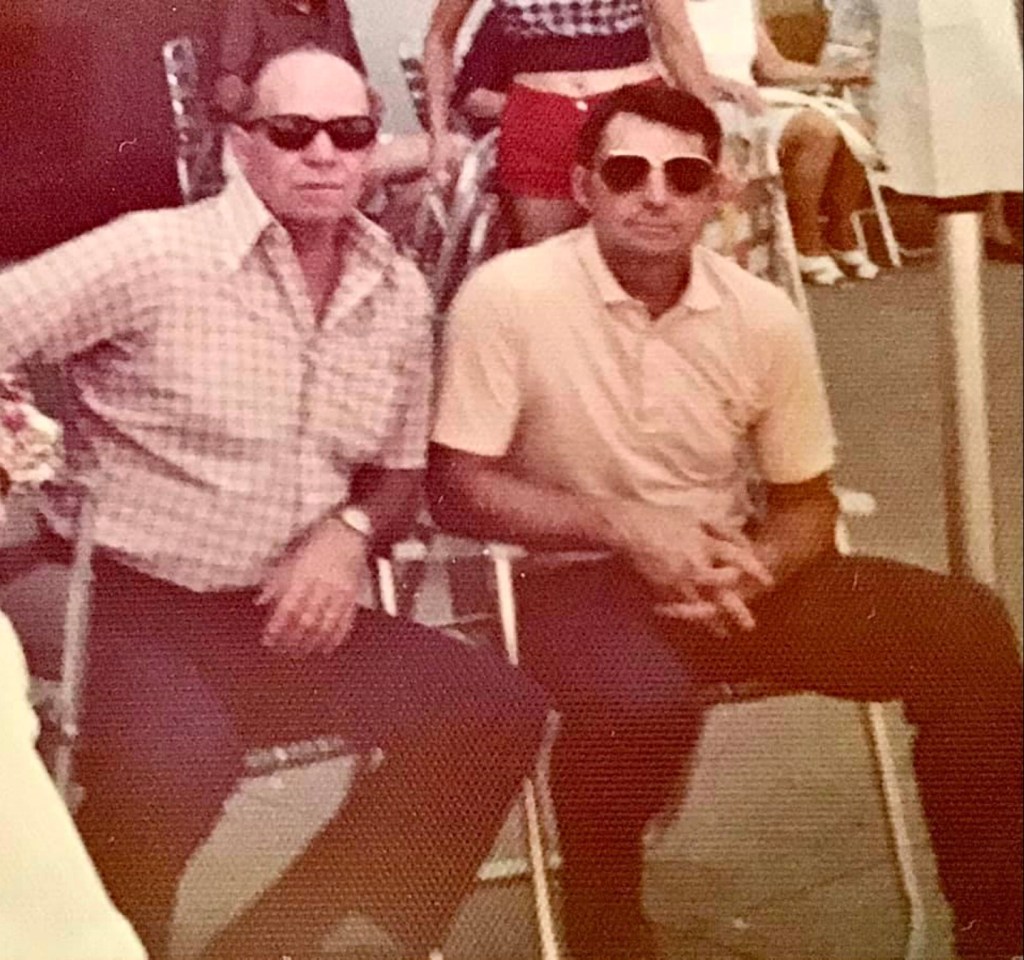
Noble and Dad in the Mid-‘70s in Ottawa. Still Ready to Kick Ass.
I feel so lucky having known them and having heard the stories Noble and Dad told. It’s only in the last decade I’ve matched those stories up to the details in history books. I can tell you they greatly underplayed what they did for America and the free world. What I wouldn’t give for another day with Noble and Dad – listening to the stories, and this time, asking more questions.
The “Greatest Generation” is mostly gone now. I think it’s important we not let them, or their stories be forgotten.
Here’s to you Uncle Noble. Thanks for everything you did for this country and being an influence in my life. It’s a debt I can never repay.
I relied on the book, “Eight Stars to Victory, A History of the Veteran Ninth U.S. Infantry Division”, published in 1948, as background for much of the factual information in this blog.
On a beautiful sunny day, sixteen of us attended the funeral of our brother, Eric Franks. The service was perhaps, more poignant, as it was the Friday before Memorial Day. It’s always bittersweet when members of the West Point Proud and Great class of ‘78 gather and say goodbye to a classmate.
At our 45th class reunion last fall, we held a memorial service for the 82 classmates who have passed away. This year, since January, at least ten additional classmates have died. The rate of our passing seems to have increased, but I suppose we are at that age. The youngest of us is 67. The oldest, maybe 71.
For those who pass away, a contingent of classmates typically attends the funeral services. Depending on when and where it is, there might be only one or two of us able to make it, or as at Eric’s, as many as 16 or more. It’s not only a last chance to honor a brother, but also an opportunity to spend time with each other and catch up in person. The sands drop through the hourglass more quickly these days and I think we all know it. Bittersweet indeed.
And so it was with Eric. Over the years, Cath and I saw Eric and his wife Robin at various reunions, or mini-reunions. The past few years, we also met them, along with our classmate Gus Hellzen and his wife Janice for an occasional beer or lunch on the Eastern Shore of Maryland. All three couples were married over 45 years ago in the weeks after our June, 1978 graduation. Our wives also made the journey through West Point and the Army.
B-3 Company-Mates and Wives at a Class Mini Reunion in 2022: Hellzens, Wells, Franks, Halls and Powells.
At the service, most classmates in attendance were from the MidAtlantic region, but some flew in from Alabama and Florida among other places. Classmate Brad Andrews, a close friend of Eric’s was one of two speakers giving a eulogy. He told stories of Eric from our cadet days and his time in the Army, including Panama. He talked about Eric becoming a renowned and pioneering Orthopedic Surgeon and the impact he had both on his patients and on other doctors. He also spoke of Eric having cancer and how it didn’t slow him down, even at the end of his life. At the end of his talk, he called the attending West Point graduates to attention and we rendered a final hand salute to Eric.
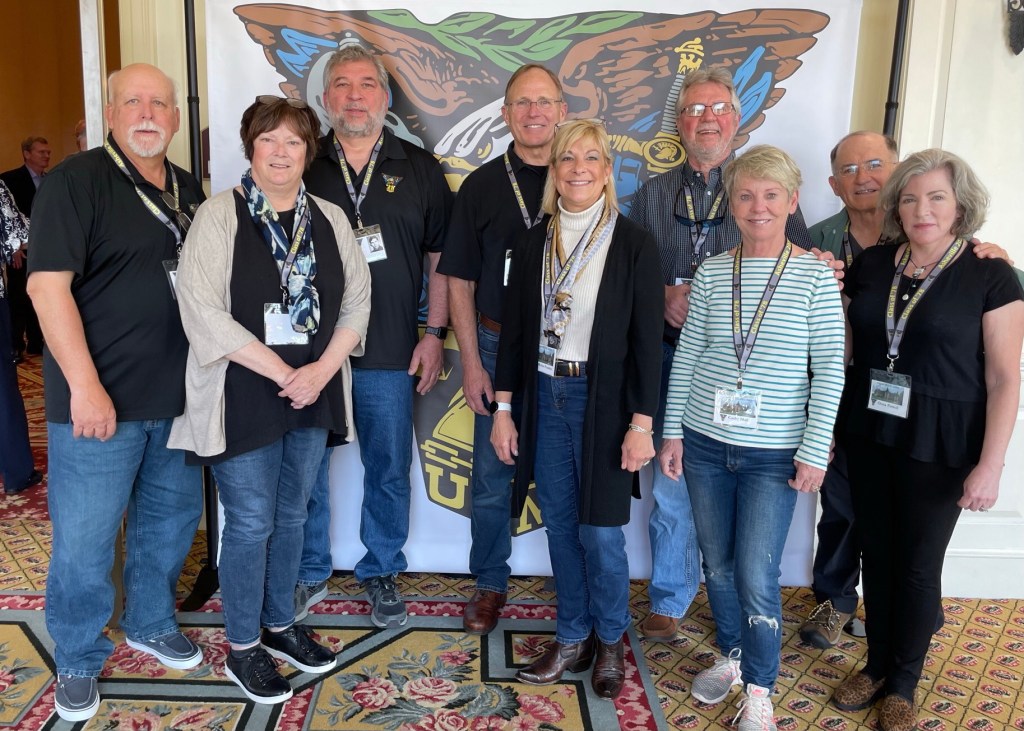
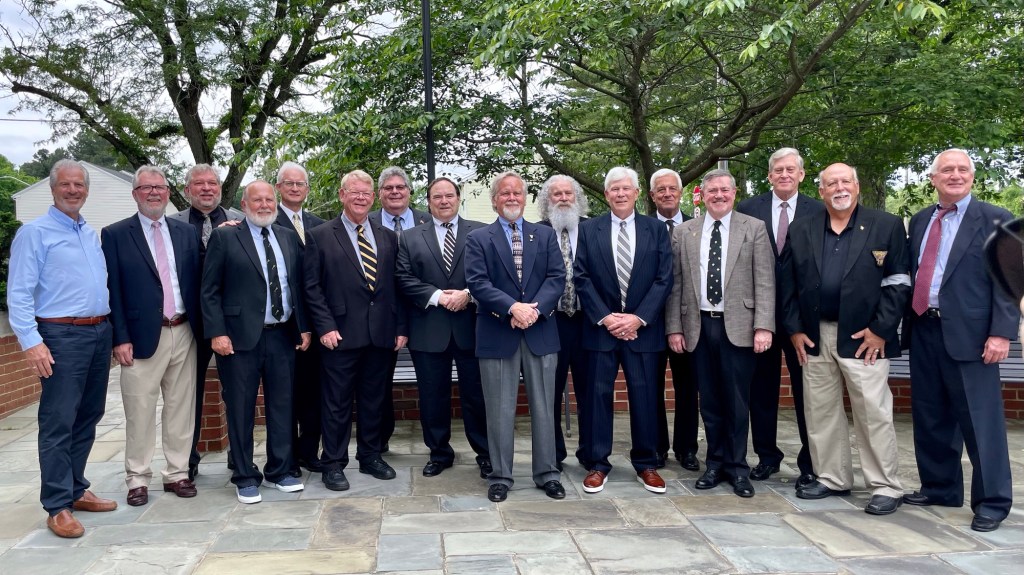
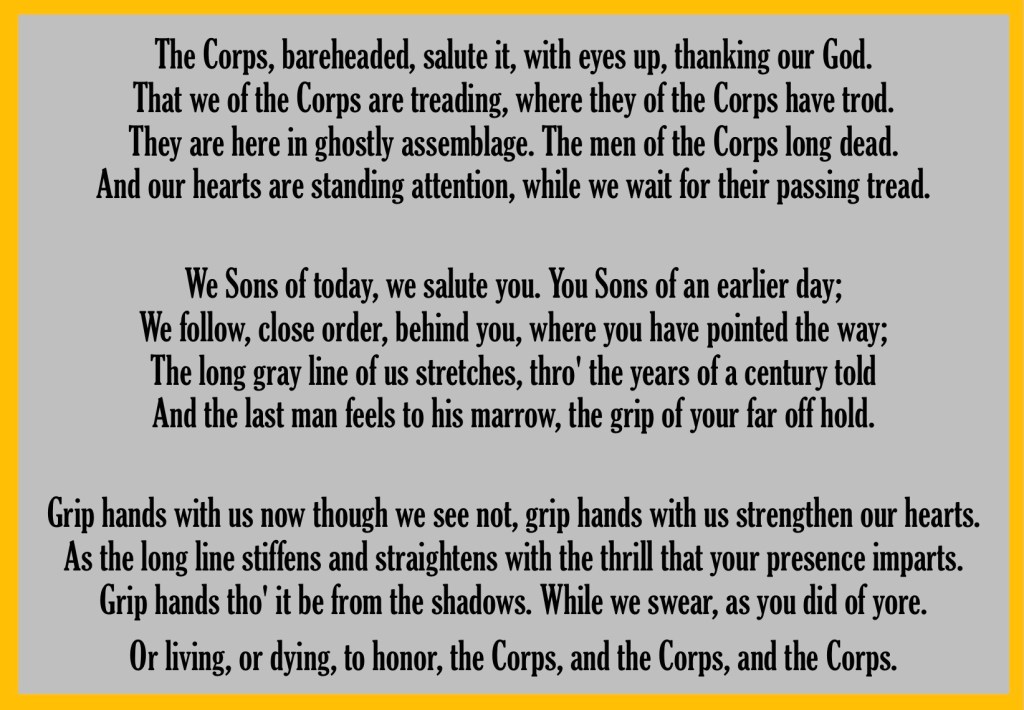
After the service, we gathered outside the church and a group photo was taken, something that has become a tradition at funerals, but also other times when some of us gather together to celebrate life and each other. The photos are usually posted to our class Facebook Page, or our email server. “Yes,” we seem to say, “we are still alive, celebrating our brother, each other and The Long Grey Line. Grip Hands.” At funerals in particular, the phrase “Grip Hands”, from the song The Corps* is more real and more important.
Class of 1978 at Dr. Eric Franks funeral in Salisbury, MD. L-R: Charlie Bartolotta, Max Hall, Bond Wells, Bob Rush, Craig College, Kevin MacCaffery, Kevin Beam, Bob Maszarose, Charlie Dixon, Adolf Ernst, Brad Andrews, Jack Paul, Hank Gillen, Chris Maxfield, Gus Hellzen & Jim Galloway.
Most of us eventually made our way to Robin and Eric’s home for lunch and libation. It was a lively time, with more laughter than tears as far as I could tell. We met with family and friends of Eric from throughout his life. At one point, Gus poured small glasses of WhistlePig** for all who wished to join us in a toast – “To Eric – Grip hands and be thou at peace. Proud & Great ‘78! Here’s to Eric.” And then, echoing from our formal events in the military (in an Army that was still mostly male in our early days), his second toast, “To the ladies!”
Eventually Cath and I said our goodbyes and left for the drive home. Along the way, we talked of the day and what a fine tribute to Eric it was.
During the drive, I also thought of some of the words Brad used in his eulogy for Eric. He quoted Samual Johnson, saying “To my question, as to whether we might fortify our minds for the approach of death, he answered in a passion, ‘No, Sir, let it alone. It matters not how a man dies, but how he lives. The act of dying is not of importance, it lasts so short a time.’ “
Our hearts are with Robin, their children Erica and Ricky, and with their families. Here’s to you Eric – You led a life worth living. Be Thou at Peace.
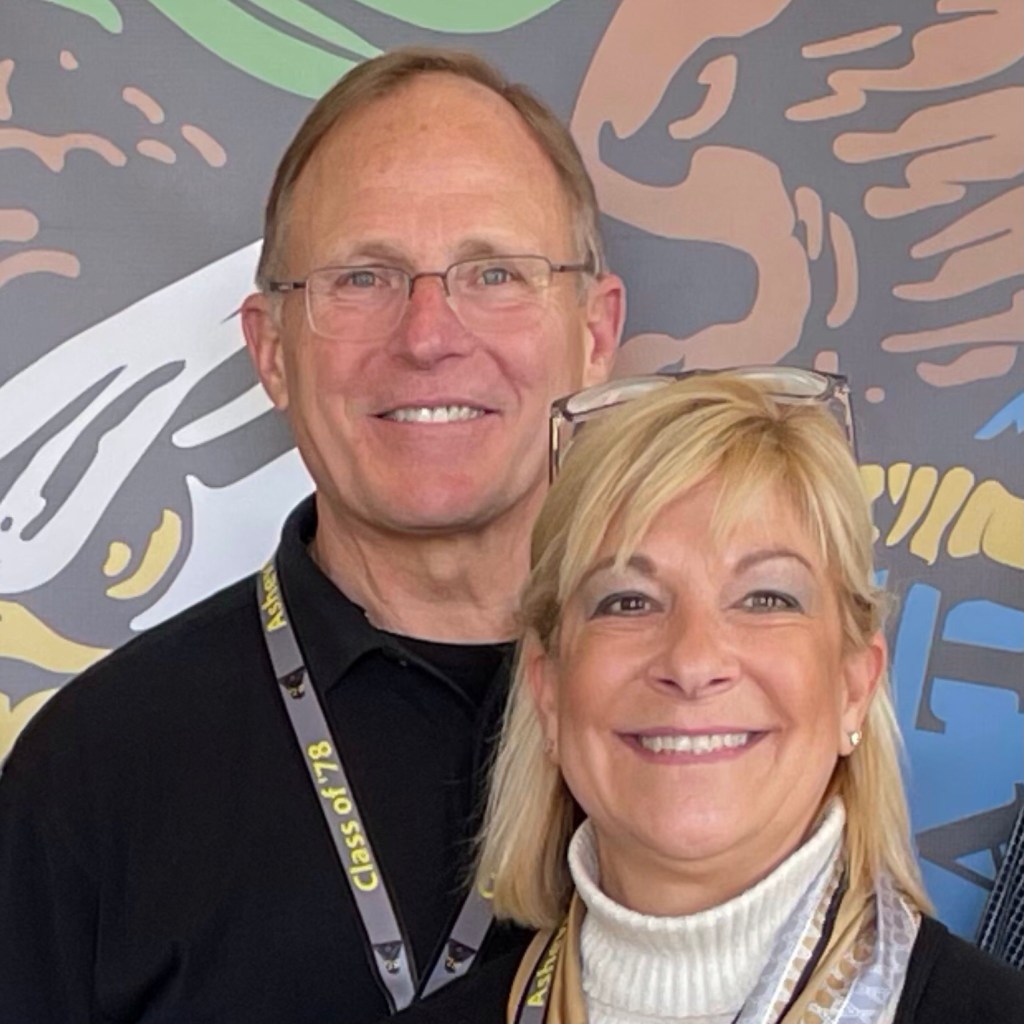
Eric and Robin
Addendum:
Here are the words to “The Corps”:
WhistlePig Rye Whiskey holds a special place with our class. If you want to learn why, you can read more here – We were on a mission to the WhistlePig Distillery in Vermont. Twelve classmates gathered to taste whiskey from five barrels. We would select two for the West Point Proud and Great, Class of ‘78 45th reunion this coming fall. We didn’t want to let our classmates down […] Continue here: https://mnhallblog.wordpress.com/2023/05/09/__trashed-2/
Thanks to Gus Hellzen for the photo of Eric and Robin at the start of this blog. Thanks to Cathy for the photo of classmates at Eric’s service.








 Live Life Exuberantly