The Bordeaux Dinner

Last weekend, Cath and I were in Chicago for a Bordeaux Dinner. There were seven of us eating and drinking together for about six hours. It was amazing.

Our good friends Tim and Renee have had this dinner every year for several years, but this is the first time we’ve been able to make it. We’ve always had some sort of conflict, but this year they scheduled it about nine months ahead of time, and we vowed we wouldn’t miss it.

The whole weekend was about friendship, eating, and drinking. We arrived Friday around noon. Dave made it down from Wisconsin Friday evening…. Sushi from a local Japanese market for lunch….wood fired pizza at a wonderful restaurant for dinner…… We generally behaved Friday night and didn’t over serve ourselves. We were looking forward to the Saturday night Bordeaux dinner – Six courses, and several bottles of champagne and wine are not for the faint of heart. You don’t want to go into that kind of dinner not being at the top of your game….. 
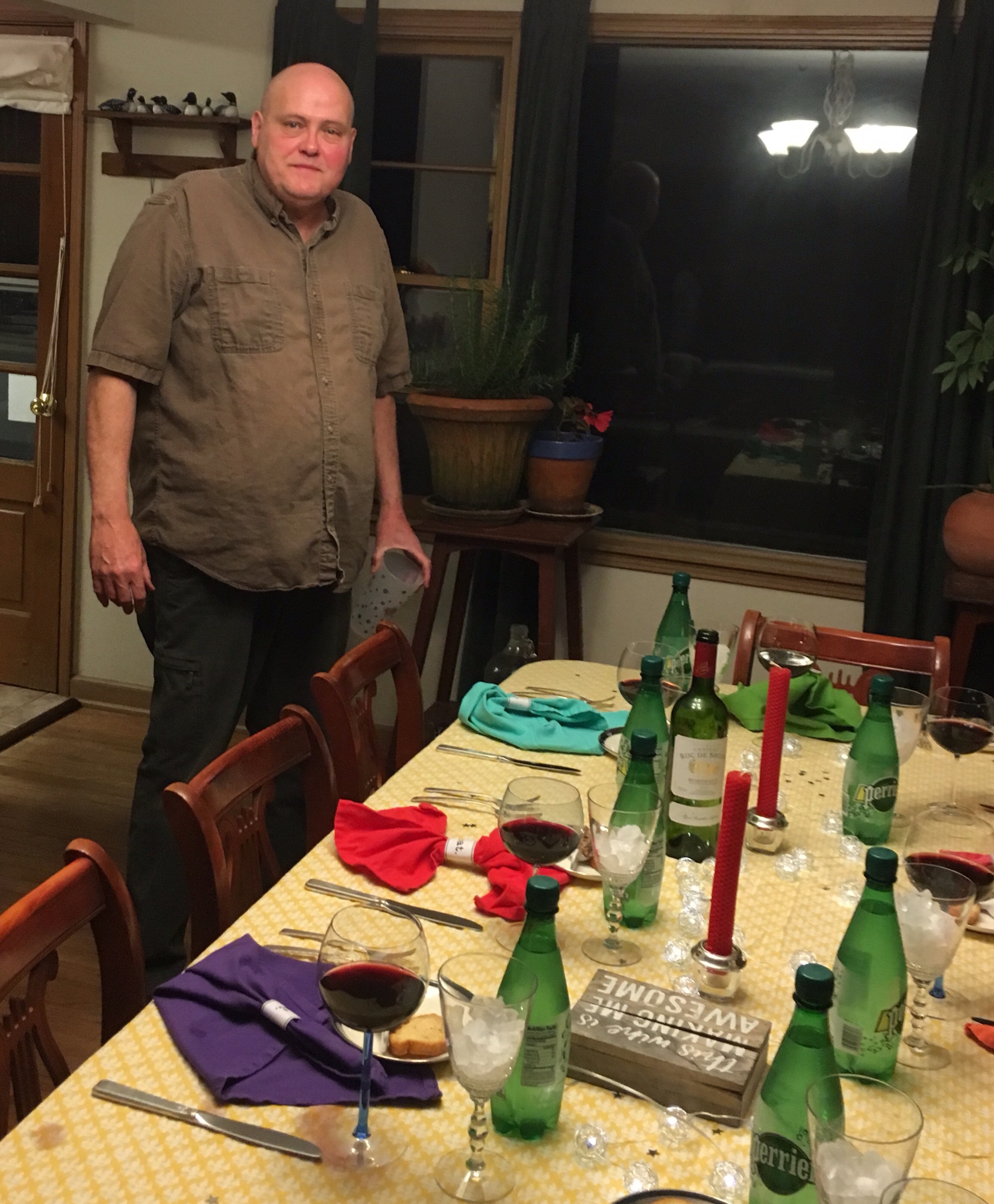

Prep work went on for much of Saturday, while dinner activities started around 6:00PM when neighbors Paul and Val joined us. The champagne and fresh oysters were a great way to begin. Renee had the oysters flown in from Massachusetts, and made several accoutrements – Guinness Granita and Radish Mignonette were my favorites. Four dozen oysters and a couple of bottles of champagne later, we adjourned to the table for the serious eating.

Tim started us off with Bourdain’s steak tartare, and the first bottle of Bordeaux. The tartare was everything you could want. Flavorful, complex, and raw. I could have stopped right there, and not eaten anything else, but we moved on to a palate-cleansing salad of baby greens.
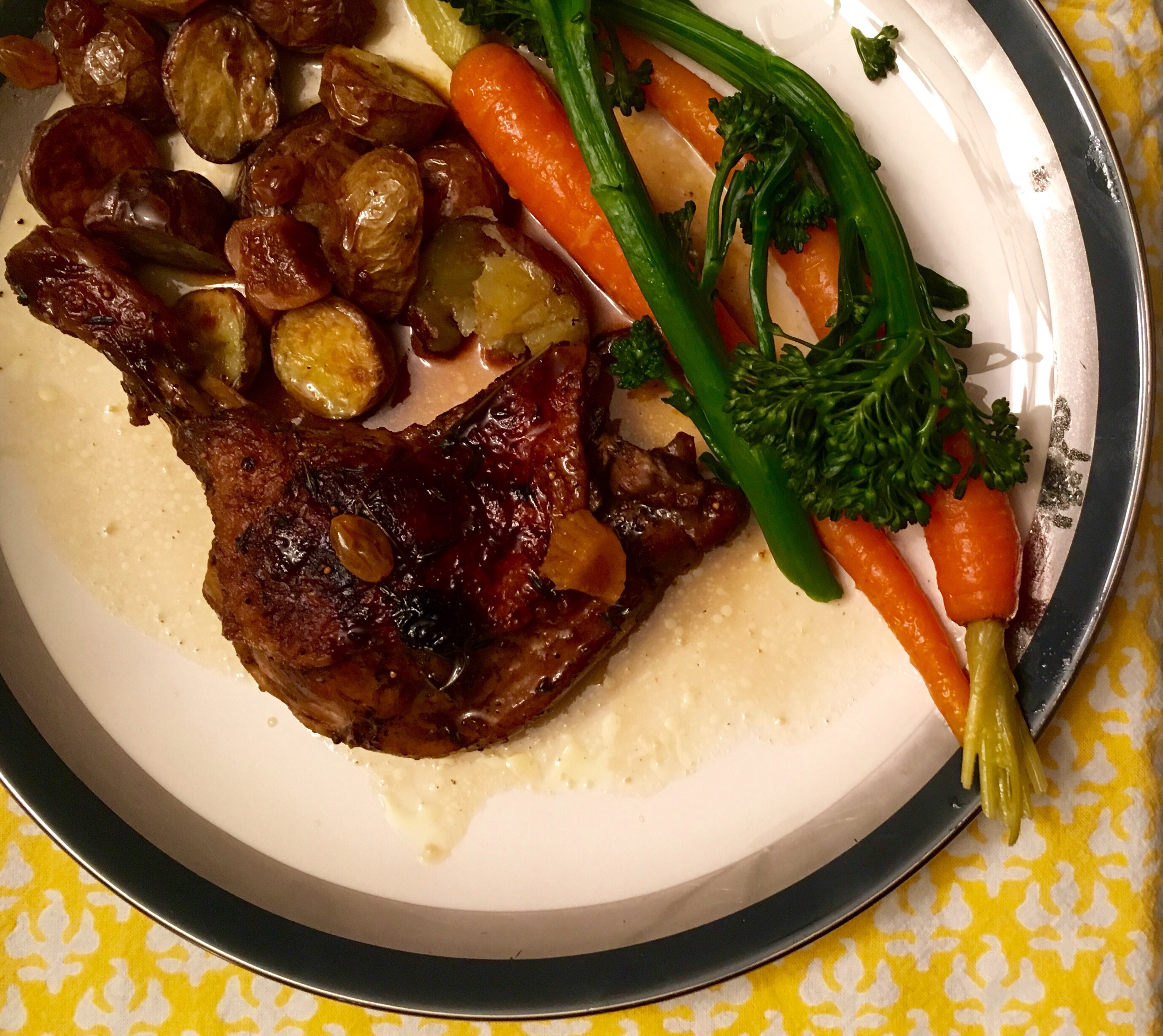
Duck leg braised in Armagnac….
A pause, and the hosts disappear for a bit. Then, they return….Braised duck leg with mixed vegetables. I’m in heaven. The duck is braised in Armagnac, a couple head of garlic, and a few other things. Could life be any better? More wine…the conversation gets louder and more engaging. Politics, religion, Chicago weather, food, wine, the Sox, other people we know. Nothing off limits and it’s the kind of conversation that just flows.

We pause a bit, and continue talking. Dishes are cleared, and the cheese course arrives. Six cheeses, including two blues. Time is getting a bit blended now. Not quite a fog, but at this point it’s been over four hours of eating and drinking. We are enjoying life, and appreciating the evening. 

Finally, the last course arrives- Chocolate Truffles. I don’t know where they came from, but they are awesome, and the perfect end to the dinner. We talk a bit more, drink a bit more, and glance at the clock. It’s around midnight now….time is speeding up, but we are slowing down. Cathy and I eventually say goodnight to all, and go to bed and a deep sleep….

The next day is a slow day. Doing dishes, then brunch and some mimosas. Dave heads back to Wisconsin, and now it’s just the four of us. We are in the family room and trying to decide whether to go anywhere, or do anything. Lethargy wins out and we stay put. Talk, catching up, some bad TV, more talk, leftovers, more mimosas. It was the perfect end to the weekend. The kind of weekend you need a weekend afterwards for recovery. I hope we are invited back for next year. 
Wait… Why am I Looking at the Blue Sky?

I’ve only passed out at a parade once, although I suppose that’s once more than most people.

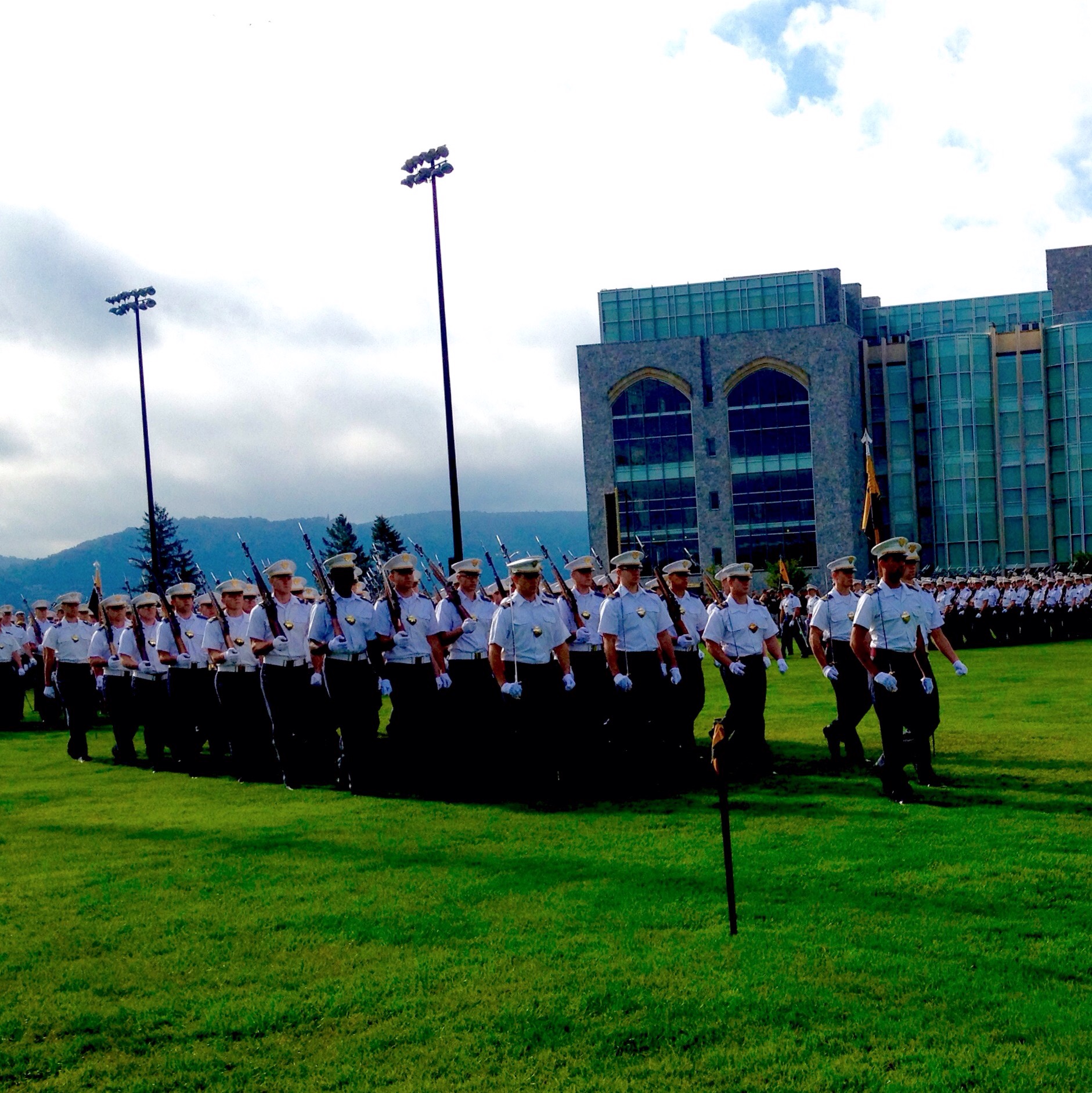
It was the spring of my Yearling (sophomore)  year at West Point. In the summer, I would be going to Germany as a “Third Liuetenant” for a month. In prep for the trip I had to get several shots, and in Army fashion, I received them all on the same day, just after lunch. For some reason I didn’t have a class that afternoon, and ended up taking a nap.Later that afternoon, we had a Regimental parade. I woke up at the ten minute bell (ten minutes until we reported for the parade), quickly dressed, grabbed my rifle and bayonet, and moved out to our formation location. The company formed, dressed, and waited for the drums to start. They finally did and we marched out through the building portal and on to The Plain, the scenic location above the Hudson where all parades take place at West Point.

We arrived at our designated location on The Plain and halted. We went through the normal rigamarole of attention, presenting arms, attention, present arms, and finally we were at Parade Rest. In a minute or two, we’d come back to attention and then present arms for the playing of the National Anthem. So I’m standing there, and then…

The next thing I know, I’m staring upward at a blue sky. What? And do I hear music? Well yes I do! It’s the National Anthem. What the….this is strange….I must have passed out. I slowly look around. Everyone else is, of course, standing at attention and present arms while the Anthem plays. I reach to my side, and sure enough, there’s my rifle on the ground with me. I grab it, and slowly get to my feet, come to attention, and then present arms. There’s a bit of snickering around me, and finally someone asks me if I have any other plans to pass out that afternoon, or whether I’m all right. I whisper that I’m alright. Then, my eyes start to swim a bit…rutro….. I bend my knees and I’m OK. Mercifully, a couple minutes later we start to march off.

After our Company retired from The Plain, our commander dismissed us, and I of course received much good natured hazing. Someone pointed out that the back of my uniform was ripped open. It turned out that when I fainted, I fell backwards on the bayonet of the cadet behind me. It cut a three inch slit in my uniform, and I had a small bruise on my back as a souvenir. The other interesting thing that happened that day was that our company received the high score for the parade. Evidently my fall hadn’t been observed…..

The Days

The recent discussions about a big military parade flashed me back to my Plebe year at West Point and an incident during a parade.

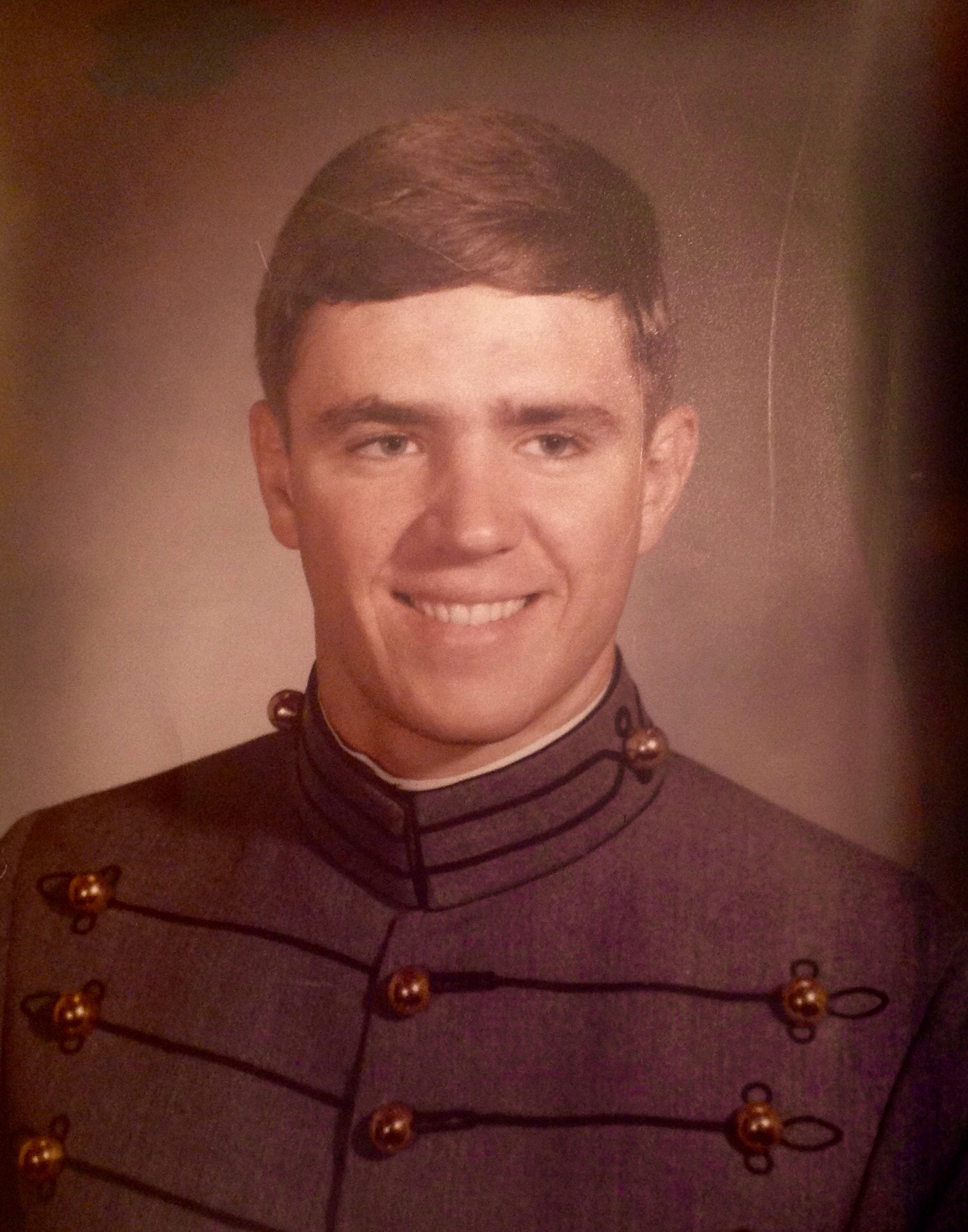
Plebe year picture of the author…..

It was the Saturday of the first football game that year. After morning classes (we went to class 6 days a week), our regiment was scheduled to march in a parade before the football game. As our company was forming, an upperclassman by the name of Pope asked me a casual question. When I answered, I didn’t include the word “sir” for some reason. As a Plebe, you always, and I mean always, use the word “sir” when answering. The upperclassman noticed my omission, and immediately said “HALL! After the parade. My room in Full Dress!”

Crap. This was not good. The parade took place, but all I could think about was reporting to Corporal Pope afterwards. As the parade ended, I double-timed back to my room on the 5th floor, left my rifle, checked out my uniform in the mirror, and then reported to Corporal Pope.

“Sir! Cadet Hall reporting as ordered.”

“Cadet Hall. Do you know why I asked you here?”

“Yes Sir!”

“And?”

“Sir! I didn’t say ‘sir’!”

“That’s right. Now, what should we do about this?”

–silence– from me…..

“Cadet Hall – Recite The Days.”

Now, The Days were an exercise in memorization. You had to tell what the events were for that day, that week, and then how many days there were until significant events for the rest of the year, such as:

– the Army Navy Football game – Christmas Break  – 500th night (500 days until graduation for the juniors) – Ring Weekend –   100th Night (100 days until graduation for the seniors) –  Spring Break – and Graduation itself. Of course the number of days to each of those events reduced by one on a daily basis, so you needed to work that in your head as well.

OK…..this wasn’t so bad, I knew The Days and started:

“Sir! The Days. Today is Saturday, 12 September. Today at 1300 hours, Army will beat Holy Cross in Football. Tonight at 1900 hours…”

“Stop Cadet Hall.  You misunderstood me. I want you to recite The Days, but insert the word ‘Sir’ before each word in The Days.

–What– ??

“Sir, I do not understand.”

“Are you deaf Hall? Say The Days, but use the word ‘Sir’ between each word.”

-crap-
“Sir, the, Sir, days, Sir, today, Sir,  is, Sir, 12 September.”…

Start over Hall.”

“Sir, the, Sir, days, Sir, today, Sir, is, Sir, 12, Sir, September., Sir, Today, Sir, at, Sir, 1300 hours”…

“Start over Hall”

“Sir, the, Sir, days, Sir, today, Sir, is, Sir, 12, Sir, September., Sir, Today, Sir, at Sir, 1300, Sir, hours, Sir, Army, Sir, will, Sir, beat, Sir, Holy Cross”…

“Start over Hall”….

And on it went. I’m not sure how long I spent with Corporal Pope that day, but it seemed like hours. In reality, it was probably about 1/2 hour. I never did get all the way through The Days. I’d make it maybe half way through, maybe even 3/4 through and then slip up and say two words together without the word “Sir” in between.

Finally, he relented. “Stop….. Now, what did we learn here today Cadet Hall?”  

Many responses went through my brain in that instant, most of which can’t be printed here. The smart part of me said:

“Sir, not to forget to say the word ‘Sir’,”

“Get out of my room, Hall.”

I went back to my room and changed out of Full Dress. The football game was about to start and I left the barracks for the stadium. I went a different way so I didn’t have to pass Pope’s room on the way out…

….

It’s funny what triggers a memory. I haven’t thought of that story in years. It’s pretty funny now, and even at the time, I recognized the ridiculousness of what was happening. Just another bump on the road while going through West Point…

The Breakdown

I was on my iPhone when the car-dashboard lights started flashing. Hmmmm….OK. Off the phone, and pull to the side of the road. I turn the car off, figuring that I can restart, and the lights will self-correct. Whoops. Bad mistake. The car doesn’t restart. 

It is now 2:30PM and I’m on the side of the road on Route 66, near route 50. Rush hour is about to kick into high gear and I’m forty miles from home. Are you kidding me? All I was trying to do way surprise Cathy and get home early.

I call the first tow truck company – no one available right now. Call the next one – they can be there in 60 minutes. OK, we’ll go with that.  I call Pohankas Lexus, which is only about 5 miles away. Yes, they can fit me in, and they work until 11PM at night. Suddenly, a VDOT truck shows up behind me, puts on his flashers, and puts out traffic cones. Things are looking a bit better.

The tow truck, driven by Sid the biker, actually gets there in 1/2 an hour. Sid hooks up the car, shows me a neat trick to get the car to come out of park and go into neutral, and we are on our way to Pohankas.

Sid drops me off at in processing at Pohankas, while he drops the car in the back. Vernon, the Pohankas guy, checks me in, and takes my info. While he is getting the info, I take a break, go outside, and pay Sid, and give him a tip. I mean, come on, it’s now been 35 minutes since my car broke down, and I’m already at the local Lexus garage.

Vernon finishes in processing me, and asks if I want to wait, or take a loaner car. I tell him a loaner car would be great. He’s going to give me another SUV, but I ask “don’t you have something sportier?”. He says sure, and gives me a Lexus IS300 Sport, with 4,100 miles on it.

I’m back on the road at about 4PM, stop at the Merry Moo store in Marshall to pick up some fresh fish, and am actually home just after 5PM, only about an hour and a half hours after I originally planned to be home. This. Is. Amazing.

Later, Cath and I have a drink, and then make dinner. Salmon with a mustard/dill sauce. Split a bottle of wine, and relax. After dinner, we watch some bad TV.

At 9:45, my phone rings. It’s my buddy Vernon, from Pohankas. A bad battery, and they need to tighten the alternator belt. Oh, and the Lexus has three safety recalls that need to be done. No charge for those, and if I don’t mind, they’ll take care of those as well. Go for it.

It’s now 10PM. I lost an hour and a half today, I’m out about $400, including the tow charge, which USAA, my insurance company will reimburse me, and I had the chance to drive a new Lexus.  

What could have been a pretty bad afternoon/evening, turned out pretty good. I’ve certainly had worse Fridays. I’ll take it. 

Gloom Period

The United States Military Academy at West Point can be a beautiful place, just not in the middle of winter. We called the time from January through early March, Gloom Period. It was a combination of the blahs, a lack of color, a lack of light, and coldness. There was a pervasive grayness to life.  

Gloom Period would start just after you returned from the high of being on Christmas Break for two weeks. Seeing your girl, seeing your old friends, and of course partying your butt off. Flying back to school, just after New Years, was enough to put you in a gray mood by itself. This was especially true if you were a Plebe, returning from two weeks of life as a regular person, to five more months as a Beanhead in the Fourth Class System. Another contributing factor to Gloom Period – First semester finals were in early January, just after returning from break.

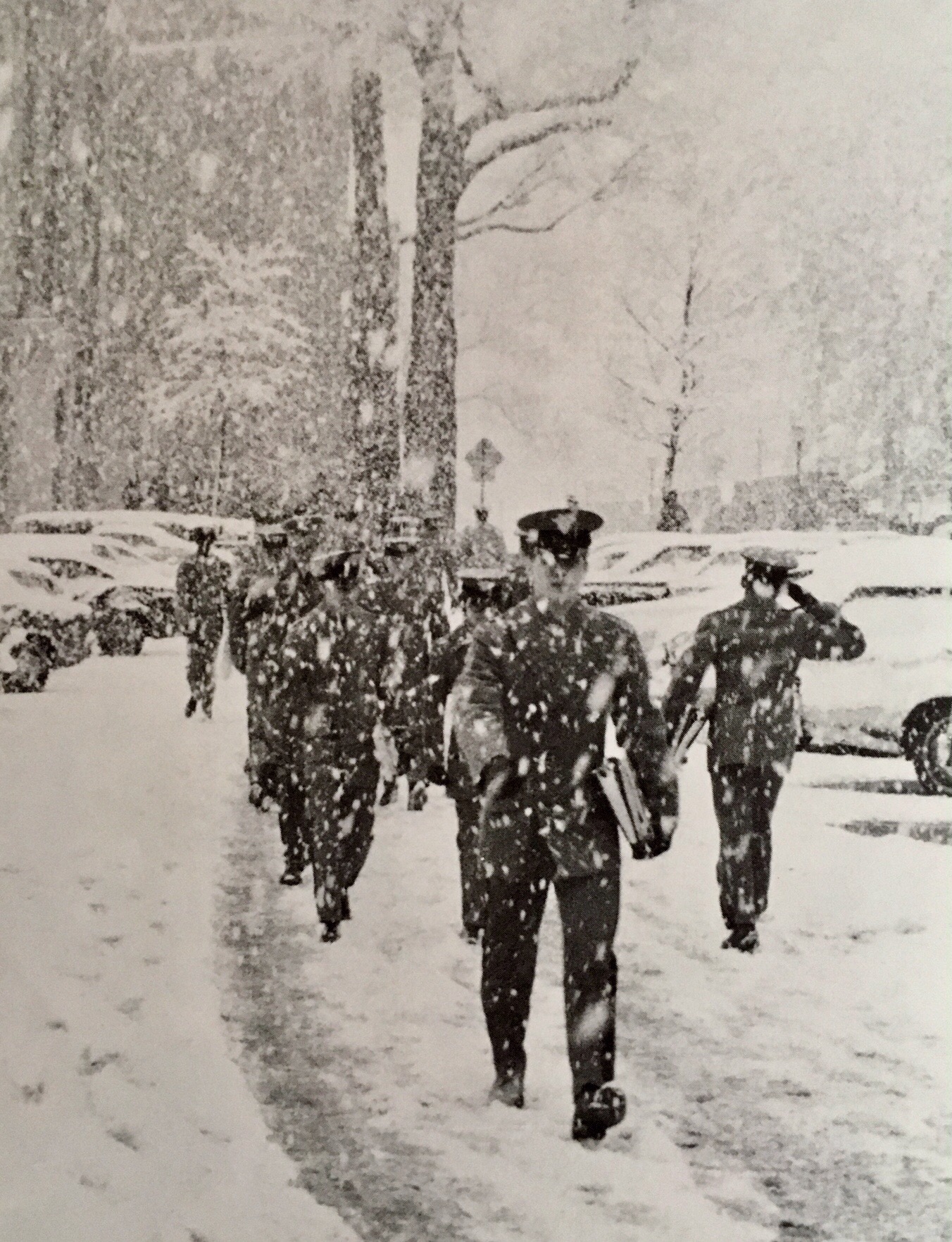
Photo from the class of 1978 Howitzer (yearbook)

Our uniforms were gray and the buildings were all gray stone. The Hudson River seemed to turn gray, and would sometimes ice up. The surrounding mountains, without leaves on the trees, were granite gray. The sky was often gray, clouds pregnant with snow. If it did snow, the snow turned gray after a couple of days with the road dirt. It was almost like living in a black and white film.

Daylight was noticeably absent durning Gloom Period. During the first formation of the day (Breakfast formation), it was still dark outside. As we walked to the first class in the morning, the dark was lifting, but it still wasn’t light. Walking from your first class to your second, you would finally see full light. Then, during the late afternoon, as you were returning from intramural sports, the evening started filtering in again, and at dinner formation, it was of course, dark.  

The cold of January in New York didn’t help. I come from Illinois originally, but the cold and wind off the Hudson cut right through our overcoats. Daily formations had their own kind of coldness to them. Standing.And.Waiting. And, if you marched punishment tours in the winter, you learned a special appreciation for the cold. 

In late January and early February, spring seems a million miles away at West Point. It of course finally arrives in late March or early April. The sky turns blue, the leaves come out on the trees, the snow disappears, and the weather warms. Gloom Period becomes a memory….. until the next year.

I haven’t thought about Gloom Period for years. Maybe the deep freezes of this January reminded me. Maybe it’s the lack of sunshine lately. I’m not sure. I do know that spring officially starts about 60 days from now. I think I’ll make it.

Uncle Don and the 1968 Tet Offensive

Uncle Don and the 1968 Tet Offensive

It was 2:00AM when the satchel charges exploded and woke my Uncle Don. The date was January 31st, 1968 and the North Vietnamese Army and Viet Cong (VC) had just launched the Tet Offensive. Don had been in Vietnam since March of 1967. He was assigned to D Company, 52nd Infantry Regiment at Bien Hoa/Long Binh and had one month left before he was to rotate back home. 

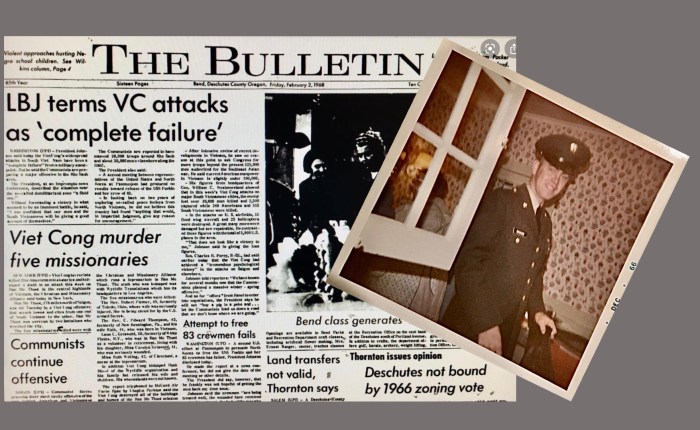
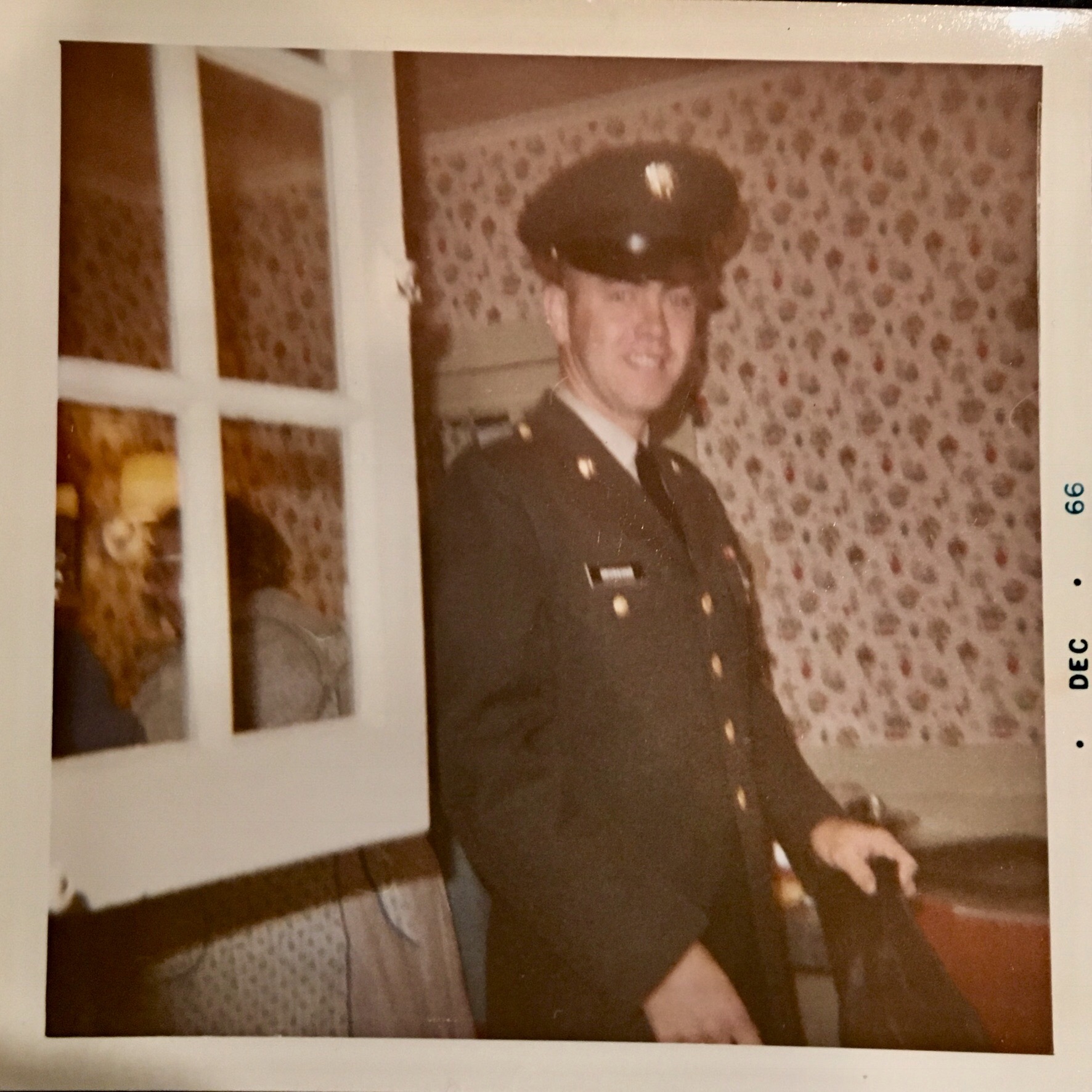
Uncle Don at Christmas 1966, 3 months before shipping off to Vietnam

The explosion woke him, threw him around his bed, and projected a can of shaving cream violently into his collar bone. At first he thought he was wounded or had possibly lost his arm, as the arm was completely numb. After visually checking that his arm was still there, he grabbed his gear and headed to the Company HQ. There, he met the CO, and others who were gathering. Most of the command was already deployed for their normal evening duty, so there were only a few men left. They learned that a satchel charge had ignited a nearby ammunition pad. North Vietnamese mortar shells then started falling across the base.

The CO, First Sergeant and a LT were getting ready to leave in a jeep to investigate the explosion. The CO asked Don to go with them, and then changed his mind. Instead, he instructed him to lead a four man team from the HQ element to a nearby guard tower and form part of a defensive perimeter. The CO’s jeep drove away and a few minutes later, they heard an explosion.  They didn’t know till  later that the jeep was just destroyed by the VC. The LT was killed immediately, and the CO was wounded. The First Sergeant would die from his wounds about seven months later.

At this point, it was all-hands-on-deck. Uncle Don formed a team that included the company clerk, the armorer, and a cook. All were carrying M16 rifles and my uncle carried an M79 Grenade Launcher in addition to his rifle. They obtained an M60 Machine Gun from the armory and everyone was carrying as much ammunition as they could – both for their rifles, and the M60. They jumped in a jeep and headed to a nearby ammunition pad and then the perimeter. On the way there, my uncle showed the cook how to use the M60 – the cook had never fired one before.

As the team headed for the perimeter, they saw a VC with an AK47 setting a satchel charge near one of the ammo pads. Don fired and dropped him. They stopped and rolled the body over to ensure he was dead. The VC turned out to be the barber who had cut my uncle’s hair, and occasionally shaved him, for the past six months. It was the first enemy he killed that night.

The team raced to the nearby guard tower and proceeded to the top. From there, they had a commanding view. They could see VC and North Vietnamese regulars everywhere outside the perimeter, and there were already sappers inside the fence. They checked in on their radio, and then left the tower and moved to a location on the ground, as there was a concern that the enemy could easily place an explosive charge at the base of the isolated tower, killing them. On the ground, they established a fortified position and saw hundreds of dots of red light as the enemy approached.  

The North Vietnamese crossed the first and then the second perimeter wires, setting off trip flares that illuminated the battlefield. The team requested permission to open fire, but were told to hold, as HQ thought there were friendlies in the area. Finally the enemy was crossing the last perimeter wire, which was constructed of concertina razor wire. They were still waiting for permission to return fire when the cook opened up with the M60. Soon, there was incoming fire from three different directions. They engaged the enemy and returned fire. The Vietnamese couldn’t penetrate the small perimeter they had formed.

The battle raged on. At one point Don raced across sixty yards of open ground and they retook two mortar positions that were previously overrun. The enemy was gone, but the mortars and ammunition were still there. They also encountered some of their own claymore mines that the Vietnamese had turned to face the US troops. Just before dawn, an ammunition pod exploded knocking Don to the ground. He got up and moved on. The enemy was then starting to breach the perimeter wire behind them. From their radio, he called in a Cobra gunship and passed the coordinates to the pilot. The first rocket was fired and when it passed, he could feel the heat of it, on the back of his neck. He elevated the range slightly and the Cobra let loose with a full complement of rockets, stopping the penetration at the wire.

As it was getting light, they received word via radio to stay put, stay off the roads, and stay under something with overhead cover. The Air Force was bringing in an updated “Puff the Magic Dragon”. Puff was a C-130 gunship used for close air ground support. It had two 20mm “Gatling guns”, along with two 40mm cannons on the ship and it could put a round into every square yard of a football field-sized target in less than 10 seconds. Puff arrived and circled the battlefield multiple, multiple times and that broke the back of the attack. The 11th Armored Calvary Regiment arrived in relief and most of the fighting ended about 1030 in the morning. Uncle Don had started the night with six bandoliers of M16 ammunition, with each bandolier holding seven magazines. Each magazine held twenty rounds, so he was carrying 840 rounds total. He also had six bandoliers of grenades with six M79 grenades in each bandolier. As the fighting ended, he had one magazine of M16 ammunition left and no grenades.

My uncle learned then that his CO was wounded and went to the 95th Evac Hospital to check on him. As he greeted the CO, a nurse approached (he says she looked exactly like Hotlips on the TV show MASH) and he realized how dirty he must look. He started to apologize to the nurse for his filth, when she cut him off. “I don’t care about your dirt, but you are bleeding on my floor.” That’s when he discovered he was wounded from the explosion that had knocked him down. There was blood running down both his arms. The nurse got a doctor, who took a look and there was shrapnel peppered in both arms from his elbows to his wrists. The doctor wanted to remove the shrapnel then, but my uncle said he needed to check on other men in his company. The doctor asked if he was coming back, and Don replied “probably not.” The doctor told him he would be picking shrapnel out of his arms for the next ten years. “You’ll be sitting at a bar and your arm will be hurting. Look for the blackhead – that’s where you can pull the shrapnel from.”

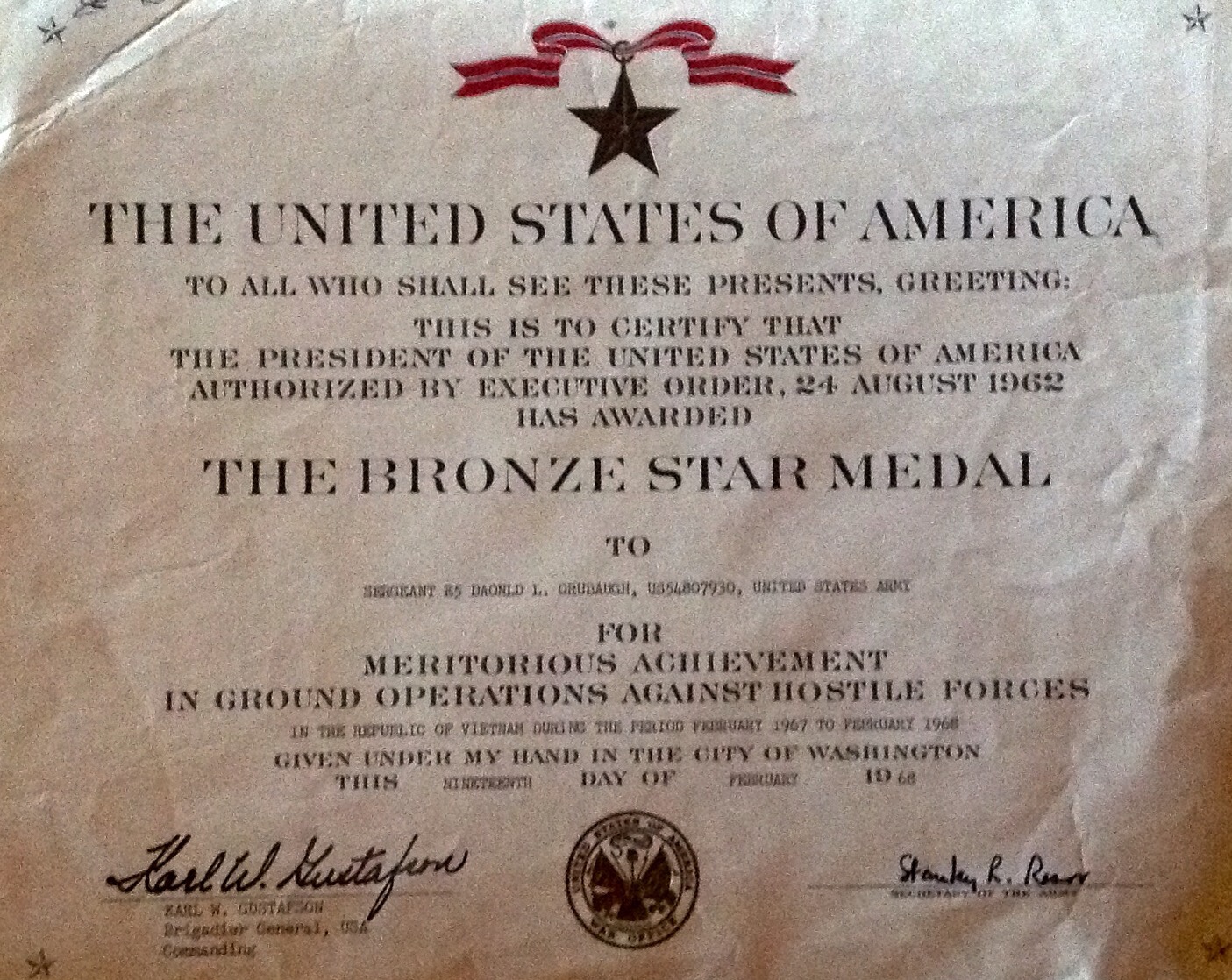
Uncle Don’s Bronze Star citation

A month later, he rotated home, after a year in country. He had been awarded both the Bronze Star, and the Combat Infantryman Badge. Because he left the hospital, his wounds weren’t recorded, and he never received a Purple Heart.  

He and his wife, my Aunt Diane, reunited in the States and he left the Army about six months later. When he returned home to Ottawa he went back to his old job at the First National Bank, and life returned mostly to normal. Like many men who have experienced combat, he never said much about it. Except that occasionally, he would be sitting at a bar in a restaurant with my aunt and she would see him picking at his forearm. She would hear the “klink, klink, klink” of him dropping the shrapnel on the bar….

***************************

This year is the 50th anniversary of the Tet Offensive In Vietnam. On January 30/31, 1968, North Vietnamese troops and the Viet Cong launched the largest battle of the Vietnam War, attacking more than 100 cities simultaneously with more than 80,000 fighters. After brief setbacks, U.S. and South Vietnamese forces regained lost territory, and dealt heavy losses to the North. Tactically, the offensive was a huge loss for the North, but it marked a significant turning point in public opinion and political support here in the United States. It was the beginning of the end of the war in Viet Nam, although it would go on until 1974, resulting in another 37,000 US deaths.

***************************

Dad, Uncle George, and the CCCs in 1939

It was 1939 and dad and Uncle George were on a train, bound for the CCCs in Wyoming.

Growing up in Illinois during the Great Depression was a tough life. Their family was poor before the Depression, and things just got worse. Grandpa worked in the coal mines of Southern Illinois, but that work dried up. The family moved north to Ottawa, Illinois. Dad’s oldest brother Dave was there, working on construction of the Starved Rock Dam, and the hope was that Grandpa could get a job at the dam as well. Unfortunately, Grandpa was an alcoholic and couldn’t hold a job for very long. What money he did make never made it home, and was instead spent on booze and nights on the town.

The ’30s dragged on and the Halls continued to struggle. In the spring of 1939, Uncle George heard about new opportunities with The Civilian Conservation Corps (CCCs), one of FDR’s New Deal programs to get the country working again. The CCCs had recently lowered its age requirements to “young men” from the ages of 17-25. Uncle George was 17 at the time, but dad was only 15 (he turned 16 in October of ’39). In the CCCs, they would each make about $30/month, but were required to send $25 home. They would keep the remaining $5 and also would be provided with food, lodging, and medical care. They decided to sign up. Dad lied about his age (no one seemed to check very closely), and he and Uncle George both joined.

Although there were over 50 CCC camps in Illinois, they, along with other Midwestern youth, were put on a train heading west for Wyoming. Once there, they transferred to trucks for the last miles of the journey. Finally, they arrived at their destination – Big Piney, Wyoming, one of 30 CCC camps in the state. It turns out that Big Piney was known as “The ice box of the nation”, due to the harsh winters there.

A foreman at another CCC camp referred to their new arrivals this way – “It was the sorriest assemblage of humans since Indian treaty days.” I’m guessing the crew that Dad and Uncle George were in wasn’t much different, as the depression had continued for so long.

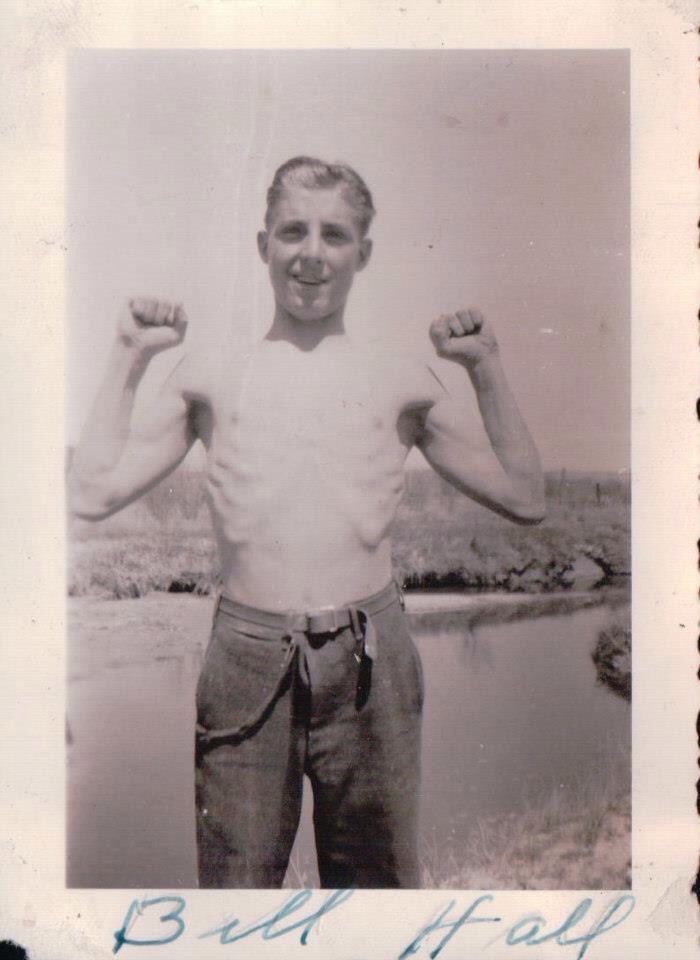
Dad in 1939 or ’40 at Big Piney, Wyoming
At Big Piney, they rotated in with members of the CCCs that were already there. Their work focused on the National Forest where they built roads, fences, fire towers and other facilities. They slept in Army style group barracks and had three full meals a day. Both dad and Uncle George put on weight. It was the best life either had known at that point. Plus, they were pocketing $5 per month in real money, something neither had really seen. The other $25 each ($50 total) was sent home. It was a huge amount for Grandma.

After their six month tour, they signed up for one more six month stint. Finally, after the year was up, they returned to Illinois. Life hadn’t changed any in Ottawa, but they were different. Bigger, and stronger, they had both seen a bit of the world.

For dad, I think it made him restless, especially since conditions hadn’t changed in Ottawa. A few months later, still only 16, my Aunt Ellen lied about his age for him, and he joined the Army. It was August of 1940 when he boarded the train for North Carolina, where he would make $21 a month as a Private in the Army. He would continue to send money home to Grandma. Over the next five years, he would see more of the world, including Morocco, Tunisia and Sicily. His accommodations in those countries weren’t quite as nice as the good ol’ days at Big Piney, Wyoming.

The Last Big Weekend Before the Invasion

“The craziest weekend I ever had was in October of ’42” Dad said.

Cath and I were visiting my folks in Illinois several years ago. It was summer and dad and I were sitting in the backyard drinking a couple of beers. We were talking about different “festive” occasions in our respective lives. I’d told of some of the Fasching (Mardi Gras) parties over in Germany. Dad talked about some of the evenings out with his old army buddy Noble.

And then he said to me me “Do you know the craziest weekend I ever had?” I stared at him. Who wouldn’t want to hear about that!? He began to talk…

It was October, 1942, and he was stationed with the 9th Infantry Division at Fort Bragg, North Carolina. He joined the Army two years before, when he was 16. Now he was 18, and a Sergeant. Pearl Harbor had occurered almost a year before and the 9th had trained hard since then.   Everyone knew that an invasion in the European Theater was on the horizon, but no one knew exactly when or where.  Then one weekend in early October of ’42, almost their entire Regiment received 24 hour weekend passes, and everyone knew that deployment was imminent

Dad, along with most of the rest of his platoon, headed to the bus station and caught a bus to Charlotte, NC, a couple hours away. They wanted to get away from the local town of Fayettville, and head to the big city of Charlotte. They had no plans, but knew they were going to party their butts off.

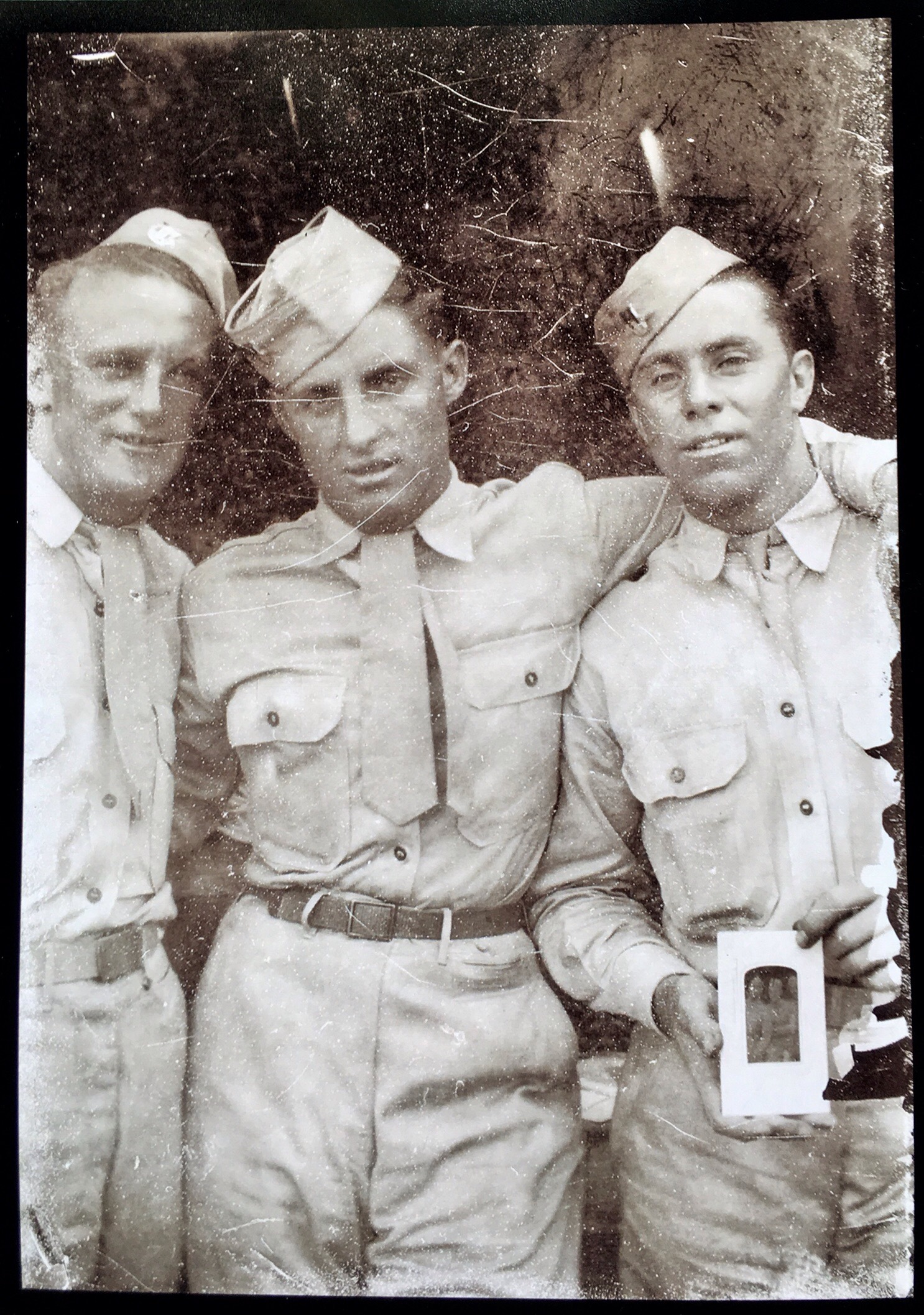
Deason, Dad, and Noble. Probably in late ’41 or early ’42.

Dad, along with his buddies Noble Clevenger and Jack Deason liked to start slow and build up to the night time. They found a quiet dive bar, started drinking beers and feeding nickels into the jukebox. No country music for them. They were all confirmed blues, jazz, and boogie woogie boys. They spent the afternoon there, drinking beer and listening to the jukebox. Along the way, they ate a couple of sandwiches. Finally, it started getting dark outside, and they moved on.

They stopped at the recently opened USO Club. It was jammed with GIs, there was music playing, and there were lots of women. Unfortunately, the USO didn’t serve alcohol, so they only stayed awhile. They moved on to Charlotte’s main drag, Trade Street, and started hitting the bars. It was crowded everywhere. They went from place to place, drinking beers and the occasional shot.  

One place had a boogie woogie band and they stayed. A bit later, a fight broke out between some guys in the 82d Airborne and another unit. Dad and his buddies hated the 82d and had a history with them. It probably started when elements of the 82d were relocated to FT Bragg in the Summer of ’42. They actually moved guys in the 9th from their barracks into tents, so the 82d could move into the barracks. They were about to join the fight, when the MPs arrived at the main door.  Dad, Noble and Deason slipped out a side door, and into the night.

As the evening progressed, they weren’t feeling any pain. They  entered a bar that was on the ground floor of a hotel, and ran into some other guys from their unit. From them, they found out that Sergeant Sopa, their Platoon Sergeant, had a room upstairs. They decided to go up and surprise him. They burst into the room, and there was Sopa, laying in bed wearing a smile, and not much else. There was a woman in the bed with him. NO WAIT, another head appeared from under the sheets – there were two women in bed with Sopa! A half empty bottle of whiskey was on the night stand. After giving him hell, they departed the room, and continued partying. At some point in the early morning hours, dad passed out or went to sleep.

When he woke, he found himself on the floor in Sergeant Sopa’s room. There were bottles, beer bottles, plates, and GIs scattered around on the floor. Sopa was passed-out in bed alone.  

Dad found Noble and they went for some food, and then found a bar and started partying again. Eventually, they left for the bus station, but missed the last bus to Fayettville. They ended up hitchhiking back to FT Bragg, where they reported in, late. It turned out that about a third of their unit, including Sergeant Sopa, was still missing. By the next morning everyone made it back. A lot of GIs thought punishment was coming their way, but it turned out bigger things were afoot. 

Dad finished the story. We drifted on to other topics and eventually finished our beers. Inside, I was smiling to myself, thinking of my 18 year old father tearing up Charlotte.

Of course the rest of the story is what makes that weekend of debauchery particularly interesting. A few days after the weekend, on October 14th, their unit was loaded in trucks and moved to the coast and their embarkation point. They boarded the ship, the USS George Clymer, and departed US waters. On November 8th, the 9th Infantry Division took part in Operation Torch, the invasion of North Africa. Dad came ashore at Port Lyautey, Morocco, and would be in combat operations for the next seven months through May, 1943. His next pass wouldn’t happen until June of 1943, after they had fought and beaten the Germans in North Africa.

I’ve recently thought about Dad and that weekend. It wasn’t in the news much, but this past November was the 75th anniversary of Operation Torch. Getting drunk and tearing up a town may not seem like much, but I guess when you are shipping out to parts and futures unknown, every minute and day matters. I like to think Dad lived his life that way.

Joy, The Squirrel Whisperer

Our neighbor Joy is a Squirrel Whisperer…. Seriously, she really is.

Well, technically, she is a licensed wildlife rehabilitator who specializes in squirrels and has done so for the past four years. She’s developed a reputation around the area as someone who knows her job, and so far this year she has saved 24 of the 25 squirrels that have come to her.

The squirrels come from arborists, housewives, referrals, vets, and local rehabilitators, among others. Typically, the squirrels come to her when they are only a week or two old, their eyes are still closed and they have no fur. Some have arrived when they were as young as a couple of days old. When their eyes are still closed, they obviously can’t fend at all for themselves, and must be fed every two hours. It turns out there’s a special Squirrel Baby Formula you can buy that is exactly what they need.

As the squirrels get older, their eyes open, and they start to transition from only formula to real squirrel food – Cheerios, fruit, nuts and vegetables and eventually they will be weaned off the formula. When they are around 12-14 weeks old, Joy starts to transition them to an outside “Pre-release” cage that’s on their porch. They get formula twice a day along with solid food in the cage and start to acclimate to outside.


After 2-3 weeks in that cage, Joy opens the door to the cage during the daytime. The squirrels eat breakfast, and eventually wander out the door of the cage. There’s a ramp from the cage to a nearby tree and they start to play in the tree. In early evening, they return to the cage for dinner, and as she feeds them, she locks the cage door for the night. Occasionally, a wild squirrel returns with “Joy’s squirrels”, but races out of the cage when it sees Joy.

And then after about ten more days, comes graduation. She feeds them one morning, opens the door, and doesn’t close it in the evening. The squirrels eventually quit coming back to the cage as they adjust to life in the wild. There are some she knows by sight, and can see them running in nearby trees.

Squirrels typically live two to three years in the wild, although they can live four or five years. It’s rare that they die of old age as they have so many predators. I’ve asked Joy why she does this, when squirrels have such a tough life to begin with. Her answer?   

Mom’s Scalloped Oysters

Mom’s Scalloped Oysters

1972” mom answered.

It was 2007 or ’08 and we were back in Ottawa for Thanksgiving.   My sister Tanya and her husband Shawn had prepared a wonderful meal at their home. Roberta brought a side dish, we brought wine, and Mom brought her “famous” Scalloped Oysters that she always served at Thanksgiving and Christmas.  The entire family was there, and with kids, grandkids, husbands, wives, and friends, it was a madhouse in the best possible way. After the meal we were all talking at the same time, as is often the case in my family. I started thinking and then said, “You know, I think this is the first time I’ve been home for Thanksgiving since…” and was then thinking about when I actually was last home for Thanksgiving.

From the other end of the table, mom answered “1972.”

Was it really that long? Of course she was right. 1972 was my senior year at Ottawa High School. After that, I headed to West Point, and then the Army. Our assignments were around the world and around the country, usually a long way from Illinois. When we were in Germany (almost all of the ‘80s), we didn’t make it back to the States much at all. Later, we were stationed in the DC area. If we could get home at that time of the year, we always planned on making it back for Christmas. After I got out of the Army, we stayed in the DC area and the same held true.

I felt embarrassed and a bit chagrined.

I’ve thought about that Thanksgiving off and on since then. You never quite know where your life is going to take you, but those are the choices you make.

I have also thought about how we took a little bit of home with us, as we travelled the world. Cathy had gathered many of her mom’s Thanksgiving and Christmas recipes when she first left home in the early ‘70s. In addition to turkey, dressing, and green bean casserole, she would make that ol’ favorite, green Jell-O salad.  She also made my mom’s scalloped oysters. I like to think that we honored both of our families with the Thanksgiving meals we made. I sure know we thought of home while making them.

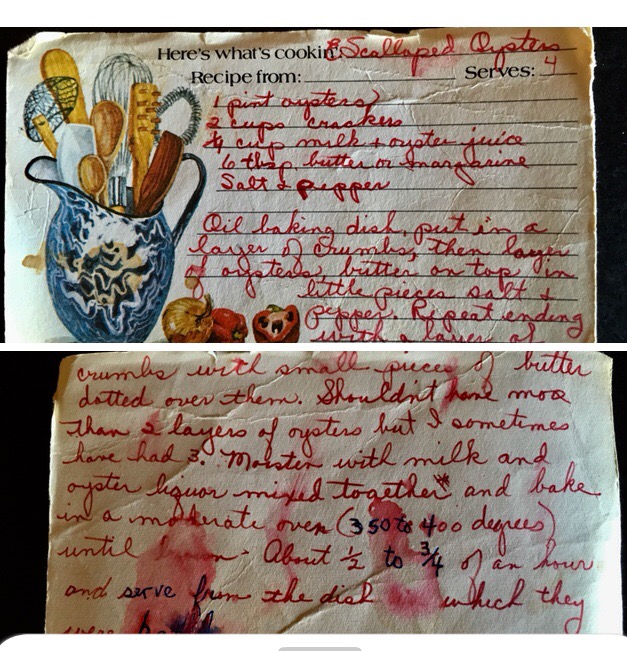
The 3×5 card from Mom with her Scalloped Oysters recipe

Mom’s Scalloped Oysters. Why she first started making it, I haven’t a clue. We lived in the middle of the mid-west and oysters weren’t exactly plentiful, or common. But every year, she would find fresh oysters in Ottawa or a neighboring town, and make “Oyster Dressing”, along with the regular stuffing. It was wonderful. And expensive. Mom would joke that she spent as much on the oysters, as she did on the turkey. Of course we never thought about that as kids.

Over the years, the scalloped oysters became a staple of Cathy’s and my Thanksgiving table as well, if we could find the oysters. Some folks liked it, some tried a small bite, and some wouldn’t eat it. I loved it. Secretly, I always hoped it wouldn’t get eaten, so I’d be able to have more leftovers in the coming days.

Life continued over the years.  Mom passed away last spring at the age of 86.  I miss her and have found myself thinking about her much more than I expected.  I’m sure that is why the Thanksgiving of 2007 popped in my brain.  Tomorrow is Thanksgiving, and as usual, Cath and I aren’t going back to Ottawa. We’re staying here in Virginia and going to a friend’s home. We are supposed to bring a dish to pass, so we are taking Mom’s Scalloped Oysters. I believe mom will be with us in spirit and giving me a few words of advice while I make the oysters. I know I will be thinking about her throughout the day.

Oh. And I hope our friends aren’t too thrilled with the oyster dressing, and we have enough for leftovers on Friday.

Love you mom….

******* ******* *******

By the way, the recipe doubles our quadruples nicely.  If you are quadrupling it, you may need to take out a small loan.