
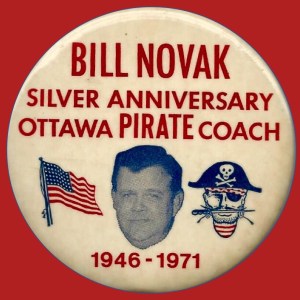
 In 1971, the Ottawa High School (OHS) football team finished undefeated, with a record of 9-0-0. Our coach, the legendary Bill “Boom Boom” Novak, was tough and appeared to get every ounce of effort from the team. I was thinking about Coach Novak with the recent news about the death of a University of Maryland football player and accusations that the coach ran an abusive program. Coach Novak was hard on us, but abusive?
Our practices were tough, especially at the beginning of the season when we did two-a-days in August. It was hot. It was humid. The coaching staff quickly saw who was in shape and who wasn’t. I won’t speak for others, but I remember sucking pretty badly at the start of that year.
There are two things I particularly recall about those practices. First, there was no water. Now, everyone knows the importance of hydration, but then it was a part of the toughness routine to go without water. Nobody thought or said anything about it. The second thing I remember was running wind sprints at the end of practice. We called them “weeds”. As practice ended, the team moved to the head-high weeds near the Illinois River. There, we would run a series of sprints, first running forward, then back peddling to the start line and getting down in a stance for the next whistle. Back and forth, back and forth we went. It often seemed weeds continued forever. Coach Novak kept us going, until we showed as a group we were going at 100%. For the last 4 or 5 days of preseason practice, Coach added a novelty to the sprints by requiring each of us to carry a car tire over our heads. One trick we learned from the seniors was to hide a slice of lemon in our hemet and chew on it when heading to the weeds. It helped our thirst.
Our coaches were teachers, both in the school system and on the playing field. They taught us technique, but they also taught us about life. There was yelling at practices and in games, but I don’t recall any cursing or name calling. The focus was on discipline and improvement. You were constantly measured against yourself and against others.
As the regular season started, practice eased up a bit, but was still rough. There were one-on-one drills and two-on-one drills. We practiced a lot of contained violence. Those drills measured your physical toughness, but in retrospect, I see how much of it was also about mental toughness. Running weeds continued at the end of every practice, but we were in shape now and there wasn’t as much pain.
At our Friday night games, the last thing we did before the start of the game was a massed “Root, Hog, or Die” chant around coach Novak. I didn’t know it at the time, but “Root, Hog, or Die” is an American phrase dating from the early 1800s. Historically, it became an expression of American self reliance. When we yelled the phrase, we were psyched and ready to play. Our team’s “self reliance” was at a maximum. Kevin Galley, our quarterback, recently said to me – “Novak’s approach, consciously or otherwise, fostered a very tight bond among all of our teammates. With only 32 players, everyone mattered”. Mike Stone, one of our captains and the team’s only all-state selection simply said “we had each other’s back”.
At game halftimes, you always wore your helmet in the locker room. This was to show you were ready to play, and also in case Coach Novak “tapped” you on the head for special instructions. I recall more than a few “taps”, particularly in close games.
The season progressed and the temperature dropped as September became October. Our hard work was paying off, with two, three, four and then five wins in a row. Finally, it was time for a showdown with our conference rivals, Sterling. Both teams were 6-0. Down 14-6 at halftime, the locker room was loud. Among my memories is Coach Novak grabbing Tom Gross by the face mask and explaining explicitly what he wanted Tom to do to the Sterling player opposite him. When the second half started, we pushed hard, eventually coming back in the fourth quarter to win 20-14. Normally, the local newspaper recognized one back and one lineman for their play, but the paper commended the entire team for their outstanding performance in the Sterling game.
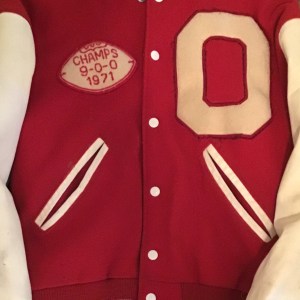 We ended that year 9-0-0. I lettered as a backup, an award normally reserved for players with high playing time, or doing special feats on the field. I had done neither. At the start of the year Coach Novak told us it took the effort of the whole team to go undefeated, and if we went undefeated, everyone would letter. He honored his word.
1971 was Coach Novak’s 25th and final year as coach and he retired at the end of the season. Ralph Bednar, a local sportswriter, said in his column the week of the retirement, “Novak is a hard man in football practice. He may make it tough on you, but as you look back, you probably see where all his hardness conditioned you for life today. Life isn’t easy and nothing should be handed out on a silver platter. Hard work is the answer”.
Times have changed and as my friend and teammate Phil Godfrey says “that style of coaching wouldn’t pass muster today, but it worked then”. We’ve all gotten a bit smarter over the years. Did Coach Novak abuse us? For my part, the answer is an emphatic no. He was tough on us and didn’t coddle us. He would yell and get in your face. He never pretended to be your friend in practice, but there was no doubt he was our coach and leader. In addition to football, we learned about teamwork, discipline, toughness, never giving up, and striving for a goal that was by no means certain. I like to think it was good preparation for my time at West Point, and throughout life.
Kevin Galley commented to me “Our team was certainly not the most talented Novak had during his coaching tenure, but we clearly had an abundance of tenacity that served us well on the field, and afterwards”. I think Kevin was right. As I’ve looked at my teammates and their lives, I see a group with good fortune. There are successful lawyers, judges, business owners, executives, engineers, managers, farmers, teachers, and yes, coaches. I think Coach Novak helped make and mold us. I feel pretty lucky to have known him, and to have played football for him. Talking with teammates, I believe most feel the same way. It may have taken some of us more than a few years after that season to gain a full appreciation for what he gave us.
Root, Hog, or Die….
_________________
Coach Novak was the Pirate’s head football coach from 1947-71. He compiled a record of 168-45-11, with 14 conference champions in those 25 seasons. Ten of those teams went undefeated and seven were perfect. In all of those years, I doubt anyone called him “Boom Boom” to his face. As a side note, the 1971 football team was elected to the OHS Hall of Fame in 2016.
** Special thanks to Kevin Galley and Phil Godfrey for their additions to this blog. Their review and input was very helpful.


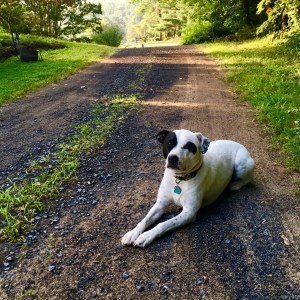 Instead of going straight to the house, I walk the 100 yards or so up the driveway to the mailbox and retrieve the Washington Post.
 We can argue about the environment, abortion, trade, the economy, health care and any number of other issues, but as a veteran and a patriot, I’m embarrassed by the events of the past week. I don’t understand our current president and his views about Russia and our European allies. When did it become patriotic to denigrate our allies and embrace our enemies?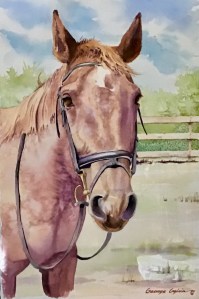
 Maybe half an hour later, our vet, Tena, arrived. Cathy put a halter on Arthur and we started for the back field. There was no talking. We crossed the dike by the pond, and for some strange reason our trek reminded me of the Beatles’ Abbey Road album cover. We were in single file at that point with Tena in front. Cathy came behind leading Arthur, and I brought up the rear. I know it’s weird, but whenever I see that album cover now, I think about Arthur. It’s strange how the brain works.
 The fireworks ended. We jumped in the car, did a quick u-turn and drove back towards Cathy’s apartment ahead of the traffic exiting DC. On the way, we decided to stop in Old-Town Alexandria and party some more. We tried to get into one of our favorite places, The Fish Market, but it was wall-to-wall people. As we were standing on King Street, we heard music coming from an upstairs bar across the cobblestone street and made our way to the entrance. We climbed the stair, and literally as we were opening the door to the bar, we heard –
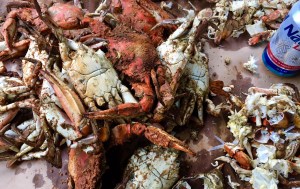 Last night, we gathered at our friend’s home and had a couple of beers while the crabs were steaming. The butcher paper was already on the picnic table. As he finished cooking the crabs, Jim dumped the first load from the pot straight onto the table. While he reloaded the steamer with the back half of the bushel, the rest of us started eating. They were oh so good. The conversation fell off a bit, but it didn’t stop as we were picking. A while later, the second load was also dumped on the table and we soldiered on, although perhaps slowing a bit. Finally, as it neared dusk, we finished up. The tables were cleaned and we adjourned to the porch for another drink or two and more conversation.
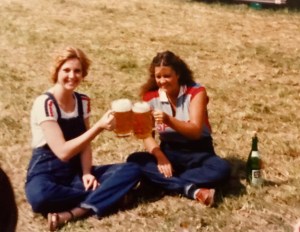 The next morning over coffee and breakfast, we asked them how the bier fest was. It turned out the fest hadn’t started yet. As a matter of fact, the huge tent was empty, except for about 20 guys. The local soccer team had helped get things ready for the fest and they were now relaxing with a few biers. They saw Roberta and Debbie enter the tent and called them over. Roberta and Debbie spoke no German, and the majority of the team spoke no English. This small impediment caused no issues and they spent the next several hours together becoming the best of friends, drinking biers and eating bratwursts.
 At some point in time, Debbie disappeared to take a motorbike ride with one of the soccer players. He was going to “show her the route of the next day’s Volksmarch”. While in the woods, the bike got stuck in the mud, and in order to get it unstuck, Debbie had to follow the cycle on foot until they were out of the muck. As Deb told me later “It was a little eerie to be stuck in a forest in Germany at midnight with a complete stranger. For a moment I questioned my sanity and if it would end well. Fortunately it did.” Eventually she returned, and Berta and Deb made the walk back to our home, arriving some time well after we were in bed.
 Live Life Exuberantly