It’s a sad day for America when all ten of our living former Secretaries of Defense feel compelled to release a letter saying the election is over, Biden has legally won, and the military should NOT be used to intervene in the election. Think about the American reality that prompted such an op-ed piece
In their letter, they take great pains to point out that they, and those in the military have sworn “an oath to support and defend the Constitution against all enemies, foreign and domestic. We did not swear it to an individual or a party”. Seven of the ten signers are Republicans, or served under Republican presidents. Two of them, Mattis and Esper, served under President Trump.
These ten men have differing views on the direction of America, but none of them believe in any one person holding sway over the Constitution. Their belief is in The United States of America itself. That they wrote and published this letter says volumes about where we are in America.
Looking across our country right now, I am disheartened at how many of my fellow citizens have taken up the “cause” of one man’s misrepresentations and lies.
There has been much written about cults, causes and movements here in America. While cults were originally thought of in regard to religious activities, the definition has expanded to include devotion to a person, idea or movement. Arthur Koestler, author of Darkness at Noon, wrote about people who convert to cults and causes. At the time, he was writing about his own conversion to Communism, but it could be about any cult, movement, or cause:
“To say that one had “seen the light” is a poor description of the mental rapture which only the convert knows (regardless of what faith he has been converted to). The new light seems to pour from all directions across the skull; the whole universe falls into pattern like the stray pieces of a jigsaw puzzle assembled by magic at one stroke. There is now an answer to every question; doubts and conflicts are a matter of the tortured past – a past already remote, when one had lived in dismal ignorance in the tasteless, colorless world of those who don’t know. Nothing henceforth can disturb the convert’s inner peace and serenity – except the occasional fear of losing faith again…”
There are now so many cults, causes and movements here, people have published warning guides about them. Compiling lists from several articles, the signs to look for include:
• The leader/group is always right and the exclusive means of knowing “truth”. No other process of discovery is acceptable or credible.
• Although there may be outside followers, there’s usually an inner circle who follow the leader without question.
• Cults typically oppose critical thinking. There is no tolerance for questions or critical inquiry.
• Typically cults exploit their members….often financially.
• The idea that if you leave the cult, horrible things will happen to you. There is no legitimate reason to leave – former followers are always wrong in leaving.
Sound familiar at all?
We, as Americans, need to look past any one person, past any one president, and look to the future of this country. Americans have never sworn an oath to only one individual and never should. I take heart that these former Secretaries, and people like Georgia Secretary of State, Brad Raffensperger, continue to do the right thing. America will weather this storm and grow from this experience. It will be because people, not Democrats, not Republicans, but Americans, did the right thing.
I’ve been honored to enjoy many great friendships over the years. Maybe due to Covid, or maybe because I am closer to the end rather than the beginning of my life, I’m more aware of that good fortune. What I feel most blessed about though, is the continuing close friendship with my childhood buddies, Tim, Kim and Mark.
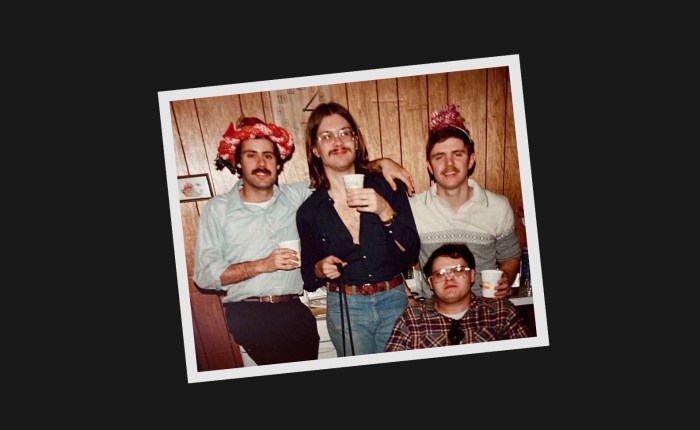
New Years Eve, 1978. Mark, Howard, Tim and I appear to be doing fine.
Mark recently sent a photo of the four of us on New Years Eve, 1978. It’s a classic New Years Eve picture. Slightly blurry, it captures us at about 3AM on January 1st, and, perhaps, slightly inebriated. Plainly we are having a good time. Although we aren’t thinking of it, our youth has passed, and our adult lives stretch out in front of us. Looking at the picture now, 42 years later, I think about our friendship and the transience of our time on this earth.
Kim, Tim, Mark and Max are also known by the nicknames Howard, June, Dunny and Ben in some circles. Those guys have been my friends forever. I first met Howard and June at about three years old in Sunday School. Kindergarten followed. Mark was a couple of years later, through Boy Scouts and youth football. I sometimes think because all of us had only sisters as siblings, we became closer over the years. Friends replacing the brothers we never had…
For the four of us, there are too many good times to count, whether in grade school, high school, college or the real world. We know and accept each other as we are, and have remained friends throughout. You might have thought with me going to West Point or serving overseas in Germany for a decade, the relationships would have faded, but they never did. Neither time, nor distance, have dimmed the closeness I feel for these guys.
Living in Virginia, I don’t see the three of them as often as they see each other, but we still make good times happen when we are together. And of course, when together, in addition to making new memories, we tell stories of the old times. Sometimes, just a name, word or phrase are all we need to generate smiles or ripples of laughter – Farrell, Wrong-Way LeBeau, The Ottawa Gluttons, The Great Wisconsin Tent Mystery, Sam’s, Wolfgang, the White Sox, certain meals or nights in Chicago…. While several of the memories are of the four of us together, many are only of two or three of us doing something. We’ve all heard the stories so often by now, it’s as if we were all at all of the events. The stories grow stale to some, but not to us. They are the chronicle of our past and the evidence to each other that we have tried to live life fully.
We are all lucky enough to have wonderful partners. Our friendships have expanded during our four marriages and one divorce. Some friendships survive neither marriage nor divorce.
Currently, one of us has serious health issues. With Covid, we can’t just rush to his side to somehow help, or try to help, or just commiserate. And so we text, email and call each other, often on a daily basis. It’s not the same as being there, but I like to think it helps him, and I know it helps me. Our communal history is a comfort that binds us beyond words.
I’ve been blessed with many great friendships over the years. From family relationships, my home town of Ottawa, West Point, the Army, neighbors, our running group, the horse world, politics… the list goes on. Tim, Howard and Mark? At the end of the movie, Stand By Me, the character played by Richard Dreyfuss says “I never had any friends later on like the ones I had when I was 12. Jesus, does anyone?” I count myself beyond lucky that my friends “when I was 12” have remained my good friends to this day. I love these guys. They are the brothers I never had.
Addendum: Thanks to Mark for sending the photo – it really did help start and formulate some things I’d been thinking about for awhile.
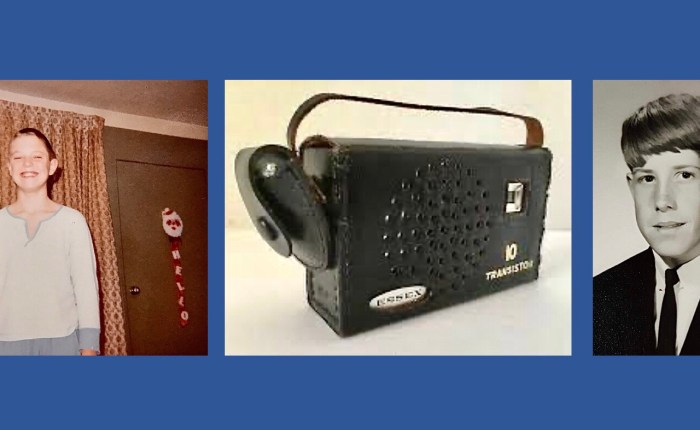
It was Christmas, 1965. I was ten years old and in Fifth Grade. I’d figured out a year or two before Santa Claus wasn’t real, but my Dad made me promise not to tell my sisters. Even though Santa wasn’t real, it was still an exciting season.
For Christmas at our house, you’d typically receive one “big” present, several smaller presents, and of course clothes (ughhh). For the big present, you could petition Santa at the little Christmas House in downtown Ottawa, or more importantly, make sure Mom and Dad knew. Sometimes you’d receive the present, but just as often not. Money was typically tight at home, and Santa might, or might not come through.
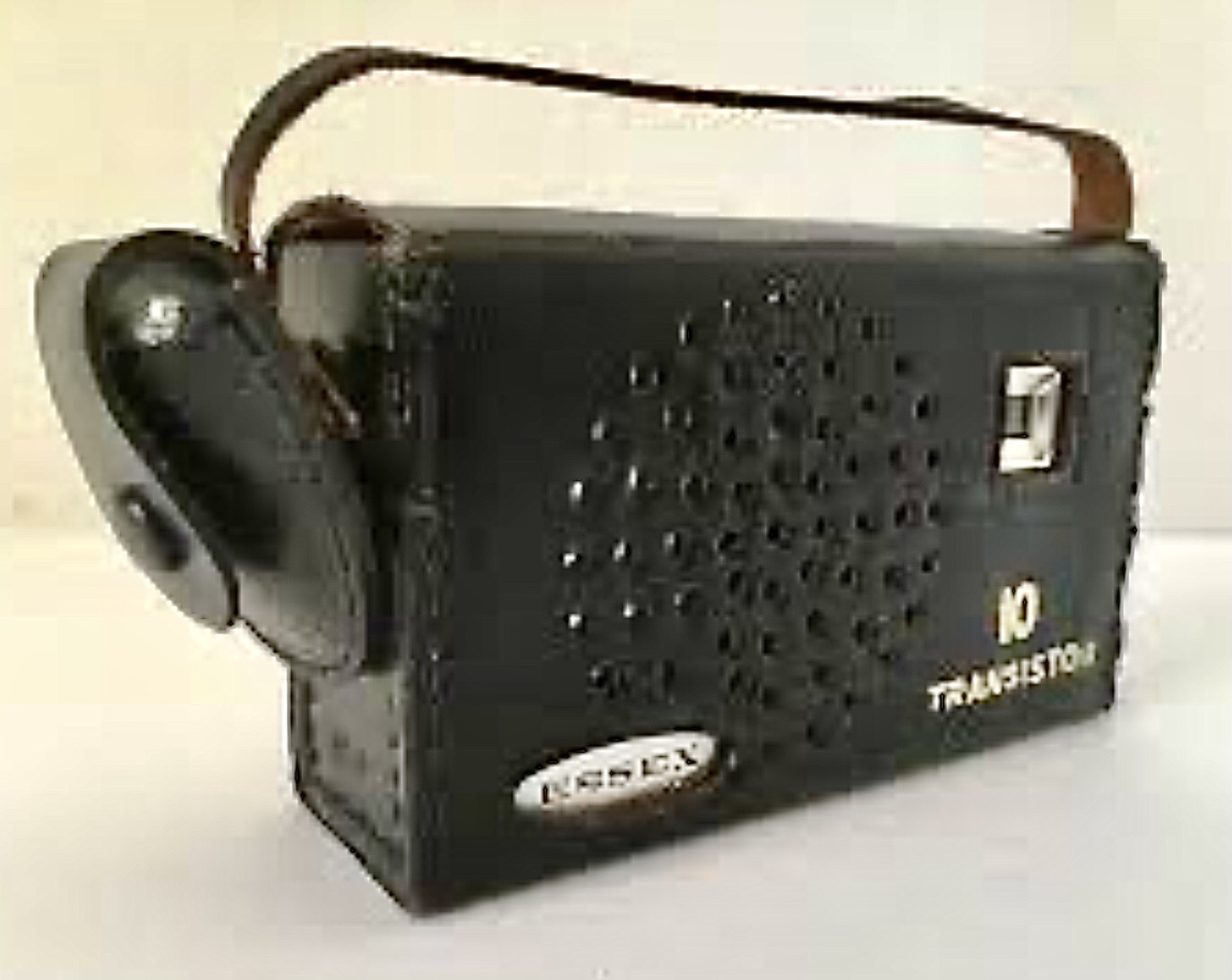
In 1965, I wanted a Transistor Radio. They’d been around for a couple of years by then, and the price was starting to come down. Before the iPhone, iPod, Boomboxes, or the Sony Walkman, there was that first mobile music device – the Transistor Radio. The Beatles and The Stones both appeared on Ed Sullivan in 1964, but more importantly, Rock ‘n Roll was on the radio. If you were a kid growing up in Illinois at the time, that meant WLS out of Chicago. Everyone listened to WLS.
Unfortunately at home in the Hall household, if the big radio was turned on, it was tuned to WMAQ, also out of Chicago, which played Big Band, some Jazz, and “popular” (not Rock) music. Dad didn’t like Rock. He was strictly a Jazz/Big Band guy, and “those kids who only played four chords” weren’t going to be on the radio in his house. A transistor radio promised freedom, but from my view the odds of getting one weren’t high.
Christmas Eve finally arrived, and then came Christmas morning itself. We kids started waking around 3:30AM, making trips to the bathroom so we could see the Christmas tree along the way. Finally, around 5:30, Mom and Dad let us get up, and we started ripping into the presents.
As we were opening the presents, there it was! The Transistor Radio! I opened the package itself, took out the radio and turned it on. Nothing. Silence. What?! I was crestfallen, it was broken. Then dad said “There is no battery in the radio. Maybe there is one somewhere else under the tree.” Hope restored, I went back to the presents.
Eventually, I found the battery. Dad showed me how to open the radio and we placed the battery inside. I turned it on…. and music! Wait, what’s this? It was old people music. Dad explained to me he received a special deal on this radio and it didn’t include WLS. It did however have WMAQ and their adult music. I was disappointed, but at least I had a radio.
Merry Christmas!
Later that morning, I was in our backyard, sitting in a tree, listening to the radio as it played Christmas music from WMAQ. A car pulled into our driveway and out came Uncle George, Aunt Mary and my cousins. They all wished me a Merry Christmas and wanted to know how Christmas had been. I said pretty good and showed them the radio. Uncle George, Aunt Mary and the older kids laughed, waved and went into the house.
My cousin Billy, who was only a couple of years older than I, came over to the tree, climbed up to another branch and joined me. We listened to the music a bit and then:
Billy: “What are you listening to?”
Me: “WMAQ’s Christmas music.”
Billy: “Why aren’t you listening to WLS?”
Me: “Dad got some kind of deal on the radio and it doesn’t get WLS”.
Billy looked at me as if I was stupid, and then exclaimed “Gimme that!”
I handed him the radio and he played with one of the wheels and all of a sudden – Boom! There were The Beach Boys singing “Little Saint Nick”! Whoa! It turned out I didn’t know about the frequency dial on the radio, and Billy had tuned it to WLS at 89 AM. (He was right to look at me the way he did. ;-). )
I raced into the house with the Radio. “Dad, Dad! The radio DOES get WLS! Billy showed me how to tune it in!” Dad looked at Billy and me, and I believe a small smile crept across his face. “What?! The salesman told me it wouldn’t receive WLS. I’ll have to talk with him”. He then made Billy and me go back outside “if we were going to play that Rock ‘n Roll”…
I recently talked with Billy about the story. He laughed at the memory and remembered thinking my Dad might kill him. He also remembers changing all the buttons in his family’s car to WLS for the drive home that day.
Having a good Christmas, and then your big cousin helping to make it even better – how cool is that?
I know with Covid, this Christmas will be different for many of us. Here’s hoping you make special memories to remember, and laugh about for years to come.
Addendum:
Dad grew to enjoy the Beatles. Many years later, we were talking after he and mom returned from a Jazz fest where a band played a medley of Beatles songs. Dad’s comment to me: “You know, those Beatles made some pretty good music”. Even old dogs can learn new tricks, or at least they could in Dad’s case…. 😉
If you want to read a couple of other Christmas memories from the Hall house, you can find them here:
The transistor radio really was the start of the revolution in portable music. You can follow the trail from Transistor radios to Walkmans, Boomboxes and iPhones. As it says in the referenced article, “The mighty transistor radio was the first piece of technology that gave young people complete musical freedom from parental disapproval.” Read more here: https://home.bt.com/tech-gadgets/internet/retro-tech-the-transistor-radio-11363937910884
Not all heroes wear capes. They aren’t all soldiers, first responders, or health workers in the time of Covid. Some are just doing their job. My friend, Kelly, is one such hero. She works for the Maricopa County Elections Department in Phoenix, Arizona and has received death threats, just for doing her job.
Kelly
On November 18th of this year, I noticed a blog I wrote in August of 2017 was getting a lot of online clicks/views. The blog is titled “This is not my America” and was my response to the horrific KKK/Nazi torch lit parade in Charlottesville, Va that year. I assumed someone liked the blog and linked to it in their own blog, or perhaps tweeted the link out. The next day, there were even more views (almost 150 in total). I decided to investigate further and traced the clicks to a specific blog site, as opposed to Facebook, Twitter, LinkedIn, or web searches, which is how most readers find me.
It turned out a right wing blogger was calling me a leftist in her blog and said I was “attacking the Founding Fathers”. The blogger went on to use my Charlottesville blog to condemn my friend, Kelly, as also being a “leftist”. (a link to my Charlottesville blog is at the end of this piece, if you want to see what a leftist I am).
The Right wing blogger attacking Kelly and misrepresenting my blog as attacking the Founding Fathers
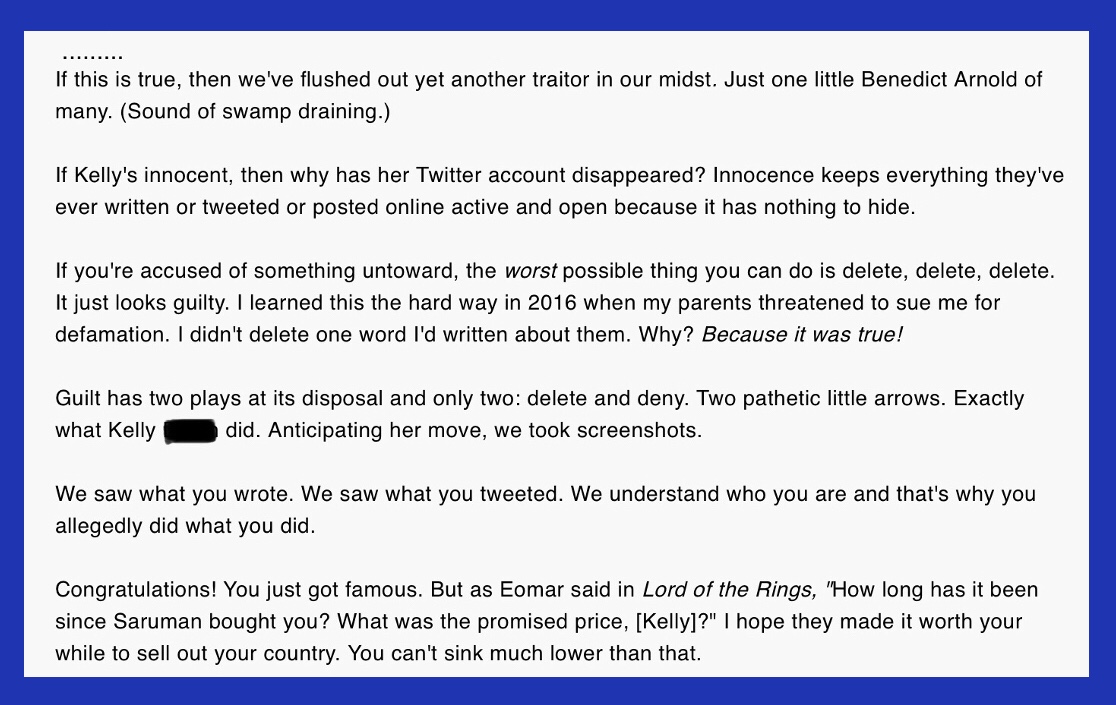
The right winger stated “no Republican/Conservative would have retweeted the blog, but Kelly did, outing herself as a leftist/Democrat”. Later, in the same blog, she commented about my friend Kelly – “If this is true, then we’ve flushed out yet another traitor in our midst. Just one little Benedict Arnold of many. ”
The blogger calling Kelly “one little Benedict Arnold of many“
Why was my friend under attack from this blogger and others? Upon further reading of the attacker’s blog, I found out Kelly now works for the Maricopa County Elections Department. In the course of her job, and at the direction of her boss, Kelly sent an email out to election workers shortly before the election, telling them voters should use the provided Sharpie pens on Election Day to mark their ballots. Evidently Kelly was an evil person and part of a cabal doing everything she could to cancel out the votes of Republicans on Election Day. Someone leaked the email to the trolls, with her full name, email address, and phone numbers.
According to conspiracy theorists, voting machines couldn’t read ballots marked with sharpies, and thus hundreds of thousands of votes for Trump on Election Day weren’t counted in Maricopa County and elsewhere. Now this was demonstrably false and was debunked multiple times. In fact, Sharpies worked better than pens, and would cause fewer issues on Election Day than ball point pens. This didn’t stop the trolls from posting about the Sharpies, or my friend. If you want to see some bizarre stuff, do a search on Sharpiegate.
I decided to contact my evil friend, and see how she was doing, but I ran into a problem or two. Her work phone went straight to voice mail. Her cell phone went straight to voice mail. Her LinkedIn account was shut down, as were her twitter and Facebook accounts. I also couldn’t reach her via Messages, or Messenger.
I was starting to worry.
I contacted a mutual friend to see if he had any other way to reach Kelly. He passed on a cell number he knew worked for her previously. I reached out…. and we connected.
While Kelly was OK, she was having some issues in Arizona. Trolls were coming after her and bombarding her accounts with threats and vulgar comments, so she shut them down. People called her names in person and online that you wouldn’t want your mother to hear. She was receiving death threats and her voicemail for work and her cellphone were porting directly to the Maricopa County Sheriff’s Office forensic team. The death threats were credible enough that the sheriff’s department discussed assigning protection to her.
Kelly and I talked about the election and what was going on in Arizona. She was in surprisingly good spirits for someone threatened with death. In her words –
“I’m OK. The County offered me a security detail because I’m getting death threats. I have all new phone numbers. There were lots of sick, disgusting messages I wish I’d never heard. These people are ugly. They’re pulling at every straw. I took everything down out of fear for my family, but they have taken that as an admission of guilt.”
The only thing Kelly was guilty of, was doing her job.
Kelly shared with me that her parents, and her wife Sarah served as her base and her foundation. They were keeping her sane with jokes, and with messages of love. Her boss and Maricopa County were also standing by her – with protection, words of support and defense of the truth.
I said to her “I’m proud of you. Now is the time for good people to stand their ground, and doing the right thing is important. You, my friend, did, and are doing, the right thing.”
She answered back “I hold that in my heart – I have nothing without my integrity.”
***
The Maricopa County Attorney’s Office completed an extensive review of all actions surrounding the election. In an interesting twist, one of those attorneys was Tom Liddy, the son of G. Gordon Liddy of Watergate fame. The Attorney’s Office found no issues with the conduct of the election, and in fact stated the Election Board did everything they should, to ensure a fair election. Mr. Liddy’s comment was “This is the best election I have ever seen… in terms of turnout, and security”.
On Friday, November 20th, the court threw out the third lawsuit raised since Election Day in Arizona. Later the same evening, the five member Maricopa County Board of Supervisors met to canvass and certify the 2020 general election results. There are four Republicans and one Democrat on the Board. In a two and a half hour meeting, they discussed the election, and listened to input from the Election Board, and the County Attorney’s Office.
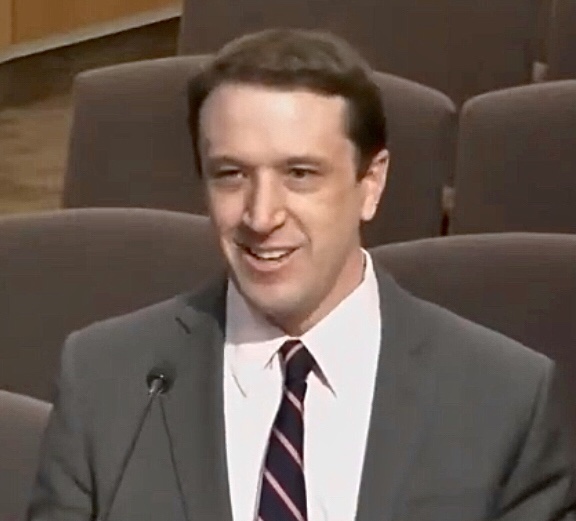
Scott Jarrett speaking at the Special Meeting of the Maricopa County Board of Supervisors
Scott Jarrett, the Director of Election Day and Emergency Voting, said this in his closing statement “The heroes of this election are the election staff…. the people who still came to work, even as people were chanting at them, and calling them names…..”
Just after 6PM, the board unanimously approved the canvass of the November election for Maricopa County.
The Chairman of the Board, Clint Hickman, said “We’ve canvassed the General Election results and can assure Maricopa County voters proper steps were taken to ensure a full and accurate count of all votes. No matter how you voted, this election was administered with integrity, transparency and in accordance with state laws.”
He went on to say “I learned a lot about the character of people in this community… I will not violate the law or deviate from my own moral compass, even though that is what some have pressured me to do… I specifically want to thank the staff who have worked tirelessly to run this election during a pandemic – Scott, Kelly, Rey…. I want to personally thank you”.
Not all heroes wear capes. One works on the presidential election in Maricopa County, Arizona. I’m proud of my friend Kelly, who continues to provide election support, even as I write this blog.
I chose to only provide a couple of screen shots of the right wing blog that linked to my site. I did not want to give the blogger any more exposure by providing a link to her site and the information she is publishing. As you may have seen in the screen shot above, there was a strange mix of comments about Kelly, the blogger possibly being sued by her own parents for defamation, and a little Lord of the Rings thrown in as well (although she misspells Eomer). It’s a strange world we live in these days.
As I was writing this blog, the trolls continue to post about Kelly. She stays in close touch with the Sheriff’s Department. Kelly was happy with me using her full name in this blog, but due to the ongoing nature of the harassment, I chose to use her first name only, and to not provide a complete picture of her.
This is a different kind of Thanksgiving story. How often do you give thanks to the owner of a septic system company on Thanksgiving Day?
In 2001, we had a family gathering at our farm for Thanksgiving. It was only two months after 9-11, and while people were still nervous about travel, many also had a strong urge to spend time with family. We didn’t realize the gathering would precipitate problems with our septic system on the day before Thanksgiving.
Mom Snow came from Alabama, along with Cathy’s aunt Bonnie from Missouri. Cathy’s sister Bonnie (Aunt Bonnie’s namesake) and husband Don flew in from California, along with Don’s folks, Shan and Daddy Don. Counting Cathy and I, there were eight of us in the house, with all bedrooms and the office occupied. We were full.
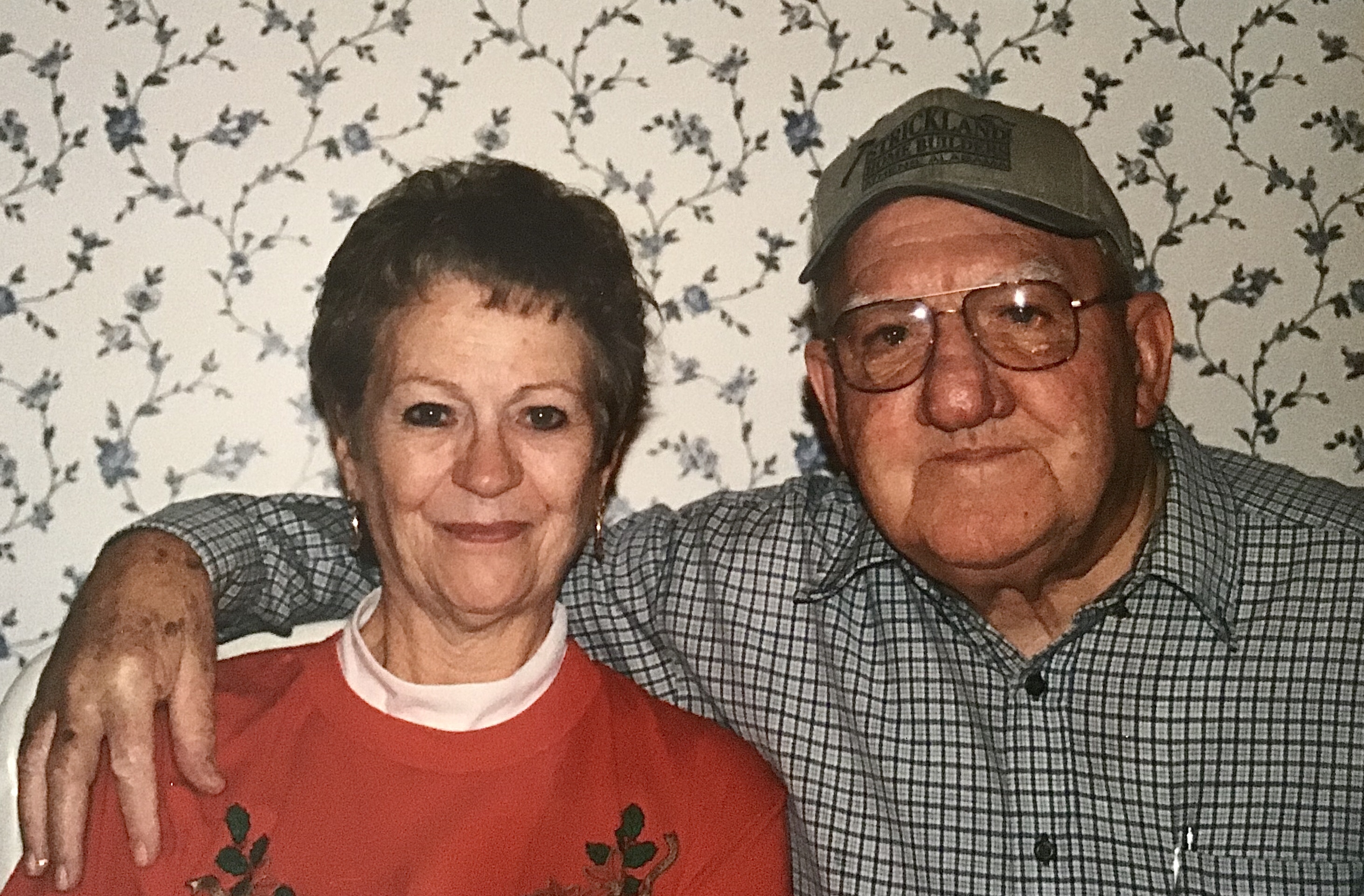
Mom and Daddy Don in 2001
People arrived the weekend before Thanksgiving, and everyone got along remarkably well. We have a nice sized house, but with eight people, and two and a half bathrooms, there could be a bit of congestion in the mornings and evenings. You might even say the bathrooms were working overtime. With the excess food and alcohol consumption that typically happens at family gatherings, and with four of our guests over 70, my observation in retrospect was there were no “regularity issues” among the group at our home.
At this juncture, it’s worth pointing out we live on a small farm in the country. The house was built in 1976. There are no city water or sewage hookups. For water, we are on a well that’s 264 feet deep and serves both the house, and the barn. For waste disposal, we have a septic system. When we bought the house in 1999, both were inspected by the county and deemed operational.
Thanksgiving week progressed and Cathy noticed a small pool of water had formed near the barn. There were recent rains, so she didn’t think anything about it. The next day, the water was still there and she mentioned it to me. Hmmmm. My first thought was perhaps a pipe from the well to the barn was leaking and the water had surfaced. We checked the water pressure in the barn, and the pump seemed fine, with plenty of pressure. To be honest, that was about the extent of my plumbing expertise at the time, and so I decided to call a plumber.
This was the day before Thanksgiving, so naturally every plumber we called was either busy, or didn’t answer the phone. As I was sitting there grumbling, Daddy Don walked by and asked what the issue was. I explained the pool of water and said I was afraid we might have a busted pipe. He asked “Where’s your septic field?” I pointed vaguely to the back yard and said “Over there.” He answered, “Well the pool of water is just below your field, maybe you have a septic problem.”
What?! Jeez, eight people in the house. I certainly hoped that wasn’t the problem. Erring on the side of caution, I thought it was worth checking out. I looked in the phone book, and found All Star Septic, in the village of Hume just a few miles away. I gave them a call and they answered. Even more miraculously, they could have someone out in a couple of hours. In the meantime, I advised everyone to stay away from the small pool of water, in case it was contaminated.
All Star Septic – “You Make it, We Take it”
An hour or so later, a septic truck pulled up, and a man climbed out. It was Chris, the Owner of All Star Septic. We shook hands, and I explained to him what the issue was. He just kind of nodded his head, then said “Where’s the pool of water?” I told him it was by the barn, and we walked over there. Chris looked around a bit and then squatted down next to the pool. He dipped a finger into the water, and held it up to his nose. He then matter of factly said,
“Uhh yep, that’s shit water”.
And with that declaration, we found out we had a septic problem.
I laughed internally to myself about all the cautions I’d taken with the water, and here was Chris dipping his finger in it. I also had the thought I probably wouldn’t shake his hand goodbye.
I mentioned to Chris about eight people at the house for the next several days through the weekend. He answered back that probably explained part of the problem. The house typically only had two people using the septic system and was now overloaded. Chris then said he couldn’t fix the problem right then (it was the day before Thanksgiving afterall), but he could pump out our tank(s) and that should help in the short term.
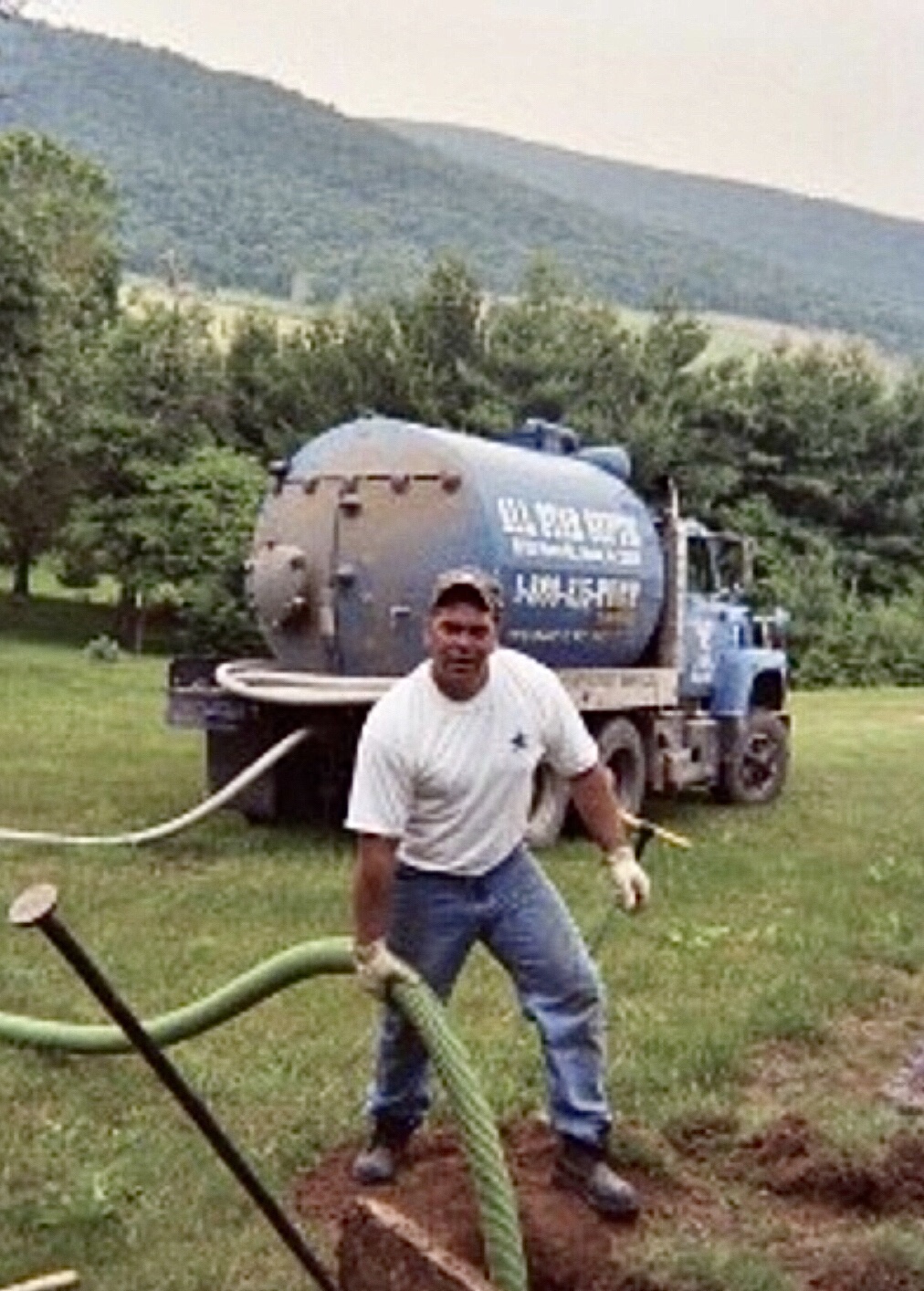
Chris, from All Star Septic
I thanked him profusely and he proceeded to pump out the two tanks. He commented the tanks looked fine and the problem was something “downstream” and we could tackle that a bit later.
Chris was right, and pumping the tanks removed the immediate issue. On Thanksgiving Day, much like Arlo Guthrie in Alice’s Restaurant, “We had a Thanksgiving dinner that couldn’t be beat, went to sleep, and didn’t get up until the next morning.” Unlike Arlo, for us, the rest of the week passed without incident and the pool of water disappeared. Chris had provided us with a temporary solution that worked, and held for the week everyone was there.
When I think back over the years about Thanksgiving, it is the celebrations that were different that I remember – the Thanksgivings in Germany when we had bachelor Lieutenants over, because they had no where else to go; serving Thanksgiving in the mess hall to the troops; celebrating in Vienna, Austria one year; the time I flew home on Thanksgiving Day itself, due to work delays; and yes, the year Chris, from All Star Septic, saved the day.
My guess is with Covid, Thanksgiving 2020 will also be special, or different if you prefer, and is one all of us will remember for a long time. I hope you make the most of the day, and give thanks for family, friends, and the things in your life that are important to you now, and always. Peace be with you.
Addendum:
The rest of the story about our septic field is a bit anticlimactic. Chris did return later and fix the problem. It turned out the previous owners had built the drive to the barn directly over the distribution box for the septic drain field. Over time, the distribution box caved in and the effluents were only going out through three of the distribution pipes in the drain field, instead of all nine. That was fine when just a few people were at the house, but when there were eight of us, it was too much for the three pipes to handle. The end result was the pool forming near the barn. So, our guests didn’t cause the problem, but in fact highlighted the already existing problem. It had probably been that way for years. Chris replaced the distribution box, and several of the distribution lines connected to the box. We’ve had no problems since, and that includes a couple of parties with over 100 people in attendance.
All joking aside, if you live in the Fauquier County, Virginia area and have a septic problem, Chris is the guy you want to call. He’s prompt, reliable, professional, and gets the job done. He’s been our guy ever since the “incident”. You can find his info here: https://allstarseptic.com/ , or call him at: (540) 272-9247.
If you’ve never listened to Alice’s Restaurant, by Arlo Gutherie, you need to do so. NOW KID! Set aside about 19 minutes and enjoy it for what it is. It’s a protest song, a Thanksgiving song and it’s just plain funny. I typically listen to it every Thanksgiving. Originally released in 1967, it’s full title is actually Alice’s Restaurant Massacree. Here’s one version: https://youtu.be/m57gzA2JCcM . In 2017, it was selected for preservation in the National Recording Registry by the Library of Congress as being “culturally, historically, or artistically significant”.
Fifty seven years ago this Sunday, the world changed and went spinning off in a different direction.
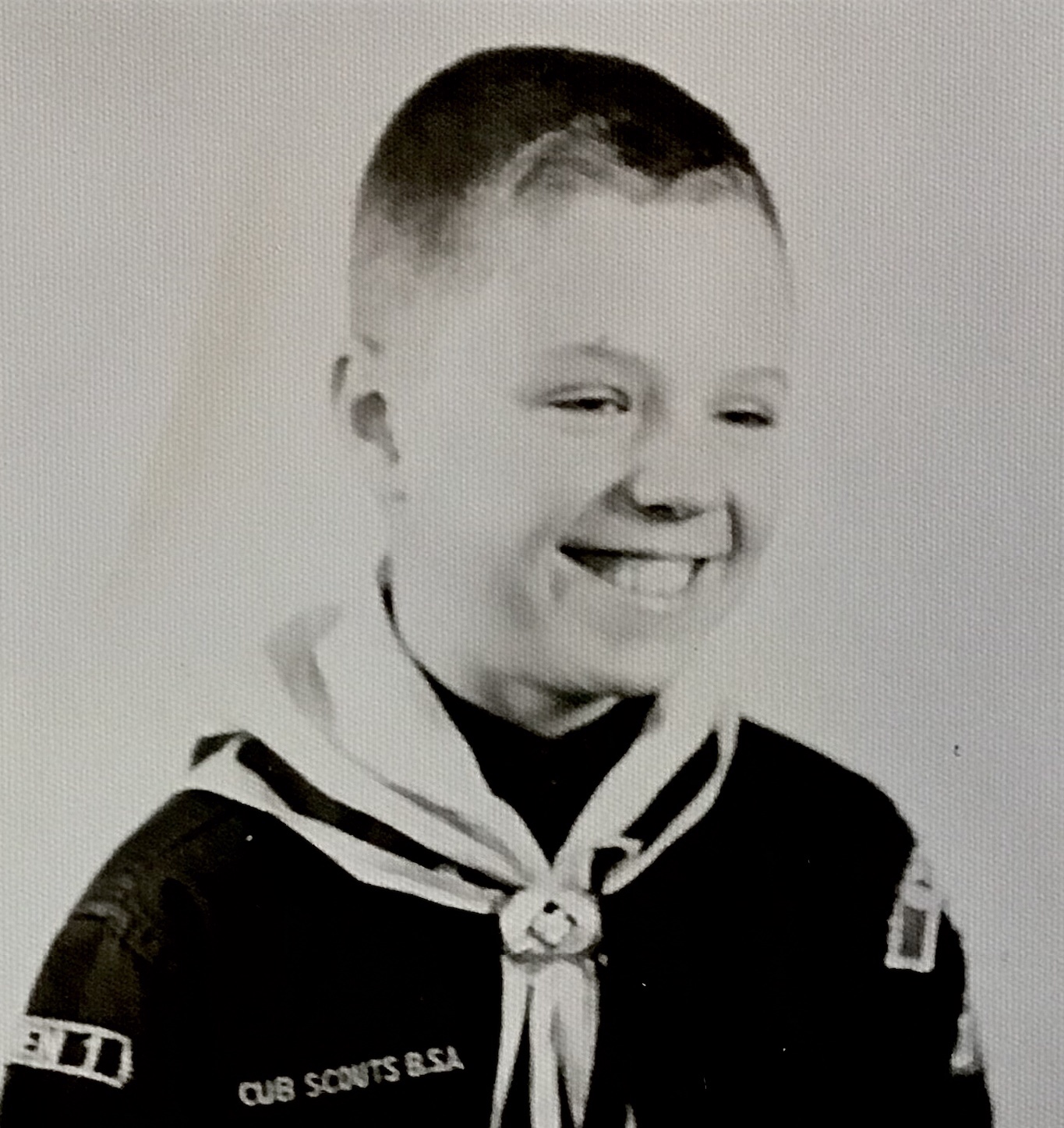
Me, in Third Grade
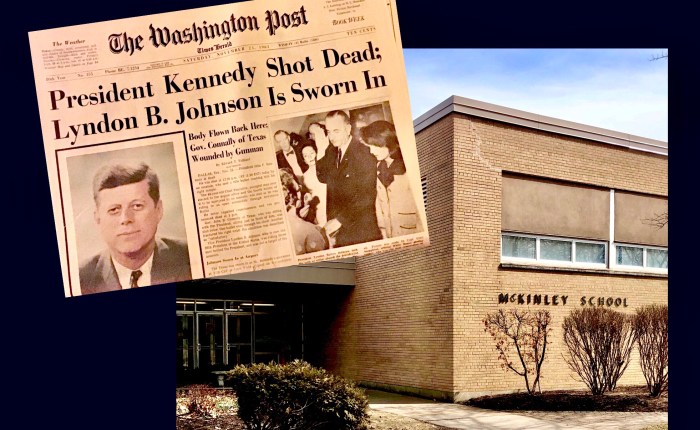
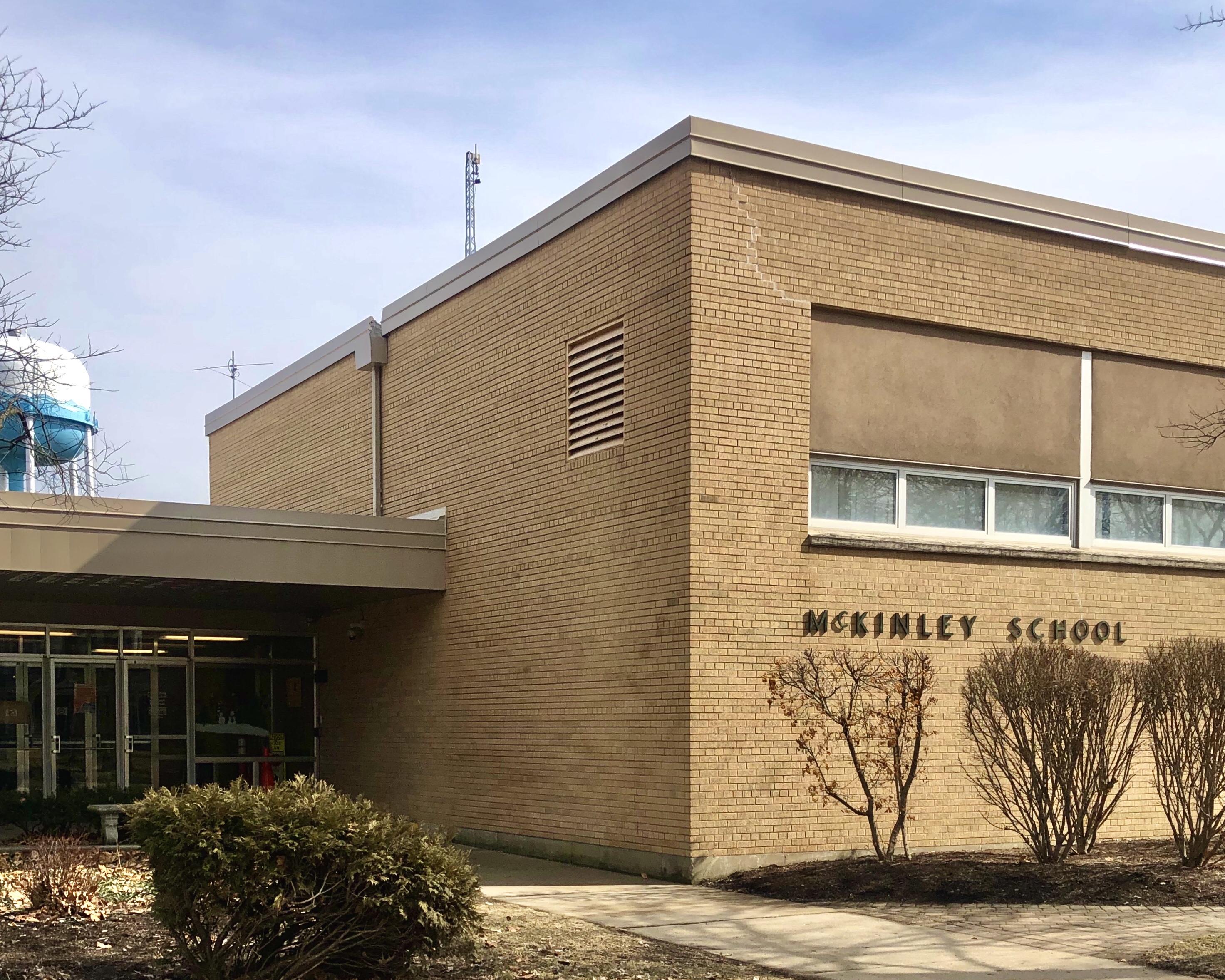
Friday, November 22nd, 1963 started like any other day at McKinley School in Ottawa. I spent the morning in Miss Langbehn’s third grade class with my friends Tim and Howard. Released from school for lunchtime, I walked the half mile home with my buddy Howard, arriving a bit before noon.
At home, Mrs. Wiley, our baby sitter, had tuna sandwiches ready for my sister Roberta and me. We ate them quickly and then adjourned to the front room to watch Bozo’s Circus on WGN TV for half an hour. Around 12:30PM, Roberta, who was in first grade, and I left for the walk back to school. We didn’t know President Kennedy was shot right about the time we left home. In that pre-internet age, the shooting wasn’t public knowledge for another ten minutes, until Walter Cronkite interrupted the live soap opera “As the World Turns” on TV to announce the news at 12:40PM.
Blissfully ignorant, we played with friends at the school yard. Shortly before 1:00PM, we lined up at the school door, as we did everyday, to enter the school in a column of twos. While standing in line, my neighbor, Leonard Mayberry, ran up to me and a couple of others and said someone shot President Kennedy. At first, we thought he was telling us some kind of joke, but he kept repeating the news. It didn’t make sense and I thought, for whatever reason, he was making up the story.
The main entrance to McKinley School
As we entered our classroom, Miss Langbehn quickly quieted us down and told us to pay attention. The intercom came on and Mr Powell, our principal, announced President Kennedy had been shot, and his fate wasn’t yet known. I distinctly remember thinking he would recover. Mr Powell left the mic open with the radio on, giving us news and updates…. the criticality of the wound… the shooting of a police officer in Dallas… the arrival, and departure, of priests at the hospital…
The classroom was stone quiet as we listened to the intercom. Miss Langbehn, and perhaps some of the girls were quietly crying.
Although it wasn’t publicly known, President Kennedy was officially pronounced dead at 1:00PM, just as we were entering McKinley School after lunch. At 1:33PM, assistant White House Press Secretary, Malcom Kilduff officially announced to reporters at the hospital that Kennedy was dead. This update wasn’t on the news yet.
At 1:38PM, Walter Cronkite came on TV and radio and announced Kennedy was dead, and Lyndon Johnson would be sworn in as the 36th President of the United States. We sat there stunned.
A minute or so later, Mr. Powell said a few words. To this day, I don’t remember what he said, but it seems they were words of comfort. School was dismissed and we walked home, each of us in our own world.
The Washington Post, the day after the assassination
The next several days are a blur to me now, but Roberta remembers sitting on the couch next to our mom, watching JFK’s funeral procession. She told mom she felt like she wanted to cry and mom answered “if you feel like crying, it’s OK”. They both might well have spoken for all of us.
Addendum:
It’s hard to imagine how different the world could have been if JFK was not assassinated. What would have happened in Vietnam? Would Johnson’s Great Society programs of Medicare and Medicaid still have passed? Could a northerner like JFK have gotten the Civil Rights act of 1964, or the Voting Rights Act of 1965 to pass as LBJ did? What about Bobby and Martin? Would Nixon have run in ‘68? Would Watergate have occurred? The list of questions and alternate futures is endless.
Thanks to my sister Roberta, along with friends Tim Stouffer, Howard Johnson, Leonard Mayberry, Joy Starjak Algate and Lynn Galley Robinson for their memories of that day. Tim and Howard were in Miss Langbehn’s class with me and had similar recollections of sitting in class listening to the intercom. Leonard, Joy and Lynne were in Mrs. Voight’s third grade class across the hall and their memories of the events, both in the playground, and the classroom were similar.
Several of us remember Mr. Powell leaving the radio on with updates. The information I’ve provided regarding the radio content here in the blog is what I’ve pulled off the internet of what those updates were. I don’t have an actual recall of what was said, only that the intercom was on and the news didn’t appear to be good.
Although the days following JFKs assassination remain a blur for me, my friends have some distinct memories. Tim remembers being confined to the house for the next several days, and not being allowed to play outside. Howard recalls the confusion of those days and not quite understanding what was going on. Lynne remembers watching TV with her dad a couple of days later and seeing Oswald shot on live TV by Jack Ruby. Joy, who later became a teacher herself, recalls the doppelgänger feeling she had when 9/11 occurred and she was again in a classroom, this time as a teacher.
Mrs Wiley and tuna sandwiches – Mrs Wiley was our babysitter then. She was an older lady and lived about a block away. Tanya, our younger sister, was only four years old, and stayed home with Mrs Wiley while mom and dad were at work. Roberta and I may or may not have eaten tuna sandwiches that day, but I think it was our lunch about 90% of the time with Mrs Wiley…. tuna sandwiches and Campbell’s Tomato Soup.
November 9th marks the 31st anniversary of the fall of the Berlin Wall in 1989. Between 1979 and 1989, I spent 8 1/2 years in Germany. As Veterans Day approaches, I think back to those years. To rephrase Gen Hal Moore*, we were Cold Warriors once, and young.
Had a land war with the Russians happened in Europe, in the ‘80s, it would not have been a particularly fun time. While we would have slowed the East Bloc armies, shear numbers would probably have worn down US and NATO forces. Many of us would have died before reinforcements could arrive. Perhaps tactical nuclear weapons would have been employed. Not a pretty picture.
Lieutenant Hall on a winter exercise in Germany
During that decade in Germany, I served in a number of command and staff positions. As a new Lieutenant, during my first assignment I deployed with an Infantry Brigade in the 3rd Infantry Division, just a few kilometers from the Czech border. Towards the end of the decade, I worked in several engineering jobs that affected the United States Army, Europe (USAREUR) Headquarters in Heidelberg, the NATO Headquarters in Mons, Belgium, and the US European Command (EUCOM) Alternate Support Headquarters (ASH)** in High Wycombe, England. ASH was where EUCOM HQ would bug out, if they needed to evacuate from Germany. Over all of those assignments, hung the Cold War threats of both conventional and tactical nuclear warfare in Europe.
And then of course, there was the ultimate symbol of the Cold War in Europe, Berlin.
We would have lost West Berlin almost immediately if a war started. Time has passed and many have forgotten that small bit of history during the Cold War. After WWII, Berlin, located in what became East Germany, was divided between the US, Britain, France and the USSR and remained an “occupied city” until the reunification of Germany in October, 1990. West Berlin was an island surrounded by East Germany. The history of Berlin is cluttered with stories of challenge and heroism during that time.
Berlin and the two Cold War Germanys
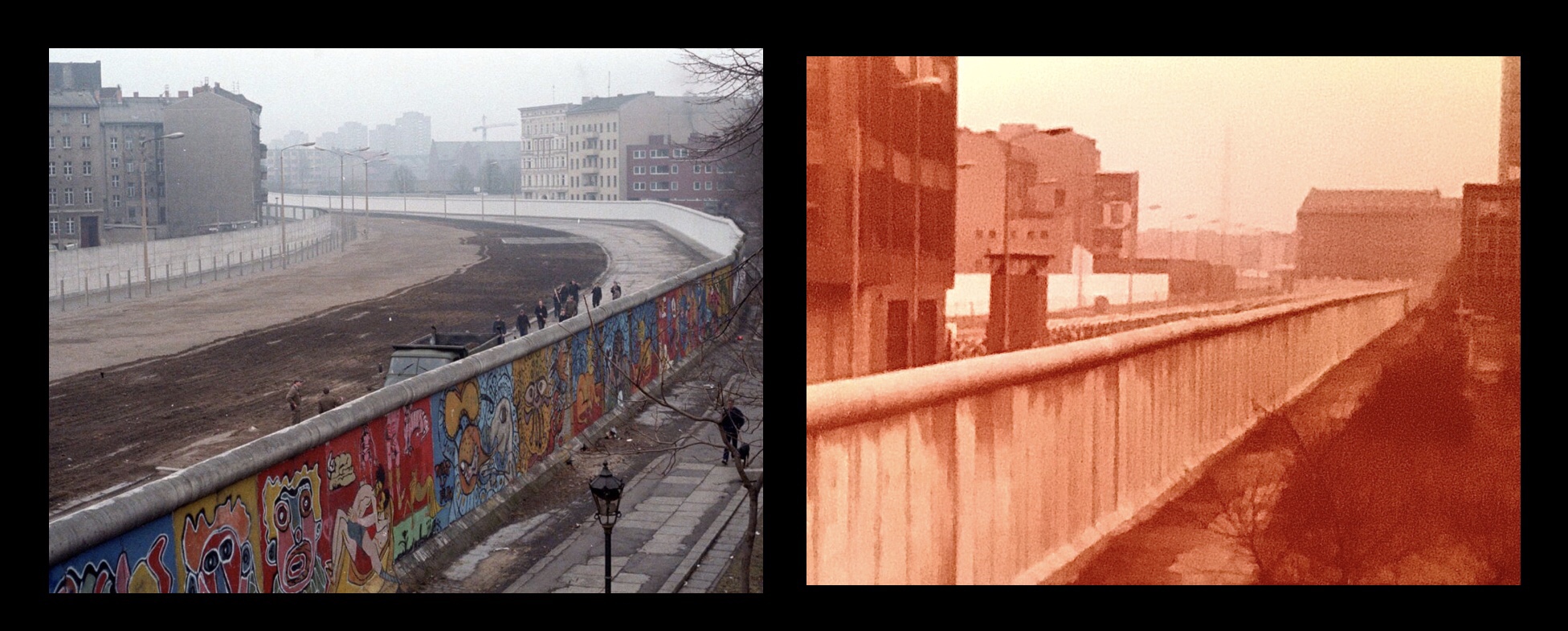
Many of those stories happened when East Germany built the Wall in 1961 to keep people from leaving for the Western sectors. They created a whole new level of aberration – Guard towers, zones of death, dog runs, bunkers and an 87 mile long wall – all to keep people in the Eastern Zone. Over the next 28 years, 5,000 people would escape from East Berlin, while more than 200 were killed trying.
The Wall. In the left picture you can see the “zone of death”. In the right, one of the Guard Towers
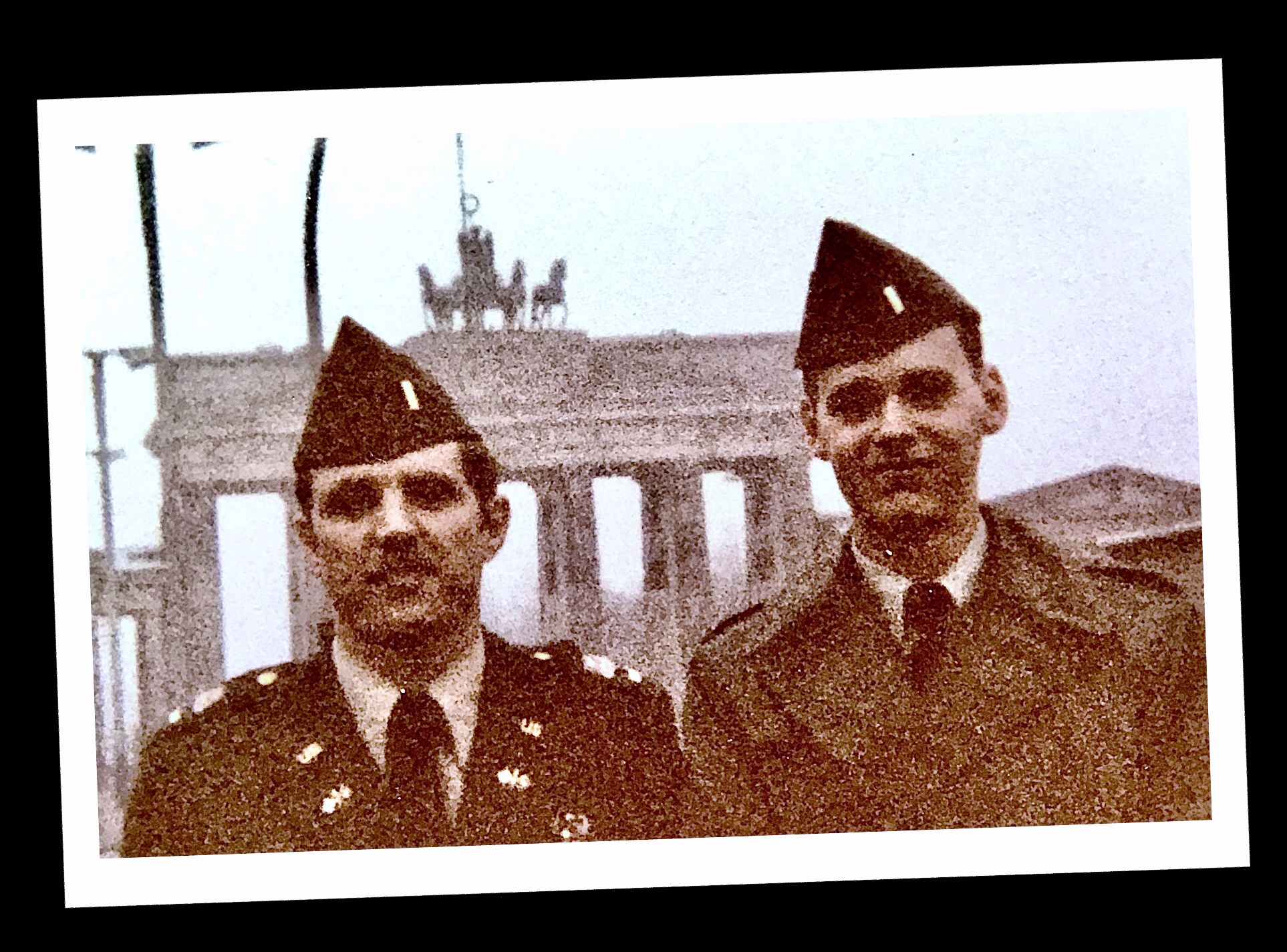
Cath and I made it to West Berlin twice during our time in Europe, once by train through East Germany, and once by plane, flying into Tempelhof. In addition to good food and bier, we of course saw Checkpoint Charlie, the Brandenburg Gate, the Reichstag, the Wall, and many other sites. We also visited East Berlin on one of those trips. As a GI, you needed a special pass and to be in uniform. If not in uniform, you were considered a spy. While there, we saw the Brandenburg Gate again (from the East), some memorials and did a bit of shopping. Parts of East Berlin looked much as it did immediately after WWII, with bullet holes still evident in the walls of homes. Seeing both sides of Berlin provided a huge contrast between the vibrancy of West Berlin and the starkness of the East. It was almost like having a color film suddenly turn black and white.
Lieutenants Hall and Chase in front of the Brandenburg Gate in East Berlin
Five months after Cathy and I returned to the States in June of ‘89. the Wall “fell” on November 9th. We watched in wonder, as TV coverage showed people sitting on the wall drinking champagne, while others hit it with sledge hammers. It was a surreal moment because of the cruelty and suppression it represented, and the beginning of the end of the Cold War. We drank a bottle of champagne ourselves that night.
A crowd gathers at the Wall near the Brandenburg Gate, Nov 9, 1989.
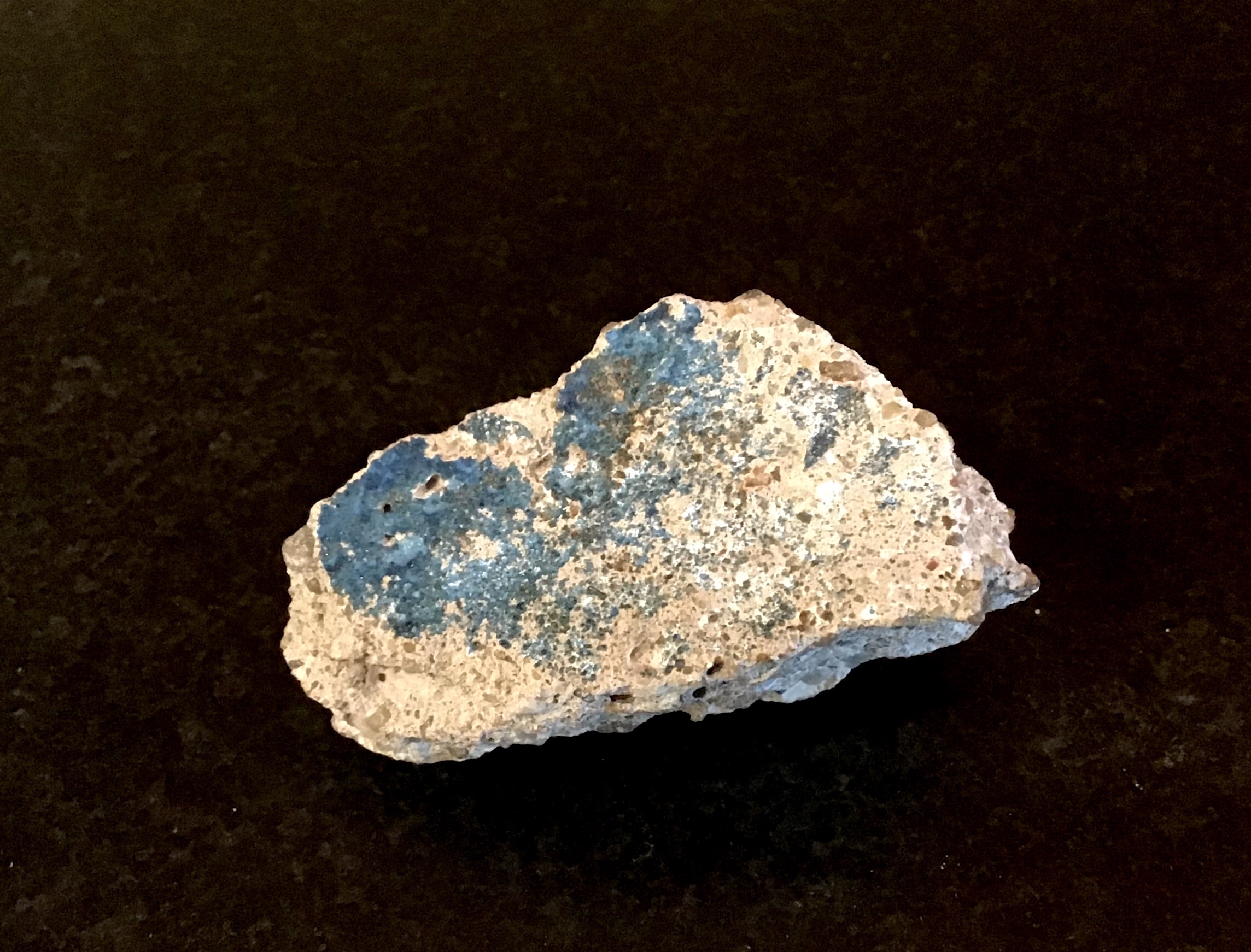
Eight months later, in July of 1990, our friend Dave who was still stationed in Germany, attended the “The Wall – Live in Berlin” concert organized by Roger Waters of Pink Floyd. The concert was held near the Brandenburg Gate in Berlin. While there, Dave collected several pieces of the wall as mementos. Later, he generously gave us one. That small piece of concrete with a smear of blue paint across it now sits in a curio case in our front room.
Our piece of The Berlin Wall
Glasnost followed over the next couple of years, and the Cold War with the USSR came to an end. I left the Army in 1992 to pursue other opportunities. It seemed the United States, and the world, were on track for more peaceful times.
Of course, we all know what has happened since then.
Looking at the faded pictures of Lieutenant Hall, and the little piece of blue painted concrete now, I remember those times, and the mission we accomplished. Did we gain anything? Yes, but in the end, how much did it matter? The world remains a dangerous place and in the long term, there is always a new risk around the corner. We fight our wars and finish them. Then our soldiers wait, and prepare for the next one. Currently, they are waiting in nearly 150 countries around the world.
Addendum:
Special thanks to my wife Cathy for help in recollecting memories of our times there, as well as editorial support. Also thanks to Colleen Conroy for her always helpful editorial support.
* Hal Moore, along with Joe Galloway wrote the book ”We were Soldiers Once, and Young”. The book is a classic and tells the story of the battle in the la Drang Valley in Vietnam in 1965. It was the first large scale combat between US Forces and the North Vietnamese. The movie came later with Mel Gibson. If you get a chance, read the book. It’s much better.
** The EUCOM ASH Bunker – The bunker was actually built in 1942 during WWII. In the 1980s, it received a major upgrade and was a designated alternate HQ for the EUCOM, should forces in Europe be overrun. It was built to survive, even in the event of an ElectroMagnetic Pulse (EMP) nuclear attack. I spent quite a bit of time working there between 1986 and 1988. You can read a bit more about the site here. https://www.bucksfreepress.co.uk/news/13486789.wycombe-abbey-school-opens-former-wwii-and-cold-war-bunker-for-one-visit/
Here are some past blogs about my military time in Germany.
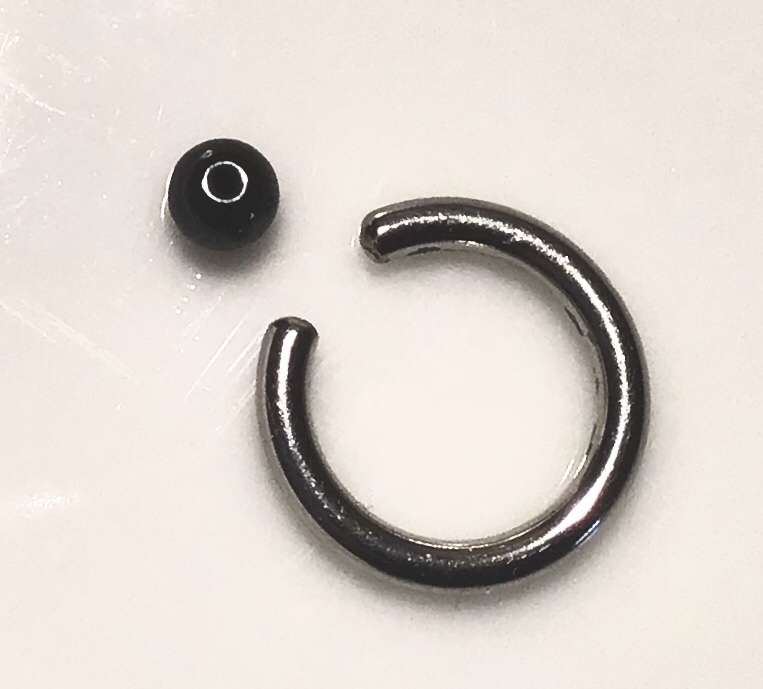
My brother (in law) Don passed away a year ago on October 20th, 2019. We still grieve his loss. Having said that, I’m a big believer in keeping the memories of those who have gone before us alive, by remembering the good times we had with them. Here is one of my favorite Don memories. It involves Don, Bonnie, Her Belly Button Ring, and a pair of channel locks….
In June of 2000, Cathy visited Bonnie and Don in Sausalito, California. I had to work at the time and couldn’t make the trip. While there, The Sisters of No Mercy (as Cathy and Bonnie are known in some circles), along with another friend, decided to have their belly buttons pierced. Jason, the gentleman who did the piercing and put the rings in, gave them specific instructions, including: 1 – Move the ring around a bit every day; 2 – Apply a sea-salt solution on a daily basis for six months to insure the piercing heals properly; 3 – Don’t take the ring out for six months to keep the piercing clean; and 4 – no swimming or hot tubs for six months.
For the next three months, The Sisters both diligently cared for their bellies and their belly button rings. They checked in with each other on email and via phone. The rings were doing nicely, and there were no issues.
Then came Labor Day weekend. On the Friday of that weekend, Cathy and I flew to San Francisco for a visit with Bonnie and Don in Sausalito. We were looking forward to the time together, prior to a longer vacation on the California coast.
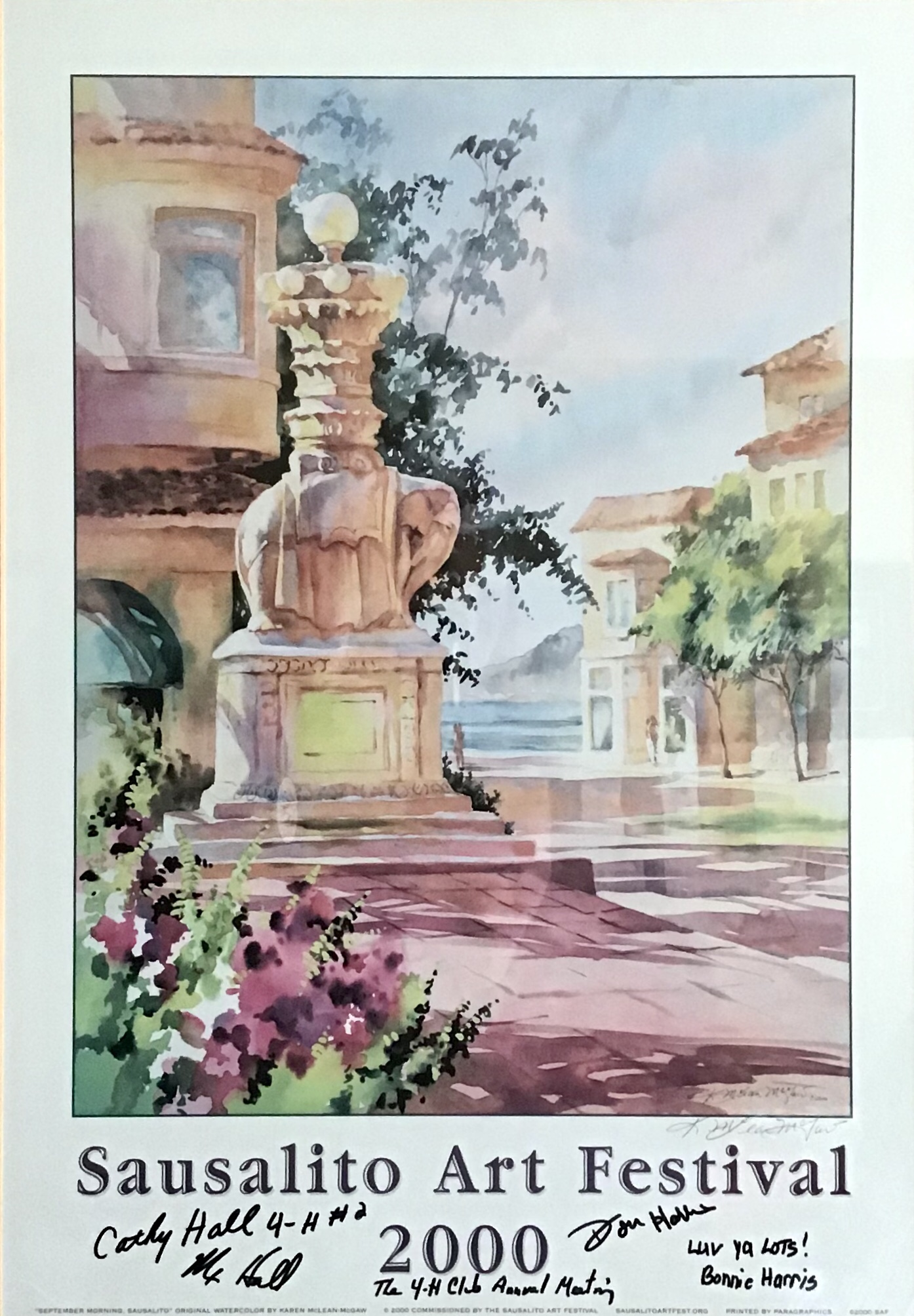
On Saturday, after a big breakfast, we walked about a mile to the Sausalito Art Festival. The Festival was held every year on Labor Day Weekend at the waterfront and was quite the event. Art of all kinds was on display and for sale. There were a number of bands playing throughout the day, and they had wonderful food and drink to keep you sated. It was our kind of place. We started the day wandering through the displays, listening to the music and drinking champagne. Cathy and I bought a print of two tulips, and Don and Bonnie bought a painting of two chairs facing a lake. He called the painting “Retirement”. I snuck off and bought Cathy a pair of earrings for Christmas at one point. The weather turned warmer, and the boys switched to beer, while the girls stayed with champagne. We eventually settled in front of one of the stages and had some food while listening to a band. We christened ourselves the 4-H Club, and later, bought a poster to commemorate the day. It was a great way to spend a Saturday afternoon.
Poster commemorating the meeting of the 4-H Club…
As afternoon turned to evening, we packed up and made the trek back to Bonnie and Don’s. We were going hiking at Point Reyes the next day, so the thought was to just have a quiet relaxing evening at home.
We were sitting in their Family Room drinking some wine, when all of a sudden Bonnie said “UH OH!”. We all looked at her.
“The ball closure just popped out of my belly button ring!”
Silence on our part, as the three of us looked at Bonnie.
Bonnie kept playing with the ring, but couldn’t get the ball to lock back into the ring. After a bit of time passed, Cathy went over to Bonnie to see if she could assist in putting the ball back in the ring. More time passed, and still the belly button ring refused to cooperate.
Don, being a man and having a penis, then said something like “Let me take a look. I’m sure I can get the ball back in” and went to assist Bonnie. Cathy stood up and got out of the way, while Don started “helping” Bonnie.
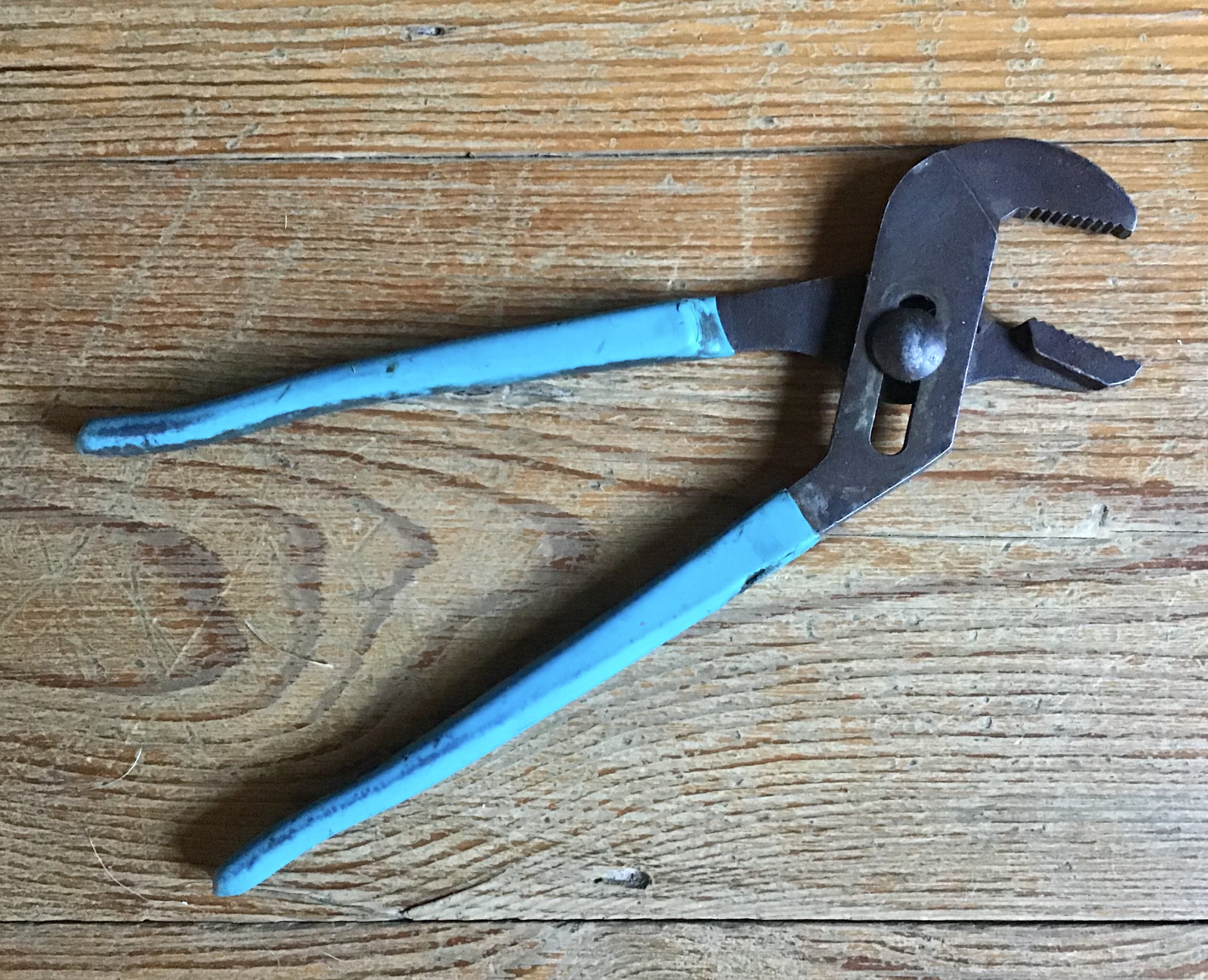
Time passed. Then a bit more time passed. Things were, perhaps, becoming a bit tense when suddenly, Don said “Max, go get the channel locks”.
Me: “What”?
Don: “Go get the channel locks. They are in the garage on the work bench. I need them to hold Bonnie’s belly button ring steady”.
Me: —silence—, then “OK, I’ll be right back”.
I went out to the garage and found the channel locks where Don said they would be. I returned to the house and handed them to Don.
The Channel Locks….
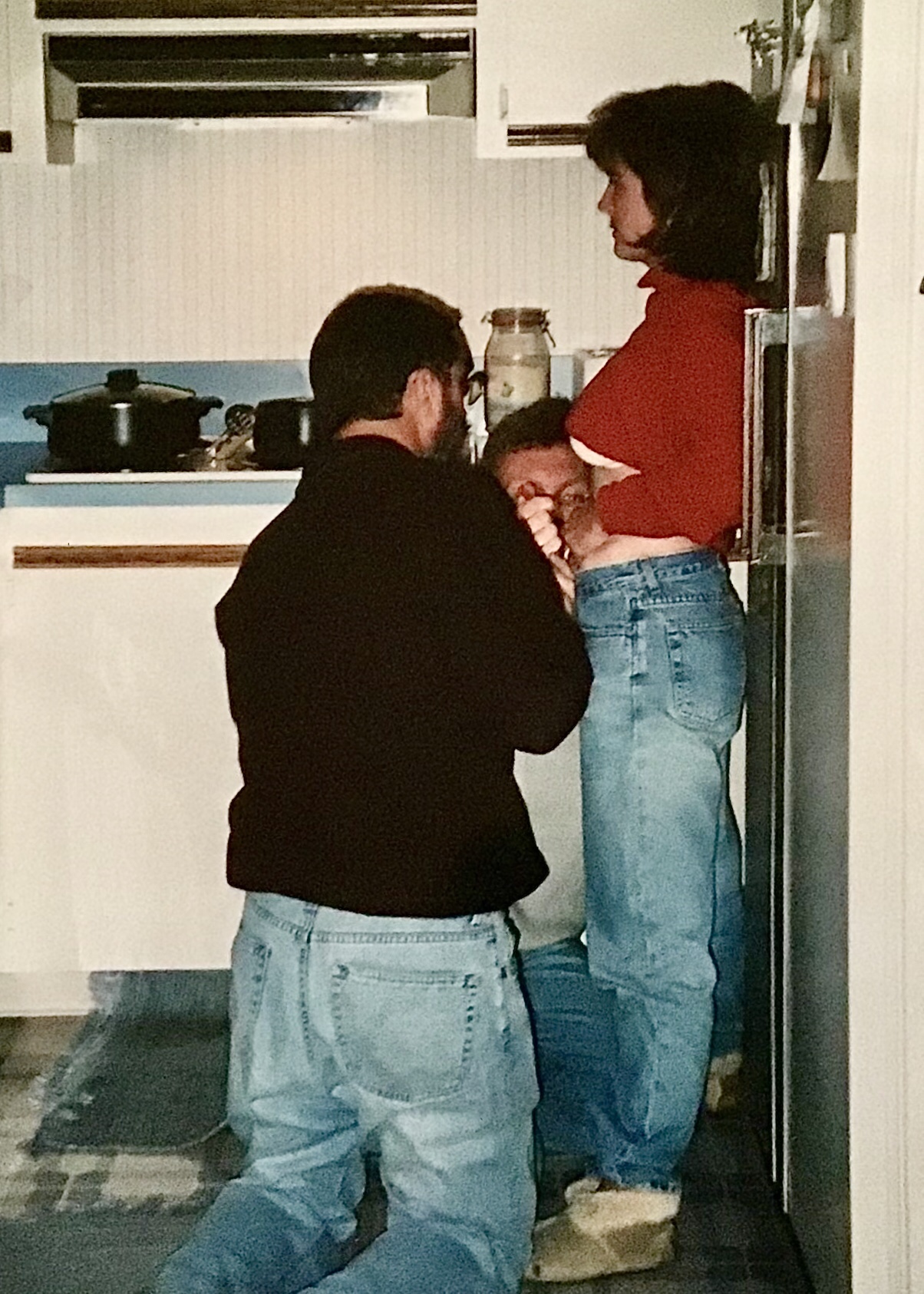
Don was at Bonnie’s knees trying, not very successfully, to hold her belly button ring with the channel locks, while inserting the ball with his other hand. Cathy and I watched from nearby. Finally he said “Max can you hold the ring with the locks? If you are able to do that, I think I can insert the ball”.
I knelt next to Don, grabbed the locks, and put a hold on the belly button ring. Don then attempted to insert the ball multiple times and failed. The ring moves around a bit in the locks with each attempt. This was not good. Things were definitely heating up, until finally all four of us were talking at once.
Holding the channel locks, while Don attempts to insert the ball in Bonnie’s belly button ring
Suddenly, Bonnie, in a loud voice said “WE ARE DONE HERE! I WILL PUT A BANDAID ON THE RING TO HOLD IT IN PLACE”. Then softer “Tomorrow, we’ll see if Jason can fix it”. Bonnie put a bandaid on the ring opening and we all retired to the family room. Needless to say, the rest of the evening was pretty quiet.
The next morning, Bonnie called Jason’s shop and said she had a small problem, could she drop by. He was open, and she could indeed come to the shop. His place was on the way to Point Reyes, so we all drove together, planning to go directly to our hike from his shop.
We arrived at Jason’s and he greeted Bonnie and Cathy warmly. Bonnie explained about the ball popping out, while omitting the multiple strategies and attempts to put it back in. Jason said no problem, let’s have a look.
Bonnie went into a separate room with Jason and he took a look at the ring. Then he pulled out a magnifying glass to look at the ring and we heard him exclaim rather loudly “Oh my God! What’s happened to the ring?! There are scratches all over it. This will tear up your skin! We need to replace this ring”.
Don and I looked at each other and then quickly looked down. We didn’t say a word. We could hear Bonnie speaking in a muffled voice with Jason in the next room. A few minutes later they came out, and Bonnie had a new navel ring. Jason looked at Don and I intensely, but didn’t say anything. Bonnie paid, and we continued to Point Reyes for our hike.
I suppose, in retrospect, using channel locks to hold the ring may NOT have been the best possible solution. Could it be, with all of the good times at the Festival, both our judgement, and our steadiness may have been slightly off? Nah…. 😉
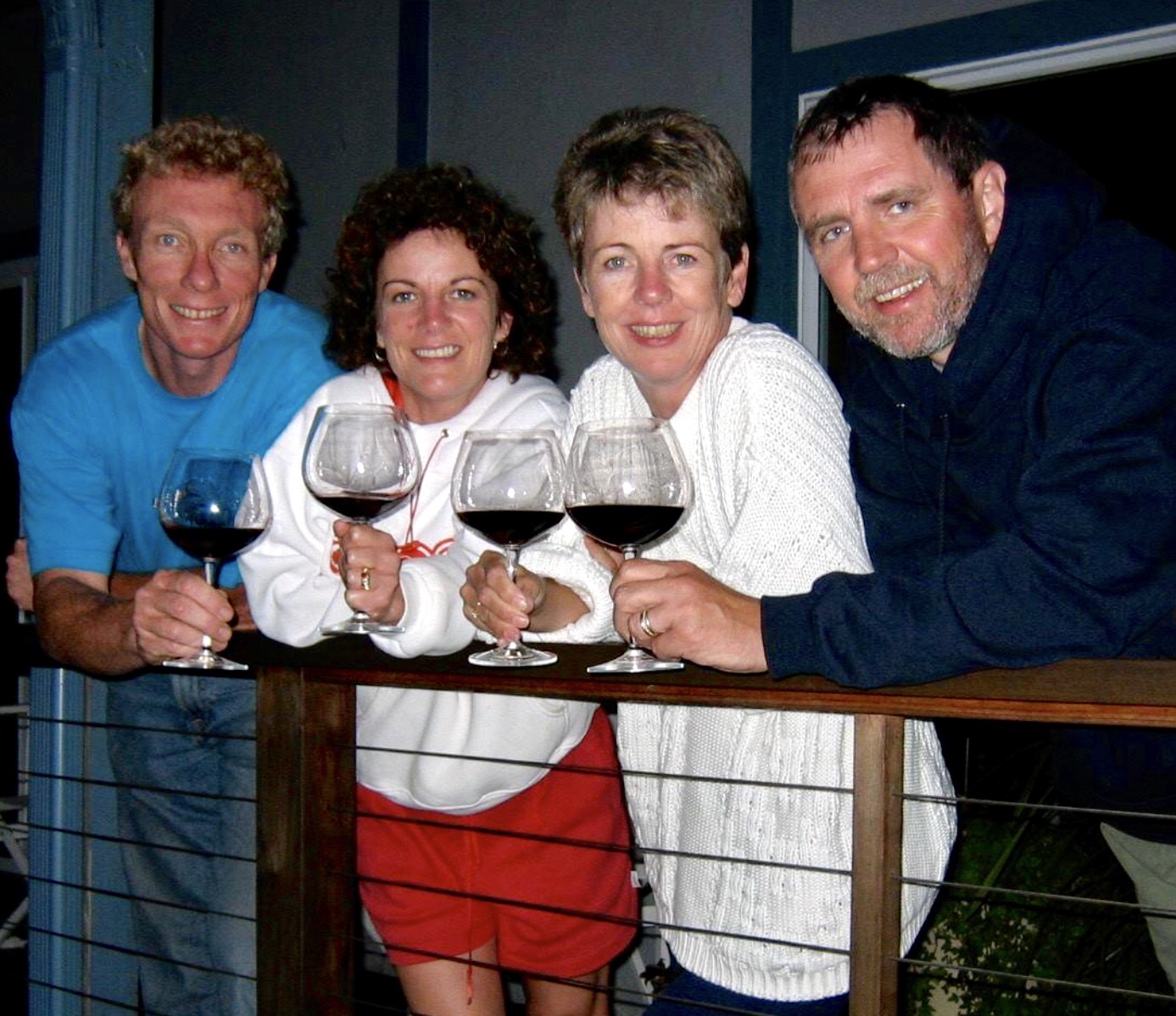
John Lennon said “Life is what happens to you while you’re busy making other plans”. The 4-H Club had a lot of great adventures over the years. While some were planned, this one definitely wasn’t. Aren’t the unplanned ones often the best?
The 4-H Club sending “Cheers!” to everyone
…
Over the course of my life, I’ve had many good friends. I’ve also been blessed with two friends I have loved like brothers. Don was one of them. I miss him tremendously. Although he died doing what he loved (surfing), he still died way too young. I’ll do my best to tell the stories, and promise to keep his memory alive. As a friend, a brother, and one of the two guys married to The Sisters of No Mercy, I owe him that.
“God has made everything beautiful for its own time. He has planted eternity in the human heart, but even so, people cannot see the whole scope of God’s work from beginning to end”. (Ecclesiastes 3:11).
Addendum:
This write up, by coincidence, is occurring at the five year anniversary mark of when I started my blog, “Live Life Exuberantly” . It seems fitting this anniversary blog is about Don. He was someone who knew how to live his life exuberantly, and did so.
John Lennon sang “Life is what happens to you while you’re busy making other plans” in the song “Beautiful Boy”. Variations of those words were around for at least two decades prior to Lennon’s usage. A version was attributed as early as 1957 to cartoonist, Allen Saunders, who worked on the comic strips “Steve Roper” and “Mary Worth”.
It was in October, 1981 when Lieutenant Colonel (LTC) Rex Pierson came in my office and asked “Who is the Duty Officer this Sunday?” I checked the roster and said “2LT Smrt”. He answered back “You need to redo the schedule and appoint yourself as Duty Officer. We may have trouble from the Nuclear Missile Protests”.
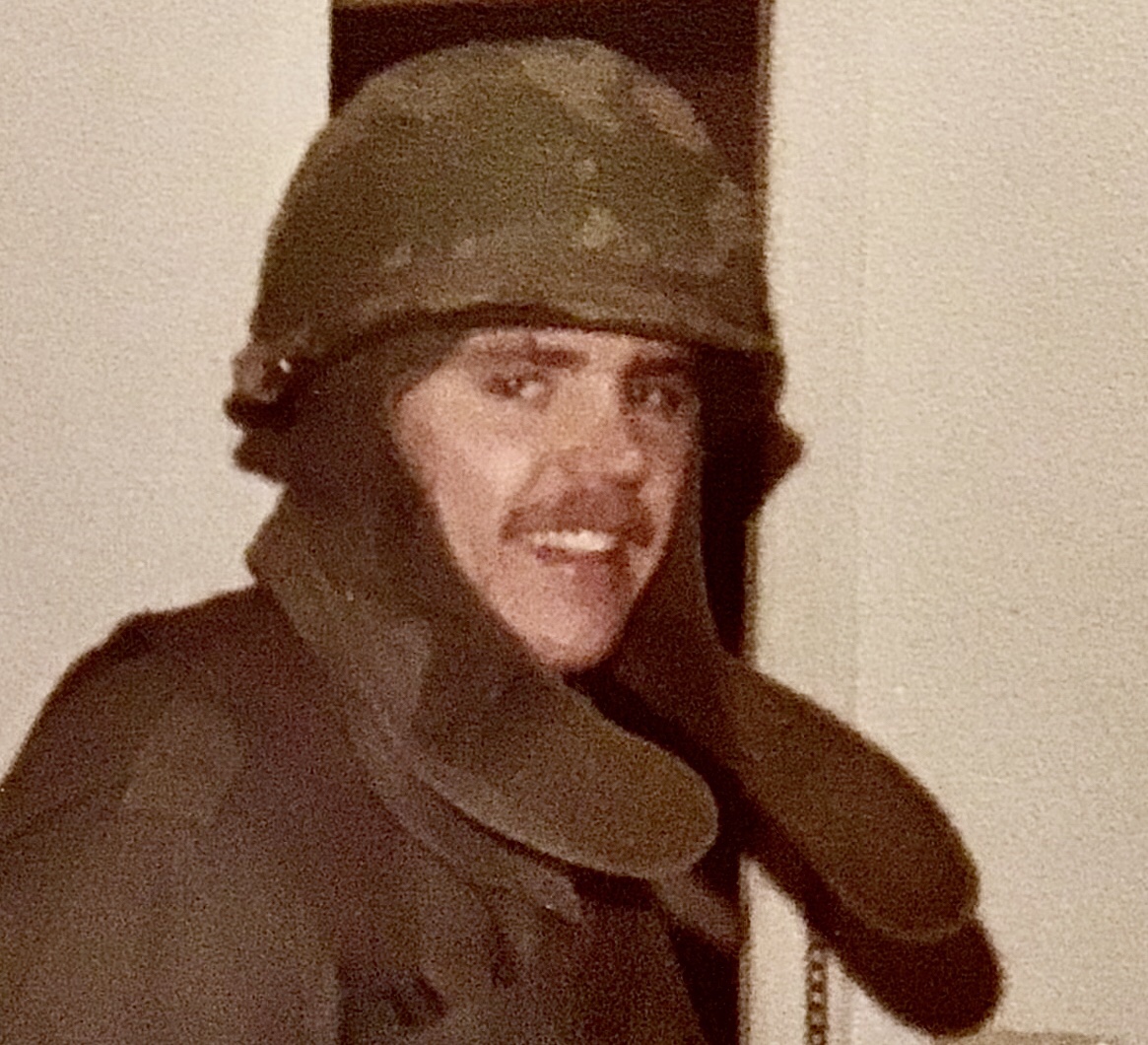
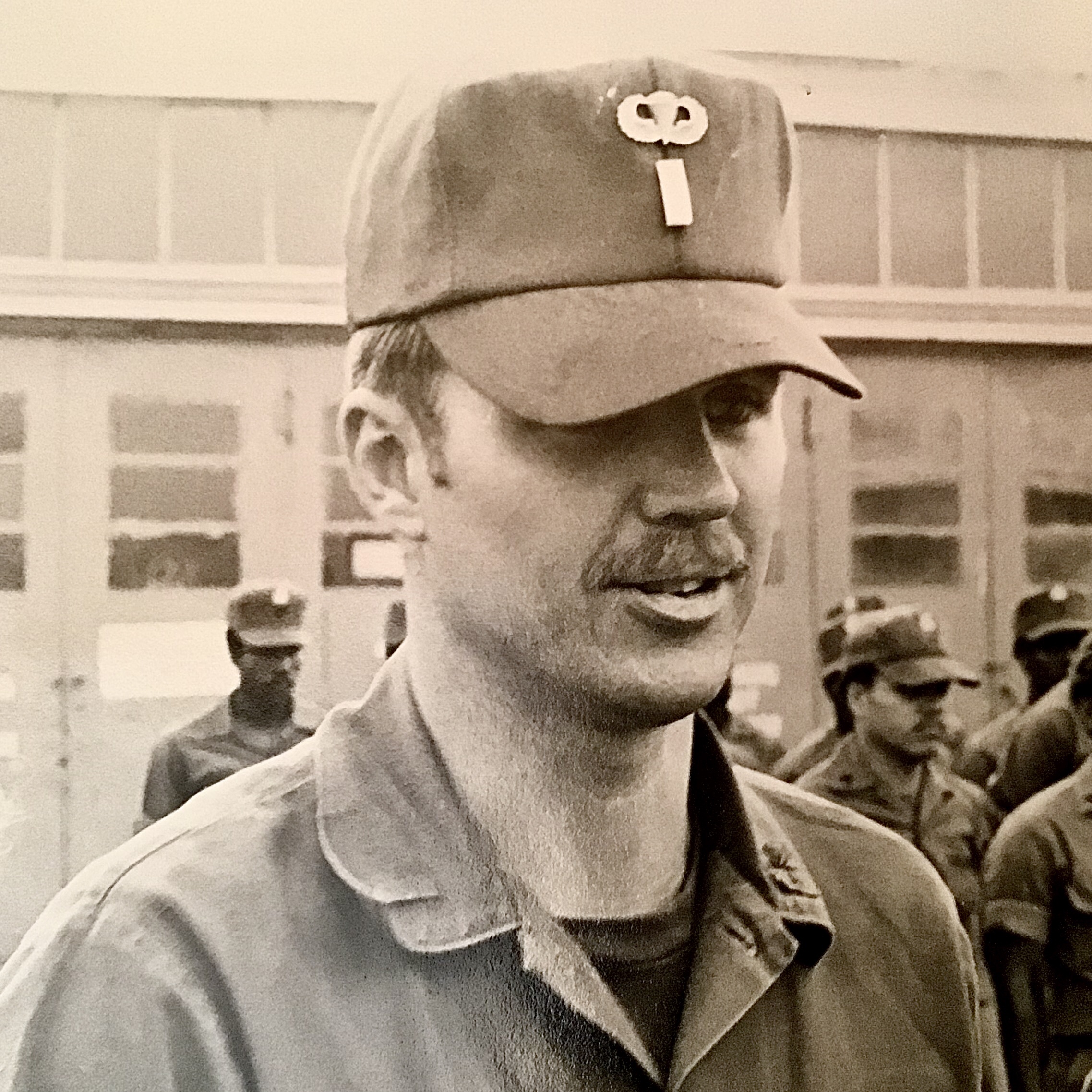
This is me, about the time of the incident
I was a First Lieutenant (promotable)* and the Battalion Adjutant for the 123D Signal Battalion, 3rd Infantry Division. One of my responsibilities was to maintain the Duty Officer roster for the battalion. The Duty Officer was “responsible” for the battalion during non-duty hours, when the officers and senior NCOs were not at work. Since the 123d was isolated at Hindenburg Kaserne (army post) by itself, our Duty Officer was also responsible for all activities on the Kaserne. On weekdays, the Duty Officer served from 5PM to about 6AM the following day. On weekends, your tour went from 8AM to 8AM the following day.
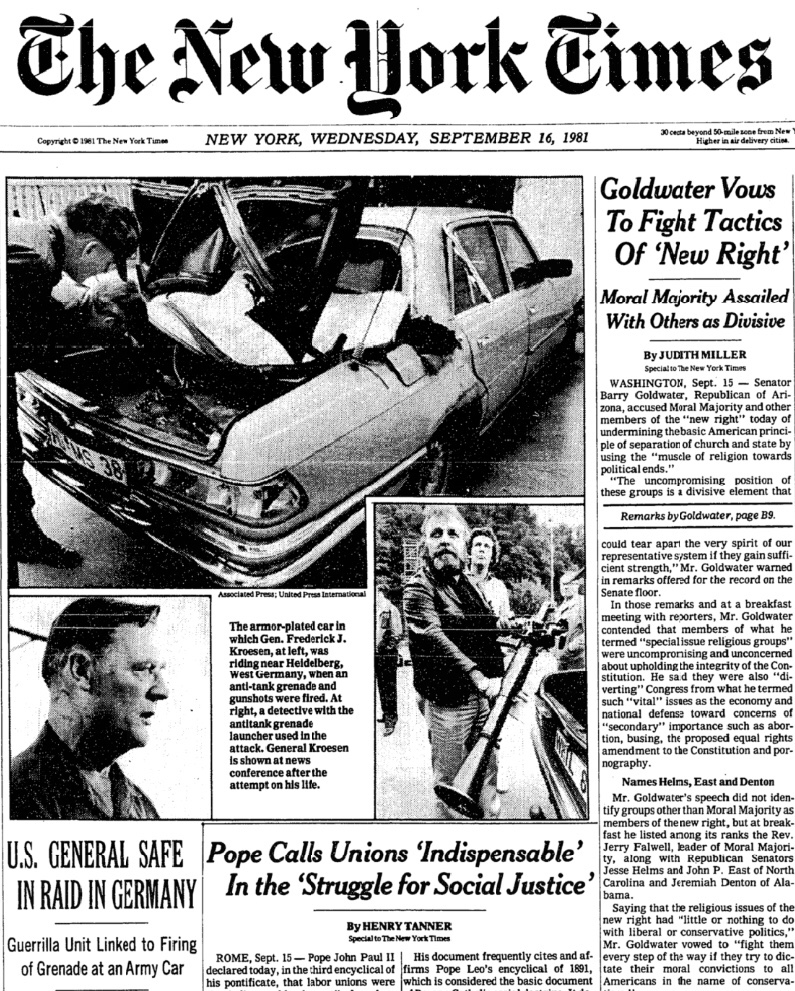
Things were a bit tense in West Germany that Fall. In August, a large car-bomb exploded at Ramstein Airbase, wounding twenty people. Responsibility for the bombing was claimed by the Red Army Faction, also known as the Baader Meinhof gang. In a letter, they declared “we have undertaken a war against imperialist war.” On September 14th, there were violent protests in Berlin, coinciding with a visit by Secretary of State Al Haig. Over 50,000 people took part in the protest. Two days later, on September 16th, the Baader Meinhof gang struck again with an assassination attempt on General Frederick Kroesen, the commander of all United States Army forces in Europe. Using a Soviet made grenade launcher, they severely damaged his car, but the General and his wife were unharmed.
The NY Times coverage of the attack on General Kroesen
On Sunday, October 11th, a massive protest was scheduled to take place against the deployment of US made medium-range nuclear missiles in West Germany. At the time, the decision to deploy the Pershing II and cruise missiles, which could reach Moscow, was viewed by many as an escalation of the arms race and could put Europe on the brink of nuclear war.
This was all part of the backdrop for LTC Pierson’s visit to my office. The main protest was to be in Bonn, the Capitol of West Germany, while scattered protests were expected in other cities. Based on recent history, concerns were legitimate that things could turn violent, or the Red Army Faction would infiltrate the protests and incite violence against US facilities. As a result of these concerns, not only did Colonel Pierson want me as duty officer, he wanted me armed. Normally, the Duty Officer in the 123D, did not carry a side arm, or ammunition. October 11th would be different. I was to carry my 45 (.45 Caliber pistol) and two clips of ammunition.
October 11th dawned and I was at the Kaserne early that morning. I checked in with our company’s armorer and drew my 45 and the two clips. I strapped the 45 to my hip, while the two clips went in my shirt pocket. I then went to the battalion headquarters and relieved my predecessor.
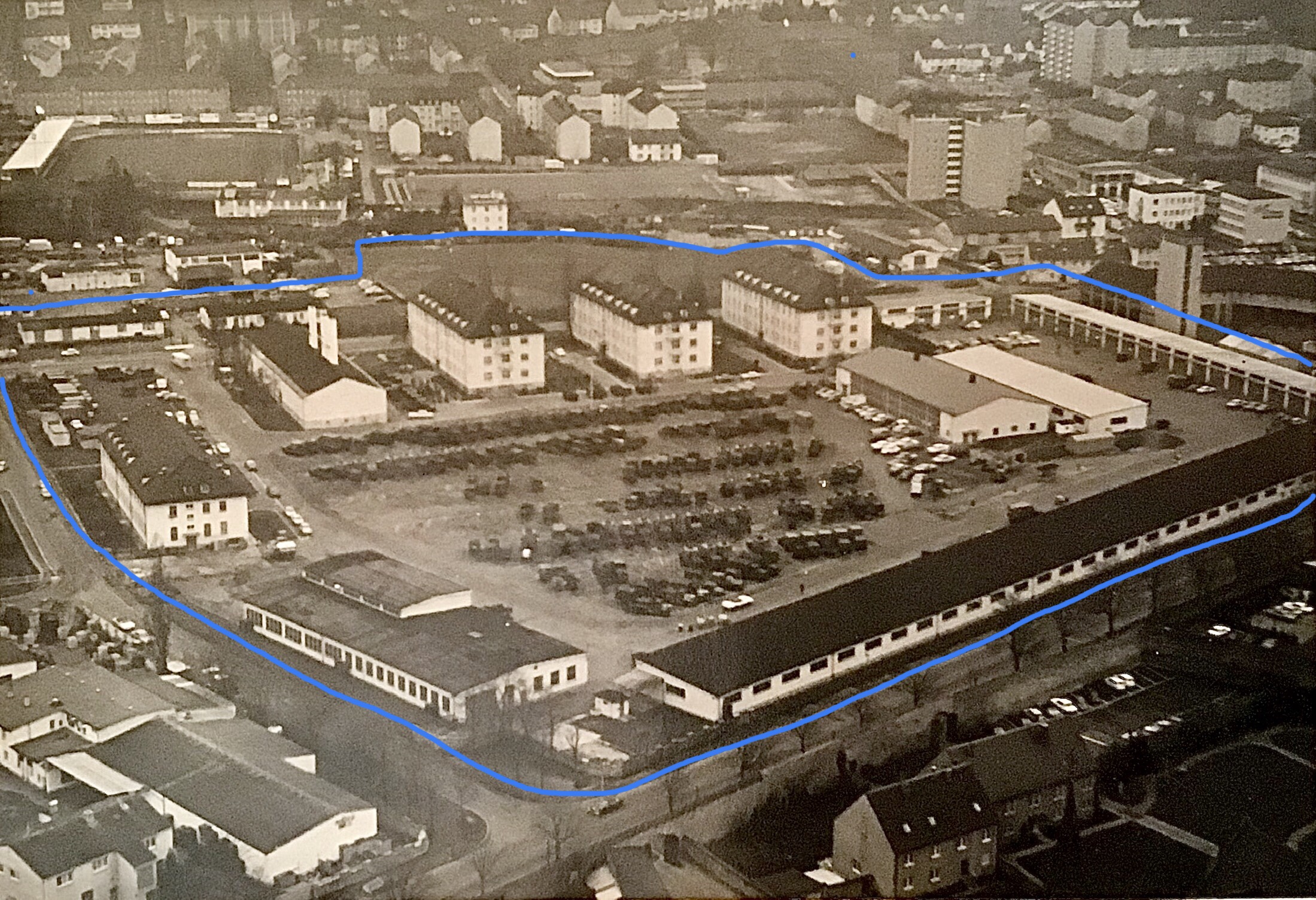
The Duty Non Commissioned Officer (NCO) and I had taken what precautions we could ahead of time. We agreed to spend more time watching the perimeter of the Kaserne and had drafted a few soldiers from my old platoon to act as observers. They were to notify us immediately of any suspicious activities. Hindenburg Kaserne was only about two or three blocks square, so it wasn’t difficult to view the entire facility from a few locations. The walls surrounding the Kaserne had barbed wire in some locations, but not all. Some of the buildings were directly on the surrounding streets with no wall separating them. The back of the Kaserne bordered a small park, and we had concerns people could slip through the woods in the park and approach us from that direction, so greater surveillance was placed there.
Hindenburg Kaserne
The day passed slowly and quietly. We checked in with the MPs across town, and with 3ID Headquarters on a frequent basis. A small protest took place in our city of Würzburg, but it was peaceful. As day turned to night, Colonel Pierson stopped by. We toured Hindenburg, and he was satisfied with how things looked. After reminding me that other acts of violence had occurred under the cover of darkness, he left, and wished me a peaceful night.
Neither the Duty NCO nor I slept. We patrolled frequently and checked in with our observers regularly. The night passed without incident.
The next morning, we debriefed the commander and Sergeant Major when they arrived. I turned my 45 and ammo back in and went home for a few hours of sleep. The event was a nonevent, at least for Würzburg.
I later learned the protest in Bonn attracted over 250,000 people. At the time, it was the largest demonstration ever in postwar Germany. Two peace groups associated with the united Protestant Church in Germany chartered 3,000 buses and 42 trains to bring protesters from other parts of West Germany and neighboring European countries. With the opportunity to easily join the protest in Bonn, there were actually very few demonstrations elsewhere in Germany. The organizers policed the protest themselves and held the few trouble makers in check. Overall, it was a peaceful event.
In the years since then, I’ve thought about that day and night and what I would have done, if protests had come to our Kaserne, or someone had tried to breach our facility. If we knew a protest was imminent, we certainly would have called the MPs for support and they probably would have arrived in time. If something happened unexpectedly and an intruder (or intruders) gained access to the Kaserne, what would I have done? Called out my old platoon as a quick reaction force? Sure. But what if it happened suddenly and I was alone? Try to talk to them? Fire a warning shot? Shoot the person? I like to think having the clips in my pocket and not locked and loaded would have enabled me to take some time and behave in a reasonable way, but I don’t know that for sure.
Our lives are defined by the events that happen in them, and sometimes by those that don’t. Looking back, I’m glad I never actually had to make a decision that day. Maybe things would have ended well, but maybe, just maybe, they wouldn’t have.
The classic novel, Once an Eagle, by Anton Meyer has a great quote – “if it comes to a choice between being a good soldier and a good human being – try to be a good human being“. On October 11th, 1981, I think I was prepared to be both. We try to prepare for realities, some of which never actually happen. Sometimes, it’s good they don’t.
Addendum:
The violence continued later that year. In December of 1981, Army Brigadier General James Dozier was kidnapped by the Red Brigade in Italy. He was rescued by Italian Police Special Forces, after 42 days of captivity.
* First Lieutenant (promotable) – I was selected for promotion to Captain earlier in the summer of ‘81 and LTC Pierson moved me from an assignment as a Platoon Leader to the Battalion Adjutant position, a Captain’s billet. I was promoted to Captain in January of 1982.
Second Lieutenant Chris Smrt’s name really was Smrt, with no vowels. I believe his family was originally Slavic.
Once an Eagle, by Anton Meyer was first published in 1968 and is a classic novel about warfare and leadership. It has been used at various times by West Point, The Army War College, and the Marine Corps for leadership studies. The book has also been on the Army Chief of Staff’s recommended reading list for professional development, and is currently on the Marine Corps Commandant’s recommended reading list. You can find out more about the book here: https://en.m.wikipedia.org/wiki/Once_an_Eagle
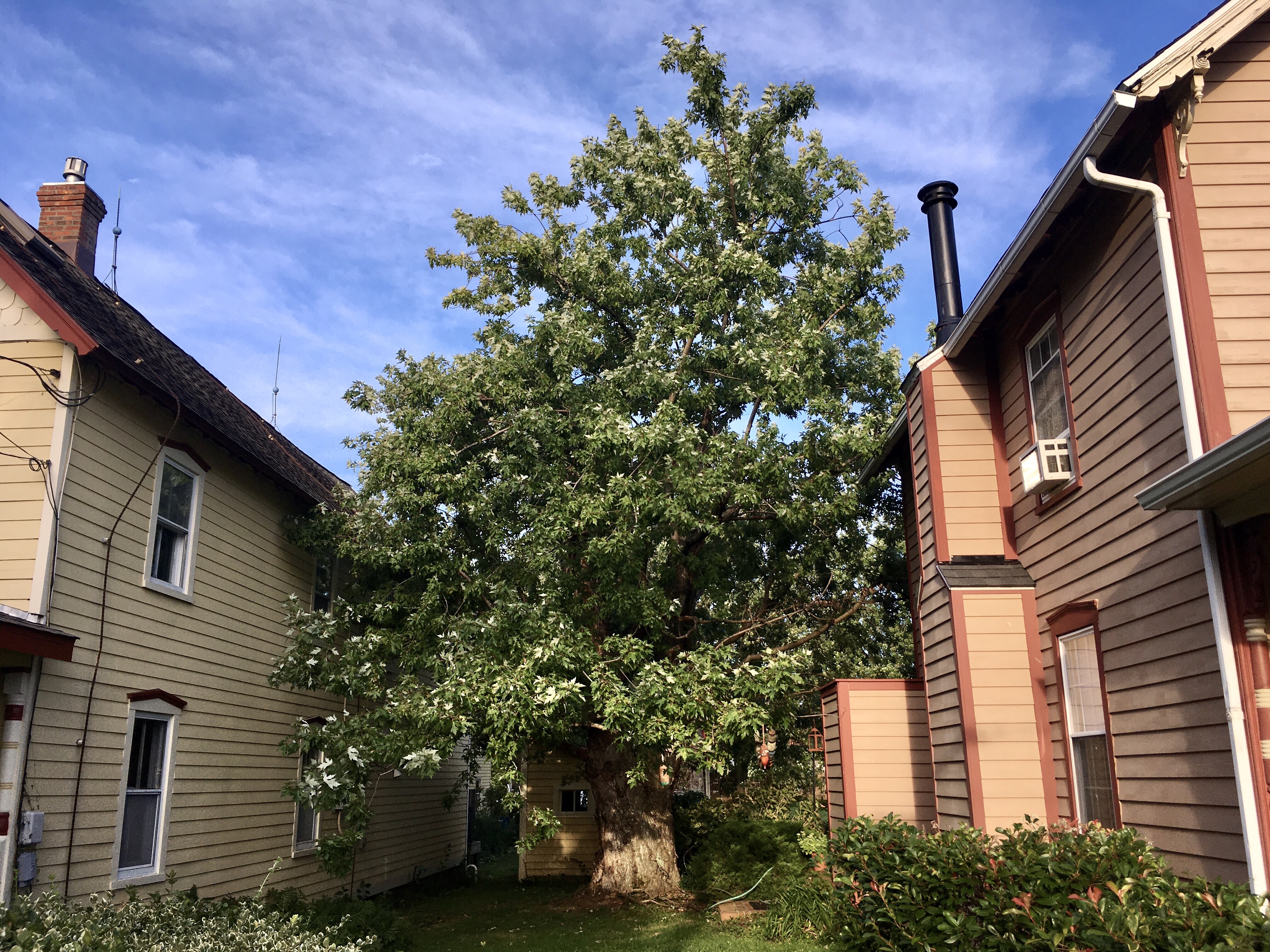
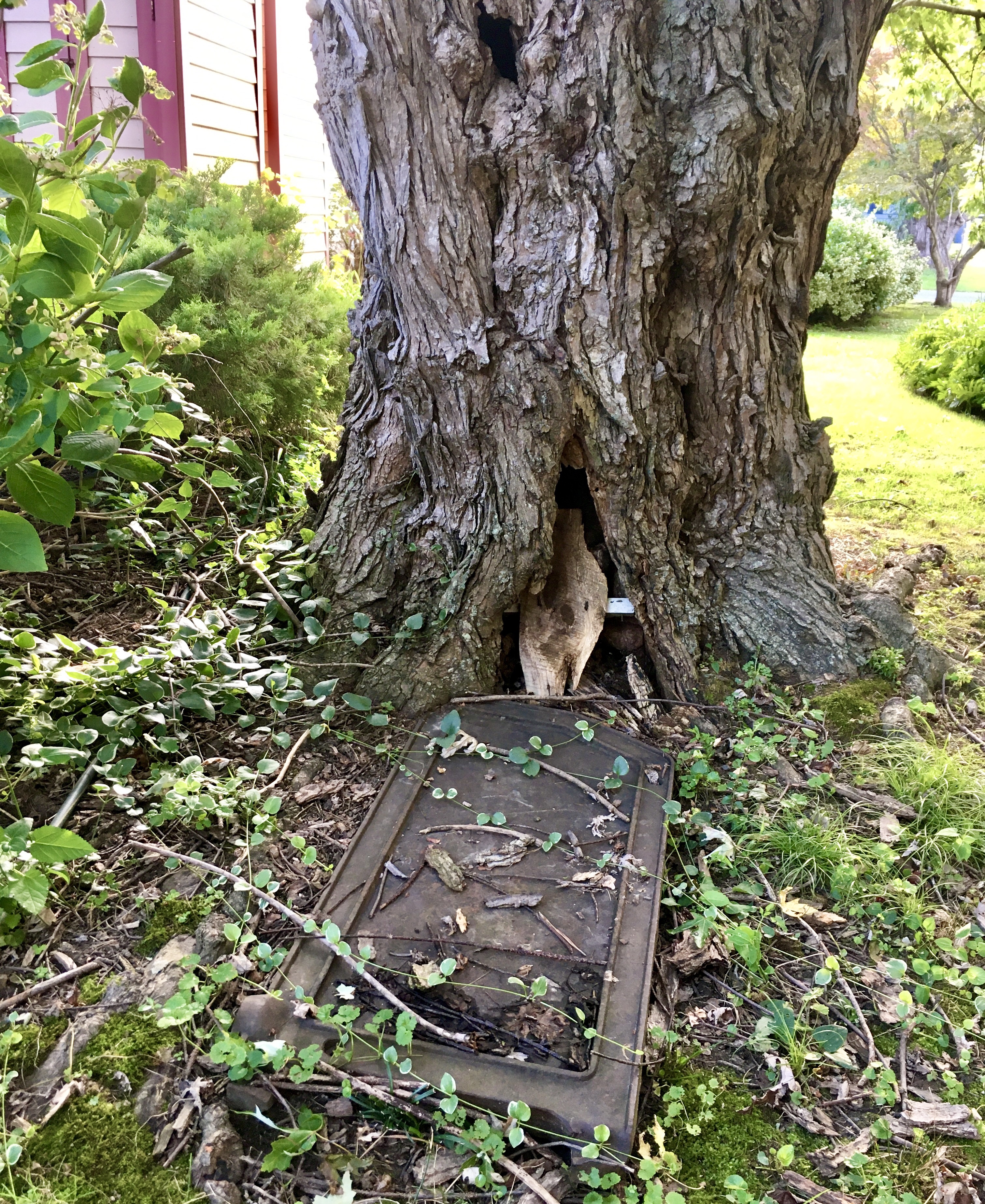
The Silver Maple sits on the property line between The Bayhouse, and our neighbor Vinnie’s home. It’s old and gnarled. Half the trunk appears to have rotted out from the inside. Vinnie says it looks like something that would grow at Hogwarts.
The Silver Maple – 14 feet from our home; 11 feet from Vinnie’s.
While not ancient, the tree is old. It’s 136 inches in circumference, which, according to tree guides, makes it about 130 years old*. Our home at the Bay was built in 1890, so maybe the people planted this tree around the time they built the house. Or perhaps it was already here, and they built the home next to the, then, small tree. The Faulkner store and house (Vinnie’s home now) weren’t built until 1912, so it’s entirely possible they planted it, not thinking another house would be built so close.
Now, it’s hoary and contorted, and probably doesn’t have many years left. A Silver Maple at 130 years of age is considered quite old. A storm, or lightning, broke the top two main trunks off the tree sometime in the past, so it’s not as tall as it once was. Instead, it has that knobby, twisted, slightly wizened look that old trees, and some old people develop. A bit of a Halloween look, if you will. There’s also a metal “door” of sorts embedded at the base of the tree. I’ve tried to lift it, or move it, but it won’t budge. At some point in time, I fully expect Christopher Walken, as The Headless Horseman, to emerge through the door.
Where’s Christopher Walken when you need him?
Vinnie is right, there is a bit of Hogwarts about the tree, although for my money, it looks more like an Ent**. If only it could talk. I think about what it has seen with the passing of time – it could tell a tale or two.
Many different families have lived in our home since 1890, but no one ever chose to take the tree down, even though it has hung over the top of the house. The tree has survived hurricanes and Nor’easters over the years, including Isabel in 2003, which tore out the County Dock, not 50 yards away. In June of 2011, a derecho came across Tilghman and toppled several old trees on our street. This was the day before we put an offer on The Bayhouse. The sound of chainsaws filled the air as we looked at the house, and the tree for the first time that day. Neighboring trees had splintered or blown over, but our Silver Maple was untouched.
The tree is gnarled, stunted and twisted, but it’s still here. Maybe John Prine is right and “… old trees just grow stronger”. Every year in springtime, it produces whirligig seeds. The leaves pop out, and it again shades our back porch, and house. We’ve strung old floats and crab pot markers in the branches, giving it a more festive look. Lunches on the porch are nice. Having a candlelight twilight dinner under it’s branches is always a special evening.
Good for a few more years, I think….
Some folk, who are either wiser, or more cautious, have said it’s time, we should take the tree down to prevent it from falling and causing damage. We politely thank them for their advice, but look at each other and know that’s not going to happen. I’m not sure why, but in our minds, the tree has earned the right to be here a while longer. I don’t know how many years it has left, but I think at least a few. We will enjoy this Silver Maple for as long as we can.
Addendum:
* I found a couple of different ways online to measure the approximate age of a tree. The most common method was to:
– Measure the circumference of the tree at 4 1/2 feet from the base – Divide the circumference by Pi (3.14) to get the diameter – Multiply the diameter (in inches) by the tree growth factor (3 for a Silver Maple). This gives you the approximate age.
For this tree, the circumference at 4 1/2 feet was 136 inches – 136/3.14 = 43.31 inch diameter – 43.31 x 3 = 129.9 years
While not exact, the method is a good approximation. Interestingly, another method I used (measuring a foot off the ground) came up with almost exactly the same age. Perhaps the tree isn’t 130 years old, but I have to believe it’s at least 108. Vinnie’s house was built in 1912. No one would plant the tree right between the two homes, fourteen feet from our house, and eleven feet from Vinnie’s. No one.
** Ents are the Tree Herders in the book and movie The Lord Of The Rings by JRR Tolkien. They look like old trees, and can talk and walk.
Thanks to my old friend Tim Stouffer for the John Prine quote.
Fairbank, our little two street village here on Tilgman Island, looks much as it did in a map from the 1930s. The makeup of the village though, has changed significantly. Back then, many of the villagers were watermen, working the Bay for crabs, oysters, and fish, or in fishing related industries. Today? About half the homes are owned by “part timers” such as ourselves, or retirees who have moved here. There are still a few families with connections to the Bay. Fritz, a waterman in his youth, now owns a local lawn service. Chris and his wife Christine moved here a few years ago. Chris is an active Waterman, and part time boatbuilder. Captain Stanley Larrimore, a 90 year old local legend, still lives across the street from us. He sailed and worked his Skipjack, Lady Katie, on the Bay for decades.














 Live Life Exuberantly