Harare

Two parties were the bookends for our time in Harare, Zimbabwe. The first was at Roseanne and Sinks’ place and was our welcome to Zimbabwe. The second was at Peter and Judy’s, two new friends we met at the Hash run.

Soweto

Cathy and I had arrived in South Africa a couple of days before. The flight to Johannesburg is 17 hour long, so we wanted a recovery day before heading to Zim. After sleeping in that first morning, we spent a half day touring Soweto, the slum area where the school riots had ignited in the ‘60s, helping to set South Africa on the road to independence. It was interesting to see the area where Bishop Desmond Tutu and Nelson Mandela had lived at different times. Both went on to win the Nobel Peace Prize, although they didn’t know each other in Soweto.

The next day, we caught our flight to Harare, and linked up with the rest of our crew. Marty, Jim and Bill had arrived the day before, while Magoo got there in the middle of the night. Roseanne and Sinks, friends of Marty’s who had helped plan parts of the trip, were hosting a welcome party at their home. They would also travel with us for the houseboat trip on Lake Kariba.

We arrived at the party and Roseanne and Sinks greeted us like old friends. We hadn’t met in person yet, but had corresponded via email for several months and felt like we knew each other well. Also, all of us had run with various Hash House Harrier (H3) groups around the world and had that in common. The party was great fun and we met several local Hashers who were also invited. We spent the rest of the day eating, drinking, and making new friends.

On Sunday, we went to a festival at a local school. Think something like a county fair on steroids. The fair had everything from tractors to table linens for sale. We bought a few things, and then stumbled upon the gin tent. G&Ts with grapefruit slices proved quite refreshing.

Marty, Me, Magoo, and Sinks on trail with the Harare H3

Monday was spent touring Harare and a couple of its markets during the day, and then that night, we hashed with the Harare H3. A couple of the Hashers picked us up at our lodge and drove us to the start. Several of the people that night were folk we had met at Roseanne and Sinks’ two days before, so it was a bit of a homecoming, although it was our first time hashing with them. Later, after finishing the run, we had food and beers with the Hash. It was much like a hash back home, except shared mugs used during one part of the evening were washed with a bleach solution between drinks, due to the Cholera concerns in Harare. Later that evening Peter and Judy, two of the hashers, invited the six of us to their home for lunch.

The next day, we arrived at Peter and Judy’s a bit after noon. We were greeted with hugs and drinks. A few of the folk we had hashed with the night before were also there, and by now, we were all friends. Lunch went on for most of the afternoon, and there were lots of stories told of older times in Africa and Zimbabwe. In the late afternoon, we finally said farewell and walked back to our lodge. We needed to finish packing and get ready for our trip to Lake Kariba the next day. Our van was leaving at 6AM, and then we had a seven hour ride to Kariba. It would be a long day.

****

This is the first in a series of short blogs I will publish over the next several weeks, about our trip to Africa in September and October of 2018. I’m not trying to be exact in detail, rather, I’m trying to give a bit of the spirit or feeling of the various parts of the trip. Read at your leisure. Or not.

Zimbabwe

Countries: 3; Days: 35; Bags: 2

How often do you get to travel to a country where a coup d’état recently took place, Cholera, Typhoid Fever and Malaria are possible, and you need to carry cash because the financial infrastructure is in disarray? Cathy and I fly to Zimbabwe next Wednesday, as part of a three country, month long trip with a few friends. While each third of the trip has it’s own highlights, the two weeks in Zim are the most intriguing for me.

Zimbabwe has had a tough road for a long time. Formerly Rhodesia (and before then, Southern Rhodesia), the country was under strongman Robert Mugabe for most of the past 37 years. He was accused of being a dictator responsible for economic mismanagement, widespread corruption, anti-white racism, human rights abuses and crimes against humanity. Last fall, he lost power in a coup by his first vice president, Emmerson Mnangagwa.

The country hasn’t fared much better under Mnangagwa. Elections held in August of this year were called corrupt and led to rioting and deaths in Harare, the capital. The international community continues to not invest in Zimbabwe and cash is scarce, with ATMs not functioning. It’s recommended that we bring cash in dollars, and in a number of denominations.

Medically, a number of potential issues could come up. According to the World Health Organization, both Cholera and Typhoid Fever are on the rise in Zim, with malaria always a possibility. We have received our Typhoid shots, and will start our malaria pills shortly. For cholera, well, we’ll stay away from untreated water and should be good to go. We are told the chances of contracting Sleeping Sickness, the Plague or Dengue Fever are pretty low. On the good news front, Zim is outside the Yellow Fever belt of Africa.

We were warned it is dangerous and foolhardy to swim in Lake Kariba, where we are spending five days on a houseboat. Evidently crocodiles are a bit of a problem, unless you are in a swimming cage (our boat has one). The cage won’t prevent the water-borne parasite bilharzia though. Bilharzia is a snail born parasite, which can infect the kidneys, urinary track and our intestines. Fortunately, It isn’t fatal.

Seriously, if you read some medical guidelines, warnings from guidebooks, squeamish reviews, and any number of internet sources, you wouldn’t travel to Zimbabwe, or for that matter, anywhere else. Personally, I’ve always found as long as you stay situationally aware, travel just about anywhere is fine.

For all of Zim’s problems, real or imagined, we can’t wait to get there. In Harare, we are going to a party thrown by friends of friends. We’ll also run with the Harare Hash House Harriers (a beer drinking group with a running problem). On Lake Kariba, we will see wildlife from a vantage point few people ever experience. The Hide, where we will go on safari, has one of the largest elephant populations in the world. Daily visitors to the camp often include elephant, giraffe, zebra, impala, waterbuck and kudu. Lion come in from time to time and wild dogs have made kills in full view of the camp. Finally, we will spend several days at Victoria Falls, one of the seven natural wonders of the world. Throughout the trip, I’m also looking forward to beers with the Hash, sundowners at Lake Kariba and the Hide, and Pink Gins on the veranda of the Vic Falls Hotel.

After two weeks in Zim, we’ll travel to fly-in safari camps in Botswana, where incidents of elephant poaching have increased. From there, it’s on to South Africa, with wineries, whales, penguins and a visit to the Cape of Good Hope. This is the vacation of a lifetime.

One last thought on Zimbabwe. On the off chance we DO run into trouble in Zim, you might get a missive from us, much like Warren Zevon would send: “Send lawyers, guns and money ….” ;-).

Marty, Magoo, Bill, Jim, Sinks and Roseanne – Cath and I will see you in Harare.

_______________

Addendum:

– Robert Mugabe and his wife Grace recently left the country and flew to Singapore. They are both in poor health and seeking treatment there. They were flown at Zimbabwe state expense.

– The bags in the photo are what one of us will use for the vacation. When traveling to the fly-in safaris in Botswana, we are limited to two bags each, no larger than 24x12x10 inches, and a total of 44 pounds.

– On a side note, this is my 100th blog. I first started blogging three years ago, with a goal of writing one every other week. I feel pretty good about 100 in three years. It’s been a fun journey, and I’m still endeavoring to “Live Life Exuberantly”.

God and Country….

On Mother’s Day, May 12th, 1968, Howard and Tim, my two best friends, and I were awarded the Boy Scout God and Country award. I recently came across a photo and newspaper article about the award. That minor event took place during one of the most tumultuous years in United States history, when the country was both figuratively and literally burning. When I saw the date of the presentation, I was shocked at the innocence of the photo, given the turmoil the country was going through. Vietnam, assassinations, race riots, student protests, police confrontations…

Growing up in Ottawa, Illinois, we were in a bit of a bubble as 12 and 13 year old 7th graders. While Ottawa may not have been Mayberry, it wasn’t far off. In the pre-internet age, there was a certain isolation and simplicity in the small-town Midwest. The paper might carry a story about Vietnam on the front page, but it mostly focused on news about the town, and the people in it. There were certainly Ottawans who served and died in Vietnam and I’m sure some OHS graduates protested at universities. But as a kid, I don’t recall a focus at Central Junior High, or in Ottawa, on the violence that was taking place across the country and the world.

Looking at 1968 historically, there was so much happening – In January, North Koreans seized the Pueblo and held it and the crew for two months. At the end of the month, the Tet offensive took place, marking the beginning of the end for the Vietnam war. Our presence in Vietnam would peak that year, with over half a million troops in country. The war would continue for another five years and 20,000 more dead Americans.

The bookends for Mother’s Day itself were Martin Luther King’s assassination in April and Bobby Kennedy’s in June. I remember my dad talking with our neighbor, Mr Classon, in the yard about whether the violence and burning taking place in Chicago following King’s murder would make it’s way to our small town of Ottawa, 80 miles away. They both thought probably not, and were correct in their assessment. The country was being ripped apart, but it didn’t seem to affect Ottawa. Looking back, Ottawa was a mostly white town and no one really talked about race.

Student protests and days of rage were taking place across the world that May and June, with violence commonplace. This culminated in Chicago that August with the protests at the Democratic National Convention. TV cameras captured the bloody clashes between police and demonstrators. Some thought the Olympics that October would bring relief, but then Smith and Carlos raised their fists on the victory platform during the playing of the Star Spangled Banner. The country seethed.

In November, Nixon won the presidency, setting in place the pieces that would evolve into Watergate four years later. In that same election, an avowed racist, George Wallace, won 13% of the presidential vote nation wide.

Quite the year. And yet, there were the three of us dedicating a year of our life towards our God and Country awards. We worked with Reverend Hearn, who was our Methodist minister from when we were even younger kids. We met regularly, studying church teachings and what it meant to be a Scout and a Methodist. Our final project was a map showing historical Methodist universities and institutions around the country. You can see the map board in the photo.

On Mother’s Day 1968, we were presented our awards at that Sunday’s church service. Our Scoutmaster, Farrell Brooks (not a Methodist) was in the congregation and watched our mothers pin the medals on our chests. A small piece of Americana taking place against a much broader, less idealistic backdrop. Interestingly, we all received letters of congratulations from the Governor, Otto Kerner Jr., who was later convicted of mail fraud, and sentenced to jail in 1973.

Tim, Howard and I continued in Scouts, with all of us achieving our Eagle awards. We pursued different paths in college and life, but have remained steadfast friends to this day. We occasionally talk about our innocence as kids, and the bubble that appeared to encase Ottawa. We ask ourselves now if it was really that idealistic, or whether as kids, we were just oblivious. I can’t answer the question, but for us, we all agree that it was a great place to grow up. We also agree that there were aspects of our maturity around racial and religious diversity that perhaps didn’t fully develop until adulthood, with greater exposure to life.

Fifty years later, and it’s now 2018. Today, we have an unending war, North Korea is in the news and racism seems on the rise. We don’t quite have violence in the streets, but demonstrations are taking place and the threat of violence appears to increase. Nike and Koepernick raise passions on both sides of the “respecting the flag” debate. With the internet and social media providing constant coverage of today’s events, I wonder how our youth will reflect on these times in fifty years. 2018 doesn’t appear to have as much room for innocence, as that crossroads year of 1968 did in Ottawa.

_______

A couple of interesting addendum from my research for this blog:

First, my Boy Scout Handbook from 1965 talks about some of the requirements for the God and Country award, which was focused towards the Protestant faith. It also talks to the requirements for the equivalent awards in the Muslim, Catholic, Jewish, Buddhist, and Mormon faiths, among others. Today, they have added other religions as well. Maybe there’s something for all of us to learn there.

Second, the Boy Scouts continue to progress. The twelfth point of the Scout Law is: “A scout is reverent.” In today’s world, with so many questions about organized religion, I wondered how the Scouts were handling that. I found this on their web page in a discussion of being reverent ( http://boyscouttrail.com/content/content/scout_law-1760.asp ):

From the Scout Handbook – A Scout is reverent. A Scout is reverent toward God. He is faithful in his religious duties. He respects the beliefs of others…..

…..Many outdoors people claim that the wilderness is their ‘church’ rather than a specific structure or organization. These people revere in the awesome power of God by being in the thick of natural creation. The reverence expressed for the world and its creation is common ground that all scouts can reach when struggling to understand the last point of the Scout Law…..

…… Respecting the beliefs of others can be a challenge. It does not mean to accept and believe those other beliefs. It means to allow other people the freedom to believe what they have found to be true in their lives….in troops with scouts from various beliefs, we need to be careful not to promote specific practices of one group.”

Just some food for thought.

**********

Thanks to my good friends, Tim Stouffer and Howard Johnson for their help on this blog, and the honest discussions we continue to have.

Eating Raw Pork

It was late at night and we were standing at the bar when Howard leaned over and said “Wolfgang is bringing out some special raw pork for us to try.” What?!

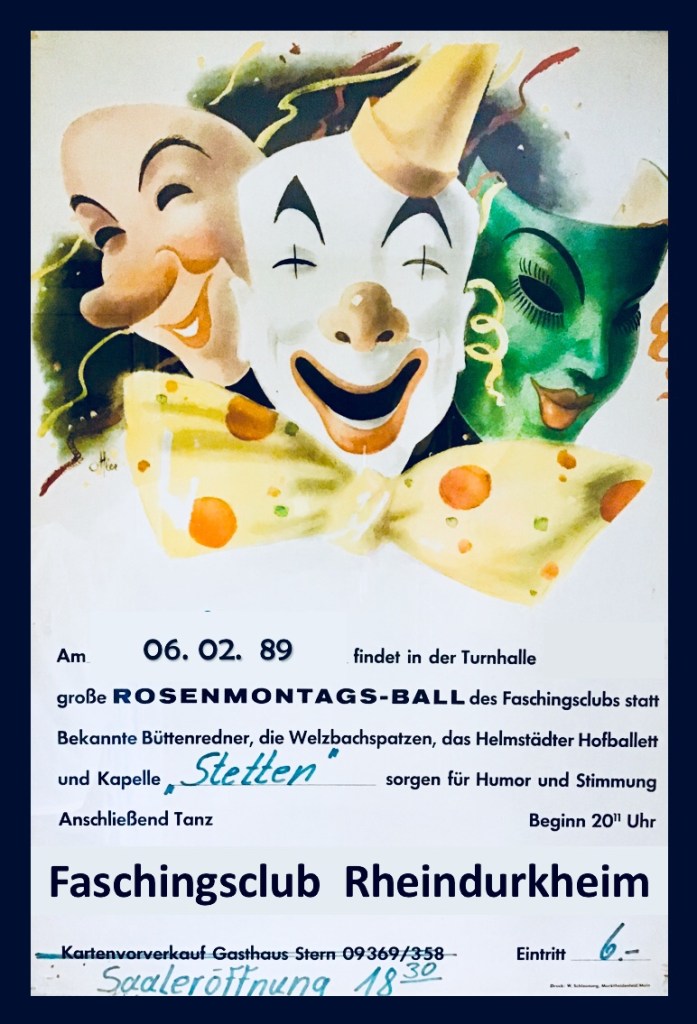
It was sometime in the late ‘80s, probably 1988. Our friend Howard, who I’d known since Kindergarten, came to visit us in Germany. He’d been in England with the Pythons, where I think he was researching his latest book. After finishing with them, he popped over the channel and caught a train to Worms. He had visited us several times before and this was just a low key trip. Maybe go to a weinfest, but otherwise, stay in Rheindurkheim and sample some local food, bier and wein.

On the night in question, Cathy was at the University for a class, so it was just us guys. I put our dog Top on a leash, and Top, Howard I walked to our favorite Gasthaus, Sportheim. Top was always welcome there, and as much of a regular as we were. Cath and I knew the owners, Vroni and Wolfgang, pretty well. In fact, we had travelled to Spain with them the year before.

Prost from Germany!

When we arrived at Sportheim, I reintroduced Howard to Vroni and Wolfgang. They had met Howard a time or two before during his previous visits and welcomed him like a long lost friend. We sat at a table and ordered a couple of biers and dinner. After dinner, we migrated to the small bar where a few of the regulars were standing and I introduced Howard. We joined them and ordered another round of drinks. Howard didn’t really speak much German and most of the locals only spoke limited English, so I acted as translator. It worked out pretty well and the regulars did a good job making Howard feel welcome.

As the night wore on, the crowd thinned. I let Top off his leash and he wandered around and barked “Guten Abend to Blackie, Wolfgang’s dog. Finally, it was just Howard and I at the bar, with Vroni and Wolfgang standing behind it. It was past closing time, but everyone was enjoying the evening and in no hurry for it to end. We were having Asbachs (German brandy) and Vroni and I were chatting about nothing in particular. Howard and Wolfgang, although neither spoke the other’s language, seemed to communicate with each other just fine. I’ve often noticed that the free flow of alcohol over the course of an evening greatly improves language comprehension. It certainly worked at Sportheim.

About this time, Wolfgang disappeared into the back of the Gasthaus and Howard leaned over and said “Wolfgang is bringing out some special raw pork for us to try – he seasoned it here at the Gasthaus.”

What!? Howard, I’m sure you misunderstood. He must be bringing out some cooked sausage, or leftover schnitzel to eat.” But no, Howard was insistent that Wolfgang had some raw ground pork that was slightly spiced and he wanted us to try it – it was almost like tartar. Plainly Howard had misunderstood. It was late, we’d been drinking a bit and these things happen.

About then, Wolfgang arrived back at the bar, with a loaf of bread and a small plate of gherkins. And….wait a minute…..what’s that in his other hand?… a plate of raw ground pork. Howard looked at me beaming. “See? I told you he was bringing raw pork.”

Wolfgang put some small plates in front of us and invited us to try the pork. I looked at him and said “Ummmmm, Wolfgang – are you sure this is a good idea? Aren’t you afraid of trichinosis?”.

Wolfgang looked at me like I was stupid. He explained how trichinosis was pretty much gone in Germany, and besides, this pork came from the very best butcher shop in Rheindurkheim (Adolf’s) and from a local farm (Helmut’s). We had nothing to worry about. He was trying a new seasoning blend and wanted our opinion.

We spread some of the pork sausage on the bread and tentatively tried it. Wow! This was good. The pork was seasoned with spices to something near a bratwurst flavor, but slightly different. In fact, it turned out that Wolfgang was going to make sausages (for cooking) the next day, but he wanted to share some with us that evening. We had more sausage with the bread and a couple of Gherkins, and washed it all down with a bit more beer. Now, everyone was talking to everyone and having a good time, and we all complemented Wolfgang on the sausage.

It grew late and finally, it was time to go. We said auf wierdersehen, put Top on his leash and walked back to our house. There, we headed to bed, and a great night’s sleep. Neither of us had any adverse affects from the pork.

To me, the most interesting part of that evening wasn’t that we ate raw pork, or that we didn’t get sick from eating raw pork. What I really loved, was watching two friends find a way to communicate with each other, even though neither knew much of the other’s language. How on earth did Wolfgang communicate “I’m bringing some raw pork for you and Max to try. I think you will like it. The pork is from Adolf’s, but I did the seasoning myself. I’ll be right back.

It’s amazing how easy it is to communicate, if people are willing to try.

‘Wiedersehen….

********

Special thanks to Howard Johnson for clearing up some of the story from that somewhat foggy evening….

Root, Hog, or Die….

In 1971, the Ottawa High School (OHS) football team finished undefeated, with a record of 9-0-0. Our coach, the legendary Bill “Boom Boom” Novak, was tough and appeared to get every ounce of effort from the team. I was thinking about Coach Novak with the recent news about the death of a University of Maryland football player and accusations that the coach ran an abusive program. Coach Novak was hard on us, but abusive?

Our practices were tough, especially at the beginning of the season when we did two-a-days in August. It was hot. It was humid. The coaching staff quickly saw who was in shape and who wasn’t. I won’t speak for others, but I remember sucking pretty badly at the start of that year.

There are two things I particularly recall about those practices. First, there was no water. Now, everyone knows the importance of hydration, but then it was a part of the toughness routine to go without water. Nobody thought or said anything about it. The second thing I remember was running wind sprints at the end of practice. We called them “weeds”. As practice ended, the team moved to the head-high weeds near the Illinois River. There, we would run a series of sprints, first running forward, then back peddling to the start line and getting down in a stance for the next whistle. Back and forth, back and forth we went. It often seemed weeds continued forever. Coach Novak kept us going, until we showed as a group we were going at 100%. For the last 4 or 5 days of preseason practice, Coach added a novelty to the sprints by requiring each of us to carry a car tire over our heads. One trick we learned from the seniors was to hide a slice of lemon in our hemet and chew on it when heading to the weeds. It helped our thirst.

Our coaches were teachers, both in the school system and on the playing field. They taught us technique, but they also taught us about life. There was yelling at practices and in games, but I don’t recall any cursing or name calling. The focus was on discipline and improvement. You were constantly measured against yourself and against others.

As the regular season started, practice eased up a bit, but was still rough. There were one-on-one drills and two-on-one drills. We practiced a lot of contained violence. Those drills measured your physical toughness, but in retrospect, I see how much of it was also about mental toughness. Running weeds continued at the end of every practice, but we were in shape now and there wasn’t as much pain.

At our Friday night games, the last thing we did before the start of the game was a massed “Root, Hog, or Die” chant around coach Novak. I didn’t know it at the time, but “Root, Hog, or Die” is an American phrase dating from the early 1800s. Historically, it became an expression of American self reliance. When we yelled the phrase, we were psyched and ready to play. Our team’s “self reliance” was at a maximum. Kevin Galley, our quarterback, recently said to me – “Novak’s approach, consciously or otherwise, fostered a very tight bond among all of our teammates. With only 32 players, everyone mattered”. Mike Stone, one of our captains and the team’s only all-state selection simply said “we had each other’s back”.

At game halftimes, you always wore your helmet in the locker room. This was to show you were ready to play, and also in case Coach Novak “tapped” you on the head for special instructions. I recall more than a few “taps”, particularly in close games.

The season progressed and the temperature dropped as September became October. Our hard work was paying off, with two, three, four and then five wins in a row. Finally, it was time for a showdown with our conference rivals, Sterling. Both teams were 6-0. Down 14-6 at halftime, the locker room was loud. Among my memories is Coach Novak grabbing Tom Gross by the face mask and explaining explicitly what he wanted Tom to do to the Sterling player opposite him. When the second half started, we pushed hard, eventually coming back in the fourth quarter to win 20-14. Normally, the local newspaper recognized one back and one lineman for their play, but the paper commended the entire team for their outstanding performance in the Sterling game.

We ended that year 9-0-0. I lettered as a backup, an award normally reserved for players with high playing time, or doing special feats on the field. I had done neither. At the start of the year Coach Novak told us it took the effort of the whole team to go undefeated, and if we went undefeated, everyone would letter. He honored his word.

1971 was Coach Novak’s 25th and final year as coach and he retired at the end of the season. Ralph Bednar, a local sportswriter, said in his column the week of the retirement, “Novak is a hard man in football practice. He may make it tough on you, but as you look back, you probably see where all his hardness conditioned you for life today. Life isn’t easy and nothing should be handed out on a silver platter. Hard work is the answer”.

Times have changed and as my friend and teammate Phil Godfrey says “that style of coaching wouldn’t pass muster today, but it worked then”. We’ve all gotten a bit smarter over the years. Did Coach Novak abuse us? For my part, the answer is an emphatic no. He was tough on us and didn’t coddle us. He would yell and get in your face. He never pretended to be your friend in practice, but there was no doubt he was our coach and leader. In addition to football, we learned about teamwork, discipline, toughness, never giving up, and striving for a goal that was by no means certain. I like to think it was good preparation for my time at West Point, and throughout life.

Kevin Galley commented to me “Our team was certainly not the most talented Novak had during his coaching tenure, but we clearly had an abundance of tenacity that served us well on the field, and afterwards”. I think Kevin was right. As I’ve looked at my teammates and their lives, I see a group with good fortune. There are successful lawyers, judges, business owners, executives, engineers, managers, farmers, teachers, and yes, coaches. I think Coach Novak helped make and mold us. I feel pretty lucky to have known him, and to have played football for him. Talking with teammates, I believe most feel the same way. It may have taken some of us more than a few years after that season to gain a full appreciation for what he gave us.

Root, Hog, or Die….

_________________

Coach Novak was the Pirate’s head football coach from 1947-71. He compiled a record of 168-45-11, with 14 conference champions in those 25 seasons. Ten of those teams went undefeated and seven were perfect. In all of those years, I doubt anyone called him “Boom Boom” to his face. As a side note, the 1971 football team was elected to the OHS Hall of Fame in 2016.

** Special thanks to Kevin Galley and Phil Godfrey for their additions to this blog. Their review and input was very helpful.

Boone’s Farm and the New Riders of the Purple Sage

For the record, Howard and I were not among those arrested for illegal drugs, weapons charges, aggravated assault, or trying to illegally bring stage equipment in to a rock concert. We did, however, score some mighty fine Boone’s Farm Strawberry Hill wine.

It was July 3rd, 1972, the summer before our senior year in high school. I don’t remember whether it was Howard or I who first heard the news about the displaced Rock Festival. Promoters scheduled an outdoor rock concert called the “Spirit of ‘76 Rock Festival” at the Bailey farm near Peoria, Illinois. The headliners were the New Riders of the Purple Sage and REO Speedwagon, and they were expecting over 30,000 attendees. The New Riders had played the Hollywood Bowl just two weeks before with The Grateful Dead, and people were excited.

Unfortunately, the local government was not excited. Or perhaps they were overexcited. In either case, an injunction was filed and the concert promoters were told they could not hold the festival anywhere in Peoria County. Not to be outdone, the promoters found a new location on a farm near Streator Illinois, which was about 10 or 15 miles from where Howard and I lived in Ottawa. The festival was to start either July 3rd or 4th. On Sunday, July 2nd, the promoters told those already gathering for the festival in Peoria to head north to the new location near Streator.

This is when fortune smiled on us. My folks were out of town on vacation and left me at home in charge of my two sisters, Roberta and Tanya. I also had my dad’s work car, a three-on-the-column ‘65 Dodge Dart. We immediately decided to go to the festival the next day, party and listen to music for a while, and then drive home with no one the wiser.

What Howard and I didn’t know was that another injunction was filed that day in LaSalle County and a judge had already banned the festival from taking place at the alternate location near Streator. As people were arriving from Peoria, the police weren’t allowing them to go to the farmer’s field for the concert, but were instead channeling them to the Sandy Ford Conservation Area, halfway between Streator and Grand Ridge. In fact, they arrested several people attempting to bring stage equipment into the Conservation Area, a violation of the injunction. In the meantime, more and more people were arriving for the festival.

Oblivious to all of this, Howard and I met on the morning of the 4th and started driving towards Streator, looking for the rock festival. We knew about where it was, and figured we could follow the traffic when we got close. Sure enough, we were a couple of miles south of Grand Ridge and saw lots of traffic turning off of Route 23 onto a small road. We turned onto the road, and joined the throng. I think the road turned to gravel, but in any case we eventually pulled off on the side of the road and parked, just as everyone else was doing. I seem to remember seeing police, but they weren’t a big presence.

From the car, we walked a mile or so down the road. No one was taking money or tickets for entry. We eventually arrived at an open field, where a band was playing on a makeshift stage. There was a big crowd, along with tents, cars and vans scattered about. People were drinking, smoking, laughing and generally having a good time. Howard and I wandered around and finally asked a guy where we could buy something to drink. He told us he had some extra Boone’s Farm Strawberry Hill wine if we were interested. We quickly bought a bottle and settled in to listen to the music.

We watched a couple of bands play, drank our wine and generally felt very cool. We met and talked with several in the crowd, although at 17 and 16, we were younger than just about everyone there. As a side note, the girls/women ALL seemed older than us, which was somewhat intimidating ;-). I don’t remember any fights or problems, just that the music was pretty good, and there were lots of people. The news at the time saw it a bit differently and said that “hippies” were gathering at the festival and people needed to be careful. News reports in Streator and Ottawa advised local stores to close down.

As evening approached, neither the New Riders nor REO had played yet, but we had to leave. Either Howard had to check in with his folks, or I had to take my sisters to the fireworks that night. We paid for a couple more bottles of Boone’s Farm and walked to the car. By now there were vehicles everywhere and it was hard to turn around and get out, but we eventually made it home in one piece. Unfortunately, one of the bottles of wine leaked on the back seat of my dad’s car, and caused me to have a mild panic attack. Luckily, dad never noticed the wine stain and our trip stayed secret.

Adults around Ottawa were pretty worried about the “hippies” causing trouble, or being a bad influence on our town’s youth. After our day at the festival, Howard and I suffered no apparent ill effects and seemed to turn out OK. Heck, after a few years, we even outgrew our taste for Strawberry Hill wine.

*****

I flashed on this fest recently when Howard was meeting with an old friend of his from the Ozark Mountain Daredevils. For some reason, seeing them together in a photo made me think of the festival. I decided to do some research and see what really happened there. You can read the article included here and it’s pretty funny. It turns out the festival wasn’t authorized and in fact neither the promoter, nor most of the scheduled bands made it to Streator. According to news reports on the 5th of July, neither REO Speedwagon, nor the New Riders of the Purple Sage showed at the fest in Streator. Instead, local bands arrived, along with a couple of the smaller original bands, and they crafted a stage and held the festival. There were only around 20 arrests. Somewhere between 6-15,000 were there and it sounds like the police shut the whole thing down late on the evening of the 4th, sometime after Howard and I departed.

As Howard and I were recently discussing that day, I found out that he returned to the fest the next day on his bicycle. There was still someone there selling Boone’s Farm out of the back of a truck. Howard snagged two bottles and returned home a bit later. I think we drank the wine with friends the next weekend at the Butler House in Varland Park. Ahhh, youth.

**** Special thanks to Howard Johnson for verifying or correcting my memory about some of this blog.

Cindy

As many of you know, my sister-in-law Cindy passed away three months ago on April 30th, 2018. It was not unexpected, but was nonetheless too soon. In February of this year she was diagnosed with cancer and given six to nine months to live. She passed away just over two months later in April.

I first met Cindy when she was thirteen, way back in the summer of ‘72. In all of the time that has passed since then, the one thing I’ve known consistently about Cindy is, as Cathy says, she has always marched to her own drum. She lived most of her life outside the box.

With my military and corporate background, I suppose I’ve lived much of my life inside the box. In spite of our different approaches to life, or maybe because of them, we loved each other in our own way, as you often do with members of your family, or extended family. I can’t say that I always liked what Cindy was doing at a particular time in her life, but I always loved her.

Cindy, enjoying life.

Her remembrance was held in Alabama on June 10th. We gathered together to celebrate her life. Friends and family were there, including cousins and three of Cindy’s four surviving uncles. Bonnie and Cathy both spoke eloquently about Cindy, her life, and their relationships with her. There was much story telling, some funny, some sad, and more than a few margaritas were drank that day in her honor. At Cindy’s request, Norman Greenbaum’s “Spirit in the Sky” was played, allowing us to reminisce about our youth and leaving us with feelings of hope and redemption.

I think there is always an extra bit of sadness when someone dies young, as Cindy did. Having said that, at the remembrance enough time had passed since her death, and we were able to celebrate her life among us and our memories of her.

And now she has been gone for three months. For my part, I will remember the good times we did share over the years. And I will think of Ecclesiastes 5:18, both for Cindy, and for myself –

“Even so, I have noticed one thing, at least, that is good. It is good for people to eat well, drink a good glass of wine, and enjoy their work – whatever they do under the sun – for however long God lets them live.”

Peace be with you Cindy. Thanks for helping me remember to celebrate the good things in life.

___________________________________

** This version of Ecclesiastes 5:18 came from the New Living Translation of the Bible.

Morning Routine

Our dog, Carmen, and I have a morning routine that hasn’t changed in the past three years.  It’s pretty much the same, no matter the season, or the weather. It can be a regular day, Christmas Day, or raining cats and dogs, it doesn’t matter. This is what happens.

Everyday we wake up between 6:30 and 7:00AM.  Somedays I’m up first, somedays she wakes me, but always in that same timeframe.  (If I’m not home, she never wakes Cathy, but instead waits for her to get up). As I dress, she stretches a time or two and then sits and waits by the bedroom door.  I open the door and we head downstairs, Carmen leading the way.  I proceed to the back door, where she’s waiting for me.  I slip on my shoes, open the door, and out we go.  Interestingly, if I let her out, but then go back inside to do something for a minute, I’ll find her sitting just outside the back door waiting for me (“Let’s go dad, what’s up?”).

As we proceed to the barn, Carmen will do her business along the way.  Typically our barn cats, Stan and Ollie, will say hello and the four of us make our way to the barn for feeding time.  In the summertime, the horses have been out for the night and are waiting to come in (in winter, the horses have been in the stable all night and are ready to go out).  

At the barn, I fill each horse’s bucket with water and throw some hay in their stalls.  Carmen wanders the barn and checks things out to make sure nothing has changed from the day before, and also to see if the cats have left any food around their bowls.  We then walk to the feed room to get grain for the horses and the dry food for the cats.  As I am about to return to the barn, I look at Carmen and she sits down in the feed room. I close the door.  She knows that she’s not allowed out while I bring the horses in.

I put the feed in each stall’s bucket, give the cats their food, and then go for the horses.  Noggin’ and ‘Shendo come in first from the nearby paddock, and then it’s Sailor and Katie’s turn from the backfield.  Once all of the horses are in, I let Carmen out of the feed room and we head back up the drive.  

C28FC4B8-83ED-4559-814D-09EF0071DB1CInstead of going straight to the house, I walk the 100 yards or so up the driveway to the mailbox and retrieve the Washington Post.  Carmen doesn’t follow me, but instead lays down in the driveway about two feet inside the invisible fence.  When  I come back from getting the paper, she is invariably waiting for me there.  I come over the hill, she stays put.  I walk down the hill, she stays put.  Finally, when I cross the invisible fence line myself, she jumps up and trots to the back door of the house.

We go inside, and I fill her bowl with food.  As she is munching down, I go to the kitchen, make my coffee, check email, and proceed to read the Post.

Our days diverge after that and we both get on with our lives.  Sometimes we are doing things together, but other than our afternoon walk, often times not.  I like to think that we are comfortable with each other in our friendship.  I know both of us enjoy our morning ritual together.  It’s something we can count on and look forward to, come what may.

It’s a pretty good start to the day. What’s yours look like?

Embarrassed Patriot

The vast majority of my blogs aren’t political. They are about my life, or the lives of my friends and extended family. After the recent events in Belgium, England, and Finland, I felt compelled to write this piece.

img_0335We can argue about the environment, abortion, trade, the economy, health care and any number of other issues, but as a veteran and a patriot, I’m embarrassed by the events of the past week. I don’t understand our current president and his views about Russia and our European allies. When did it become patriotic to denigrate our allies and embrace our enemies?

If you have studied history at all, you know that NATO is a major reason that we have had peace in Europe for the last 70 years. Is NATO perfect? No. Are there issues? Sure. But to belittle the organization is ridiculous. And then to specifically go after Great Britain (May) and Germany (Merkel), two allies that have stood with us not only in Europe, but also in Iraq and Afghanistan is nothing short of foolish.

Fast forward to Helsinki. The president’s comments at the press conference were distressing. First, he supports Putin, a man that wishes nothing but ill will not only for our country, but for all nations in the West. He has poisoned people, interfered with elections (not only ours, but others as well), caused issues in Crimea and the Ukraine, imprisoned internal opposition candidates and murdered Russian citizens. Then, our President takes it a step further and talks badly about our own intelligence agencies, blames the US for the poor relations between our countries, and again supports Putin in his allegations. The press conference could not have been more favorable to Putin, if Putin had scripted it himself. And this is our great deal maker?

I am glad to see politicians of both parties have called our president to task for his poor performance in Europe, but that’s not enough. We as citizens all need to express our concerns and ensure our voice is heard. Write your elected officials, write the White House, talk to your neighbors, protest peacefully if you are so moved, but above all, vote.

As an American and a veteran, I’m embarrassed by our president’s performance in Europe, When I was in the Army, I spent almost nine years in Europe as a part of NATO defending this country. I understand that times change and the “Cold War” ended many years ago. For our president to not understand that these times are equally treacherous and that history repeats itself is not only unfortunate, but could prove tragic for us.

—-Please feel free to share this blog——

____________________________________________

Arthur’s Burial

Arthur

I’m not sure why, but the burial of our horse Arthur has stayed with me in greater detail than many human funerals. This came to mind recently as I was bush hogging our back field and hit a rock I forgot was there. It was the stone we had put in place to mark where we buried Arthur many years ago.

Arthur made the transition with us when we moved from the suburbs to the country. I suppose you could make the argument it was because of Arthur that we moved to the country. He had a good life at the stable in the ‘burbs, but I like to think he enjoyed it a bit more here at Rohan Farm. Cathy still competed with him, but he and his pal Red had plenty of green pasture to roam when not working.

Cathy rode Arthur for a few more years, but he finally got older and was having some problems. Cathy bought Tucker to compete with, and we retired Arthur. He spent his days grazing with Red. Eventually, his problems worsened and the arthritis in his spine was causing significant pain. Another vet visit, and we decided it was time.

The day we put Arthur down was a pretty fall day with a vivid blue sky. The gravedigger, Larry, arrived and I showed him where we wanted Arthur buried in the back pasture. He offloaded his backhoe and started to work.

Maybe half an hour later, our vet, Tena, arrived. Cathy put a halter on Arthur and we started for the back field. There was no talking. We crossed the dike by the pond, and for some strange reason our trek reminded me of the Beatles’ Abbey Road album cover. We were in single file at that point with Tena in front. Cathy came behind leading Arthur, and I brought up the rear. I know it’s weird, but whenever I see that album cover now, I think about Arthur. It’s strange how the brain works.

In any case, we kept going and crossed the little creek that marked the entrance to the back pasture. At that point, you could hear the backhoe operating. As we crested a small hill, Larry and the grave came into view. Larry saw us and pulled the backhoe off to one side and shut it down. As we approached, he stood and took off his hat.

Larry made the hole in such a way that there was a ramp going down about eight feet to the bottom of the grave. When we arrived, Cathy led Arthur to the bottom and stood there stroking his mane. She gave him a last carrot, which he slowly munched, and then it was time. Tena gave him the shot and after a few seconds, Arthur slid to the ground. Cathy was holding his head and I was petting his side. A bit later, the life left his eyes and Tena checked his heart. It had stopped beating. We stayed with him a while longer, tears in all of our eyes.

We trudged back out of the hole and made our way across the field. Larry put his hat back on and sat down on the backhoe . As we crossed the stream at the edge of the field, I heard him start the backhoe again.

Arthur was 25 when we put him down. When Red died a few years later, he was 31. We put him in the back field next to his buddy Arthur. Both graves have turned green with new grass over the years. The stone markers have sunk into the earth and don’t protrude much anymore. When the grass gets higher, I can’t see the stones and occasionally hit one with the bush hog.

Over time, we buried other horses, dogs and cats here on the property. While I remember the others, it’s Arthur’s burial on that pretty fall day that has stayed with me. Larry’s sensitivity and Tena’s compassion were a part of it, as was Cathy’s and my sadness. And Arthur himself? I suppose it’s strange to say it, but his dignity was with him to the end. He was a good horse.