Fly Away Little Bird

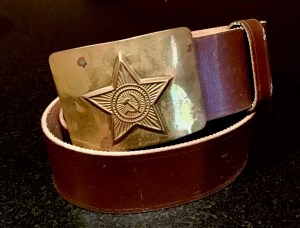
I think the odds are stacked against this baby bird, but maybe not. His mom picked a poor location for the nest. It’s in our garage, in the center of a tool belt hanging on the wall. I think it just hatched today, maybe in the last couple of hours. Mom flew off when I went into the garage, and that’s how I found the nest.

Little bird with sibling still in an egg

Every year birds try and build nests in the garage. Most years, I get them out before they start building. Somehow, I missed this one. I’m not against birds. It’s just not healthy for them to build a nest in the garage. If the door is down, they are either trapped in the garage and can’t get out, or trapped outside and can’t get in. They also don’t understand a partially closed door. They keep looking to fly out at the top, not knowing there’s an exit just two or three feet lower. They circle, and circle, and circle, never seeing the exit below.

We could leave the door open all of the time, although this year there is another challenge. There is a bear in the area, who already tried to haul off our trash once. Our dog Carmen alerted, and the bear ran off, leaving the trash bag in the drive. From past experience, we know it will return. Because of this, I keep the garage door closed at night.

Our barn cats, Stan and Ollie, don’t help the situation. Stan has discovered the bird nest. He hangs out at the garage these days, often on the table below the nest. He can’t climb to the nest, but I know in the future when the bird starts to fly, Stan may well be there waiting for a mistake. Several years ago, we came home to find our old dog, Holly, insanely jumping up and down in the garage. When we walked into the garage, and saw the three dead baby birds on the floor and one in Holly’s mouth, we realized what had happened. Another nest built in the wrong location.

I hope this little bird makes it. The odds seem stacked against it.

Mom and Dad’s Anniversary

No married couple is perfect, but mom and dad sure made a run at it during their heyday. This coming Tuesday would have been their 69th anniversary. They married on May 14, 1950 and were together for 60 years, until dad passed away in 2010.

Mom and dad on their wedding day, with Uncle Mick and “Aunt” Dorothy

Rather than thinking of specific memories, today I am seeing them through a more diffused light, almost as if through a mist. They had a balance of life together that I think all married couples strive for. They were unified by their love of each other, their love for us kids, and their mutual interests. They also had the ability to laugh, whether at life, each other, or one of dad’s many jokes. As our cousin Janice said “they laughed through life together. I will always remember their laughing. So sweet”.

Although life wasn’t simple for them, they always found ways to enjoy it during their journey together. Whether going out to dinner when dad got off work on a Saturday, or taking their grandkids for a walk in a local park, they made their time together count. Jazz, music, and dancing also played a big part in their lives. They had the ability to dance effortlessly together, no matter the music. They did the “Gen and Bill” step and moved easily, as they glided across the dance floor.

More than anything, they had a balance between them. After dad’s stroke, the equilibrium changed, but before that, it was about perfect. I think our cousin Dawn captured it best:

“Your mom was like home. Comfortable and warm. Your dad was like a spark that gets a flame going, then keeps the fire dancing. They were special people. I’m smiling now thinking about it.”

Happy Anniversary mom and dad. I’m sure you’re dancing across heaven, even as I type this.

The Pelican

Sometimes it’s handy to have a pond. For instance, say you want to give a Viking Funeral to a stuffed pelican with a history. A pond is very handy.

Howard first obtained the Pelican sometime in the early 80s. As he said to me “It was in the back yard of one of my parents’ neighbors. Incredibly, they were going to throw it out! I asked, and they gave it to me”. Eventually, it migrated to Chicago with Howard and took up residence in the apartment on Racine Avenue he shared with Tim.

People either loved or hated the Pelican. There was a certain beauty and repulsiveness to it at the same time. It was a bit creaky, dusty, and maybe just a little creepy to some. And, always the question – why would someone stuff a Pelican to begin with?

The Pelican was in it’s glory days. Sitting on the fridge, watching over the apartment and all of the goings on. It drew many comments (not all flattering), and also had the chance to see, and be seen with Bill Murray, Del Close, Graham Chapman, Eric Idle, Joel Murray, Bob Odenkirk and Dave Pasquesi, among others.

In 1994, Howard finally moved out of the Racine Avenue apartment to marry Laurie. The Pelican remained behind with Tim. It was still perched on the refrigerator, gathering dust, greeting all who entered, and surveying it’s domain. A few more years passed, Tim (and his then girlfriend, now wife, Renee) moved on and the Pelican went with them to a new home. Eventually, they bought their own house and the Pelican moved with them yet again. No longer prominently displayed, it also wasn’t hauled off to the junk yard. It was almost like a ring of power, just quietly biding it’s time, waiting for the right opportunity.

Time passed. Howard and Laurie had a son, Morgan.

More time passed. Morgan graduated from college, and moved to the DC area to seek fame and fortune. Cath and I would see him every few months at our place or his apartment. One of life’s great pleasures is becoming friends with your friend’s or sibling’s children. Friendship in its own right, not just, “oh, he’s the son of….”

Then one day about a year and a half ago, Tim and Renee came for a visit, along with our old friend Peggy. It turned out Peggy wasn’t the only guest in the car. There it was, boxed up for protection on the 740 mile ride …. The Pelican. Morgan came out to dinner one night while they were visiting, and a surprise gift was given to him. The Pelican was now his and could grace Morgan’s stylish digs in Alexandria, which it did for the next year and a half. The only condition of the gift was, if he ever grew tired of it, it should receive a Viking Funeral (think Beau Geste), and not be unceremoniously hauled off to the dump.

It turned out the Pelican didn’t quite fit in modern times. It didn’t get the chuckles it had in the past, and it’s effect on women was, shall we say, less than desirable. Morgan and I discussed when the appropriate time might be to hold a funeral, and decided we needed to wait for a sign. Last week the sign came, and coincided with a visit from Laurie.

When Morgan and Laurie arrived at the farm yesterday, the Pelican was in tow. We talked about the best way to give a proper send off and when to do it. Should we wait for a better time? Wait for more folk to be in attendance? The quick answer to both of those questions was no. That would have required storing the Pelican in the barn, which was unseemly. The service would be then and there, at the pond.

We found a suitable platform for a boat and secured the Pelican to it. A combustible liquid was poured on the Pelican. In Beau Geste, a dog goes up in flames with the hero, although other films are less definitive. The ashes of one of our previous dogs, Ellie, were already scattered in the pond, and we decided that was close enough.

The funeral cortege moved slowly to the pond. Cathy in front, Morgan and I in the gator providing an escort to the Pelican, with Laurie walking solemnly (or skipping lightly, depending on your perspective) behind. We arrived on the embankment and slowly lowered the float with the Pelican into the pond. After our brief farewells, Morgan said “It’s time”, struck a match and lit the Pelican as we pushed it into the pond. We watched as the flames grew higher and the Pelican was consumed. Each of us was lost in our own thoughts.

Loading the Pelican, and it’s subsequent Viking Funeral

As we returned to the house, the skies were black and it started thundering. Shortly after we were inside, the skies opened, and the rain poured. Our lives would go on, but without the Pelican.

We let others know of the Pelican’s passing, and there was much mourning (and perhaps a bit of rejoicing by some). Of all the comments we received, I think our friend Dave did the bird real justice, when he provided the following prayer:

Viking Funeral Prayer (Dated between 4 B.C. and 3 A.D.)

Lo, There do I see my Father

Lo, There do I see my Mother and

My Brothers and my Sisters

Lo, There do I see the line of my people back to the beginning

Lo, They do call to me

They bid me take my place among them in the halls of Valhalla

Where thine enemies have been vanquished

Where the brave shall live Forever

Nor shall we mourn but rejoice for those that have died the glorious death.

…..finis…..

Addendum:

Some other post funeral quotes:

“Oh, the pelicanamity! 😨 ”

“Well, it’s the end of an era. A very fitting demise to a proud, regal bird. Morgan – the next Sand Hill Crane I shoot, I’ll spring for a full body mount and gift it to you for a replacement for the departed pelican.”

“I am speechless ”

“ Mark sent the pic to me this morning. I just finished crying.”

And as Howard himself said “Heartbreaking. But if it had to go, this looks like a good way to do it”.

Protected by Saint Bill

I recently came across Dad’s dog tags from WWII. They were dented and gray, but still readable. William I Hall on the front, with his serial number, 16016203, on the back. I looked at the tags, and the grime of three continents on them. I kept thinking they are too much a part of history to leave in an envelope in a drawer, which is where they spent the last 70 years.

He received these dog tags at the age of 16, when he joined the Army in September of 1940. He had them on during the Atlantic Crossing in late October of 1942. When they invaded North Africa and he came ashore in November of that year, they were there clinking together (or maybe taped together) under his shirt.

They would have been around his neck in January of ‘43 in Algeria, during the parade for President Roosevelt, just after the Casablanca conference with FDR, Stalin, and Churchill. Later, when the 9th Infantry Division fought across Tunisia, ultimately defeating Rommel’s Africa Corps at Bizerte in May of ‘43, they were still there.

In August of 1943, when he was severely wounded in Sicily and handcarried by stretcher out of the mountains, the tags were used to identify him when he arrived at the aid station. When they couldn’t operate on him there and evacuated him to a full hospital, the tags were again used to identify him.

The war was over for Dad, although he was in the Army for another two years in both North Africa and the United States. Only after August of 1945, with the bombings of Hiroshima and Nagasaki, was he mustered out of the service. At the age of 22, he would have finally taken these dog tags off, five years after he first put them on.

I was thinking about his history as I looked at the dog tags, and an idea came to me. When I was a youngster, I was always a bit jealous of the Catholic kids with their Patron Saint medallions – their Saint Christophers, Saint Michaels, Saint Frances, and the like. I suppose I was privately thinking it gave them some kind of leg up on the rest of us. I decided to take one of the dog tags and put it on a necklace for myself – something of a Saint Bill, I suppose. My thinking was if the tags were with him throughout the war, even with his wounding maybe there was still a little magic left in them. A little protection, if you will.

William I Hall — United States Army — 16016203

I’ve worn the dog tag for a few days now. I feel it on my chest and smile. Dad was no saint in real life, but he took care of me when I was young, was a mentor to me when I was older, and a friend to me always. I’ll take my chances with this Saint Bill Medallion.

Eating a Lamb’s Eye

Mykonos was in the news last year when Lindsay Lohan opened a beach club on the Island. I read there’s now an International Airport, along with “nightclubs open well past dawn”.

In April 1980, when we vacationed on Mykonos, it was a sleepier place. We’d been stationed in Germany for a little over a year, a year of non-stop rain that was dreary, cold and damp. We were ready to visit somewhere sunny.

We caught a military hop out of Frankfurt bound for Athens. It was the first time I’d flown on a C-130 since Jump (Airborne) School a few years before. Cath and I strapped ourselves into the webbed seats, just in front of the tied-down cargo. I hoped the load master had done his job, and none of the cargo would shift. Someone on the crew gave us earplugs, and we were off.

When we landed in Athens, I actually kissed the tarmac, it was so warm and sunny. We found a place to stay, and spent the next couple of days doing the usual tourist stuff – the Acropolis, the Parthenon, the Plaka and other temples and ruins. Looking for less of a crowd, we moved on, and took a ferry to the Island of Mykonos.

As the ferry landed, we walked onto the dock, along with the other arriving passengers. At the end of the dock, there were a number of people advertising for places to eat or sleep. We saw a kid holding a sign for “Mike’s Pension” and through hand signals and a few words, found out Mike’s was in a quiet location about a half mile outside of town. We decided to stay there, and hopped into the back of his truck for the short ride to the Pension.

It was a beautiful white stone house right on the water. We were on the second floor, with a view of the Aegean Sea from our balcony. I think it cost us about $25/day, and was our home for the next few days. No one spoke English at the Pension, so we made due with hand signals and smiles. The one other guest was a German who spoke some Greek. When there was a difficult translation needed, we spoke with him in German and he’d translate to Greek for Mike.

We spent our time walking around the beautiful little town with the windmills and whitewashed buildings. We ate wonderfully, including Greek salad, octopus salad, lamb kabobs, seafood, and grilled lobster. We drank some wonderful white wines, some Retsina (an acquired taste, that worked well on Mykonos) and also had an occasional ouzo after dinner. We even bought a Flocati rug that we still own today.

Sunday, April 6th, was Greek Orthodox Easter. Mike invited us to share the feast his family was preparing. We quickly said yes and looked forward to the meal. As we left for a minibike ride around the Island, Mike and one of his brothers had started cooking a lamb on a spit over an open fire. With a laugh, and pointing to his watch, he cautioned us to be on time. We smiled and went for our ride (yes, you can ask Cathy. I was the one who crashed his minibike into some sticker bushes, after cautioning her not to go too fast).

A couple of hours later, we returned, just as the lamb was taken off the fire. The smell was heavenly. We quickly washed up and returned to the large room where family and friends were coming together. Tumblers were filled with wine. Amid the smiles and laughter, we seemed to have no trouble communicating. Finally, we all gathered around the table – maybe 15 or 20 of us. A huge Greek Salad was brought to the table and then two large platters of lamb. I’m sure there were other dishes, although I don’t remember them. Once everyone was seated, a prayer was said, and then Mike made a short speech and looked at the German and I, as did the rest of the table. I looked over to the German for a translation. It seems he and I were the honored guests and before the feast commenced, Mike was offering us the grilled eyes of the lamb.

At this point, several thoughts flashed through my brain. Lamb eyes? Honored Guest? Is this a joke? Is he making fun of me? What the hell do I do?… and finally, Go For It….

I took one of the eyes and the German took the other. I popped it into my mouth, chewed a bit, and swallowed it down. The flavor was good, and the texture was similar to a chicken gizzard. Toasts of “Yamas!” (To your health) were called out and the feast began.

We spent the next couple of hours eating and drinking with Mike and his extended family. We found ways to talk and laugh together. The lamb was delicious and we ate it using our fingers. We went through untold bottles of wine and water over the course of the afternoon. I think there was a dessert, coffee and ouzo at the end, but I have no memory of what kind of dessert. The day stretching out, seemingly forever.

Cathy eating some of the lamb, while I’m working on a tumbler of wine

Looking back, I think the day was closer to an American Christmas, rather than any Easter meal I’ve attended. The conversational volume level was loud, the sense of gratefulness and community were everywhere, and the table was overflowing with food and drink. It was perfect.

We left two days later and made our way back to the mainland. A couple more days there, and we then returned to Germany and work. It was a great vacation. I think back to the fun we had and recall many details of the trip, including visiting the ruins in Athens; hitchhiking to Sounio and the Temple of Poseidon; first hearing Alan Parsons’ “Lucifer” in a nightclub and being blown away; and even the young Israelis we talked with on the ferry ride back to the mainland from Mykonos. But what sticks in my mind most, is Mykonos and the Easter feast with Mike and his family. I’ve never forgotten their generosity in including us. It’s what made the vacation a memory, and not just a trip.

___

Addendum –

– I’ve since done some research and in many Mediterranean and Middle Eastern countries, there is a tradition of offering the “honored guest” the lamb’s eyes. Not that I ever doubted…

– Mykonos has always had a bit of a reputation as a “playground”, but in the ‘80s, it was much more remote than it is today. There were several Nightclubs, and an “unofficial” nude beach a few miles out of town. I don’t believe there was an airport on the island at the time.

– Lucifer (From the Alan Parson Project album “Eve”) was a huge hit in Europe, and made it to “Number 1” in Germany. It never had the same play in the US. I still remember sitting at the bar in Mykonos when it came on and asking the bartender “who the hell is this?!!”. I bought the album at the Frankfort Px right after we landed at the airport on our return.

– I’ve retained one word of Greek: S’ efharistó (pronounced eff-ha-reece-toe), which means thank you. It was a good word to know.

Dad and the “Code Girls”

In 1989, Cathy and I returned from Germany and were stationed in the Washington DC area, at a small post called Arlington Hall Station. I was talking on the phone with Dad one day and mentioned Arlington Hall to him. There was silence for a second and then he said “Arlington Hall? Hmmmm….I think I’ve been there”. I answered back “I dunno Dad, it’s pretty podunk, I doubt that you were here. You’re probably thinking of Ft Meyer or maybe Ft Belvoir.” He didn’t say anything more at the time.

A few months later, Mom and Dad were visiting and we were driving around town. I took them past Arlington Hall, so they could see where I worked. As we stopped at the gate, Dad looked around and then said “Yep, I was here. It must have been 1944…. No, I think it was late winter or early spring of ‘45. I was here with two WACs (two members of the Women’s Army Corps).” What?!? Dad started telling the story…

After being shot three times in Sicily in 1943, he rehabbed in North Africa for several months. Due to the severity of his wounds, he wasn’t returned to combat and eventually shipped back to the States in 1944. There, he was stationed at Camp Butner, North Carolina. Dad was able to secure weekend passes pretty easily, and made his way to Washington DC at least a couple of times.

Dad during WWII

Sometime in March or April of ‘45, he had a pass, and again caught the bus to DC with a buddy. In DC, they became separated, and Dad made his way to a bar near the Capitol. As he was having a drink, he met two young women who were members of the Women’s Army Corps (WACs) and they started talking. Dad danced with each of them a couple of times. After a while, he suggested to one of them that they go for a walk, and she agreed, telling her friend she’d be back in awhile.

Now what both of them were really looking for, was a bit of privacy. Something you may not have noticed if you are just a tourist to DC, is that there is a lot of greenery surrounding our nation’s Capitol. Dad escorted the young lady to the Capitol, where they found some privacy among the bushes and became “more intimate”. I’ll leave the rest to your imagination, just as Dad did for me.

Eventually, they returned to the bar, and rejoined the other young woman. The night wore on, and after more dancing, the WACs had to return to their barracks. Leaving the bar, Dad flagged a cab and the three of them hopped in. The driver asked “where to?” and one of the WACs answered “Arlington Hall”. They eventually arrived at the Gate, and due to security, the cab wasn’t allowed to go any further.

Dad got out of the cab, and the girl that had stayed at the bar got out first, while the other stayed in the cab. Dad and she talked for a bit, and then they kissed goodnight. After girl #1 walked through the gate, girl #2 got out of the cab. She and dad had a somewhat more extended goodby, before she too walked through the gate, and gave him a wave goodby. The next day he caught the bus back to North Carolina and as with most WWII liaisons, they never saw each other again…

At the time, I dug around a bit, but couldn’t find out much about WACs at Arlington Hall. I found a reference to the “28 Acres of Girls” at Arlington Farms, but nothing about Arlington Hall. It’s only recently that I learned more about the women stationed there.

WWII WAC recruiting posters

It turns out there were around 1,000 WACs stationed at Arlington Hall during the war, and they were there for one purpose. They were part of a classified, Top Secret effort, focused on codebreaking of the German and Japanese codes. Most of the women were cryptanalysts focused on the Japanese Imperial/Diplomatic Code known as “Purple”. The women were sworn to secrecy, on pain of death if they revealed anything. If anyone asked what they did, they were told to say that they were secretaries and doing menial work. As one lady said later, “If we went out in public and were asked what we did, we were to say we emptied trash cans and sharpened pencils.” One group agreed that “if anybody ordered a Vodka Collins when they were out at a bar together in Washington, that would be their signal that a stranger was showing too much curiosity about their work, and they were all to disperse to the ladies’ room and then flee.”

During the war, women made up well over half of all codebreakers in the US. When the war ended, the number of WACs stationed at Arlington Hall was severely reduced, but they didn’t disappear altogether. The work they did at Arlington Hall Station eventually morphed into our current National Security Agency (NSA).

The reason that I couldn’t find anything about this back in 1989, is that much of their work was still classified. It wasn’t until almost 60 years after the war ended that details of the Arlington Hall “Code Girls” were declassified and became public. Not surprisingly, the involvement of the women was minimized in previous accounts of WWII codebreaking efforts.

So, that’s the rest of the story about Dad and the two WACs. As most of you know, I love it when family history intersects with big history. I laugh a bit thinking of dad looking for a private spot in the bushes surrounding the Capitol, and then kissing both ladies goodnight back at Arlington Hall. He passed away before most of the information on the “Code Girls” became public, or before I found out anything about them. I wish I could have a conversation with him now to get his retake on that night. I’m sure Dad’s interest was purely in the women themselves, and I doubt that anyone felt the need to order a Vodka Collins. If he only knew….

______

Addendum:

* Note: WACs – the Women’s Army Corp – prior to integrating women into the Army in 1948, WACs were an auxiliary active duty unit. The WACs were first formed in 1942.

If you want more info on the Code Girls, or Arlington Hall Station, try the following books and websites:

⁃ The book, “Code Girls”, published in 2017, by Liza Mandy is excellent and I can’t recommend it enough. The quote in the text about the Vodka Collins signal was from this book. Special thanks to my cousin, Janice Connel, for introducing me to the book.

http://lcweb2.loc.gov/master/pnp/habshaer/va/va1500/va1560/data/va1560data.pdf provides more info on Arlington Hall in general, including the time both before and after WWII.

https://www.politico.com/magazine/story/2017/10/10/the-secret-history-of-the-women-code-breakers-who-helped-defeat-the-nazis-215694 is a Politico article with info on Women Codebreakers during WWII in general. It also quotes from Mandy’s book.

The Conversation

Cathy went to pick up her prescription at the pharmacy in our local grocery store. The prescription wasn’t quite ready, so she sat down on the small bench to the side of the pharmacy area. As she was sitting there, an older woman walked up slowly and sat next to her.

As is often the case while waiting, a conversation started up between the two. After a bit of small talk, the woman said “Ever since yesterday, I’ve been praying and thinking. And thinking and praying. And praying. And thinking”.

Cathy looked at her, and waited for her to continue.

“I’m 81. I’m a 37 year breast cancer survivor and now it’s back.”

She’d just found out the day before that cancer was now in her other breast. She hadn’t yet told her family. She hadn’t yet confided in her husband. She didn’t know what she was going to do.

37 years ago, when breast cancer struck the first time, she had a mastectomy and one breast was removed. After the mastectomy, she went through chemo. She remembered both the mastectomy and the chemo vividly and didn’t want to do either a second time.

They talked for awhile. There were discussions of alternate treatments, and the progress that has been made. They talked about the difficult recovery from her first mastectomy. They talked about doing an easier pill to keep it at bay, knowing it would not be curative.

I wasn’t there, but I think in addition to thinking and praying, she just wanted someone to talk with, and maybe to think out loud.

About then, her husband shuffled up and sat down. He looked frail, and timid, and suddenly Cathy understood. The woman has been the strong one, at least in recent years, and she would have to take charge of this situation as well.

They changed the subject and talked for a few more minutes until Cathy’s name was called. Cathy paid for her prescription, and then she and the lady said goodby to each other.

Cath recounted the story to me that evening, and since then, the woman has stuck in my head. I’ve been thinking of her, and praying that she finds the solution that is right for her and her family.

Cancer can be so debilitating, mentally, physically, and emotionally. I think that’s what is so troubling about this story – cancer is relentless, and sometimes, it’s hard for us to be as relentless. “Be strong”, we say. Sometimes strength takes on different forms.

******

As I finished writing this blog, I was feeling a bit low thinking about the woman and what she was going through. Then, a post came across my FB feed from a friend, Miggy (Margaret), that raised my spirits a bit. She is doing the Fauquier County Relay for Life in June of this year. If you have some spare dollars, please consider donating to her campaign at: http://main.acsevents.org/site/TR/RelayForLife/RFLCY19NER?px=48889759&pg=personal&fr_id=92477

–Peace–

Birth Among the Pandemonium

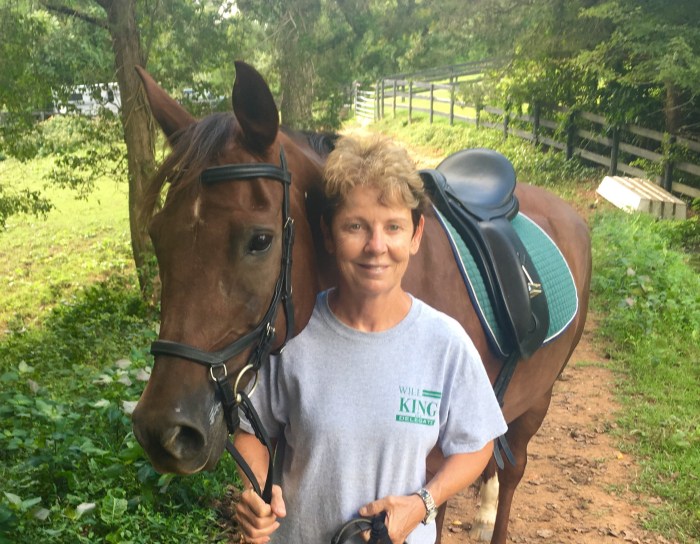
My wife, Cathy, recently had this story published in the March 2019, Mid-Atlantic Hanoverian Breeder’s (MAHB) Association Newsletter. I’m reblogging it here. Please enjoy her story of life on the farm.

***

It is a normal day in late April 2011.  I go to the barn, like I have every day for the past 12 years, both dogs following me.  Holly a Black and Tan Coonhound, and Miles, a Jack Russell, are my constant companions and helpers.

 After arriving at the barn, I put the horses out for a short while, although it is raining.  I have two pregnant mares, one of whom is due any day.  I have been closely monitoring Adancer for over two weeks, making drawings of her teats, looking for changes.  Had she bagged up and I didn’t know?  What about waxing?  I never saw wax (everything but….)  Paranoid, I Inspected her udder daily for changes in size (it ALWAYS looked the same… sigh).

 After cleaning the stalls, I bring Adancer in, as she is the mare closest to her due date.  Uh oh, what’s this?  Milk is shooting from both teats as she walks. Although I haven’t seen a birth up to this point, I know this is it.   Our first two foals were born at another barn. So I didn’t get to see those births.  For our third foal, after weeks of sleeping in the barn, I left to get a cup of coffee.  When I returned, the foal was laying on the ground in the stall.  I was determined that I was going to see this, the fourth birth, first hand.  I put the mare in her stall and watchfully began the rest of my chores. 

 Shortly after this, the repair guy for our Invisible Fence shows up to repair the fence.  “Be quiet,” I say, “my mare is going to have a foal and she must have quiet!”  While he is repairing the fence, I hear scratching noises.  After investigating I find that Miles, the Jack Russell, has fallen between the hay and the barn wall.  I climb up in the hay loft to help.  I can see the mare’s stall from my vantage point and see that the mare is going down.  Quickly, I leave Miles stuck where he is, and come down out of the hay and run to her stall.  Of course, she saw me and stood up. 

 Here comes the Invisible Fence guy, “Ma’am, the fence is repaired.  Do you want me to test it?”  “No,” I say, “my mare is having a baby!”  “OK, how are you going to pay me?” he asks.  “Whaaat, can’t you just send me the bill?” I say.  He comes back with “No ma’am, I have to have payment.”  Thinking fast I tell him to go up to the house, go in the back door through the garage, find a black purse and bring it to me.  Surprisingly, he does this without complaining.  I give him a credit card number and he leaves.  Huge sigh of relief on my part.

 By now the jack Russell has found a way out of the hay and is happily running around, chasing one of our barn cats. 

Back to the mare.  

I look in on her and find her standing but she almost immediately goes down.   I watch quietly praying for an easy birth. Slowly two little hooves come out of the birth canal, followed by the front legs.  The mare is laboring but progress is happening, and the head appears, followed by the neck and shoulders.  The rest of the foal comes out uneventfully.  It lays in the straw, both parties exhausted from their efforts.  Me?  I’m worried.  The foal is still covered with the birth sac.  Should I intervene and pull it away from the foal’s head, so it can breathe?  I hesitate.  The foal sits up inquisitively and looks around, causing the sac to fall to the side.  Whew, no need for me to do anything.   I go into the stall to quickly assess the foal and discover it is a filly.  The first and only filly our breeding program produced.  She is by Royal Prince and is quickly named Rohannah as a play on the name of our farm, Rohan Farm.  She is perfect!  In textbook fashion, Adancer, expels the placenta.  After several attempts, Rohannah gets up to nurse.

 I guess the moral of this story is that yes, mare’s do need quiet but can, and will, have a baby in utter pandemonium if necessary.

Adancer and Rohanna a bit later


National Vietnam Veterans Memorial Day

I never served in Vietnam. When the last combat troops departed on March 29, 1973, I was still in high school. I can tell you that I felt the aftermath of that war for years to come, including being spit at as a West Point cadet visiting New York City in 1975. I’m glad to see that the country did the right thing with the Vietnam War Veterans Recognition Act in 2017. This Friday, March 29th, marks National Vietnam Veterans Memorial Day.

Vietnam Service Medal

As a country, we did not do a good job in the ’60s and ’70s of separating our opposition to the war, from our treatment of those who served there, whether as a volunteer, or a draftee. Not only did we not thank those who served, vilification often greeted them upon their return. Even worse, the Veterans Administration did a poor job of helping those who needed it most. Whether drug issues, exposure to Agent Orange, or dealing with PTSD, we failed these men and women.

As an active duty officer in the late 70’s and early 80’s, I saw the effects of Vietnam, and the transition to the then new, volunteer Army. Morale was low. Drug and alcohol abuse were a problem. Our aging equipment was in less than great condition, and maintenance dollars were restricted. Due to these, and other issues, our combat readiness was not what it needed to be.

In the mid to late 80s, our military turned around. Later, following the First Gulf War, our citizens did as well, and we remembered the right way to treat our soldiers and returning veterans. There are any number of issues still effecting our veterans, particularly those who have had multiple deployments to Afghanistan or Iraq. At least now, we are trying to do the right thing by them. The VA and other organizations still have issues with supporting our troops and vets, but we as a nation are much more supportive of them, and their sacrifice.

Having said all of that, I’m not sure we ever really circled back as a country to thank those who served in Vietnam, probably our most unpopular war. Most of these veterans are now in their late 60s or 70s. Every year, more of them pass away, sometimes from “normal” health issues, sometimes from war related problems. I hope you will join me on March 29th, and every day, to say a special thanks to this under appreciated group. As time passes, there will be less and less opportunities to do so.

The Twenty Days of Maknassy

The Twenty Days of Maknassy

“Maknassy” – I can still hear Dad say the word, although he died in 2010. It wasn’t quite a snarl, but it was close. The battle, in March and April of 1943, was vicious. The Germans were slowly getting backed into a corner in Tunisia, and they knew it was either kill or be killed.

General Patton took over II Corps on March 6th, after the debacle at Kaserine Pass. On the 12th of March, Patton detached the 60th Combat Team, Dad’s unit, from the 9th Infantry Division and attached it to the First Armored Division. As a part of his upcoming operation at El Guettar, and the British Army actions under Montgomery to the south, the First was assigned a series of missions aimed at Maknassy Pass. Patton never liked to deploy armor without supporting infantry, and the 60th was given the task. Dad was a 19 year-old Sergeant, with 2 1/2 years in the army.

March 17th was the beginning of what became known in history books as the “Twenty Days of Maknassy”. According to Dad, the rain had poured for days turning the ground and roads into deep mire and mud. The Tanks were ineffective and couldn’t move. It would be up to the Infantry to get the battle started. They were directed to attack a small junction town, Station de Sened “The place everybody fought for, and nobody wanted”.

Dad explained “we started in the grass and mud to the front of the German positions. You couldn’t raise your head without getting shot, plus there were minefields in front of us. After darkness came, we moved”.

Move indeed. The 60th circled the town and climbed the backside of a steep hill, Djebel Goussa, that was to the side of Sened. Djebel Goussa was 600 feet above the valley floor and looked directly down onto Sened. They attacked on the night of the 19th. It was a brutal fight, with individuals, squads and platoons moving slowly up the hill until, by the afternoon of the 20th, they had displaced the Germans. As they now held the high ground, this also forced the enemy to evacuate Station de Sened.

The Germans retaliated with heavy shelling. Undaunted, the 60th moved and attacked again a day later, entering the town of Maknassy itself on the morning of the 22d. The Germans left sometime during the night, and the 60th entered without firing a shot. The New York Times headline back home featured a picture of the unit entering the town near the Railway Station. The easy part was over.

The 60th Combat Team enters Maknassy

They now moved on Maknassy Pass, 5 miles past Maknassy, their ultimate objective. The Germans were dug in on hills in the pass, including Hill 322, which was guarded by Rommel’s personal Guard. The tanks couldn’t go through the pass with the Germans controlling the heights, so naturally, the task again fell to the Infantry.

The 60th attacked a series of hills on the nights of the 22d and 23d with mixed success. As dad explained “we always attacked at night, but the Germans were well dug in. And they had mines on many of the approaches. The Germans used mines everywhere. The going was very slow.” They did take several of the hills, particularly on the north side of the pass, but the Germans still controlled the south side. Hill 322 was attacked many times but never taken. The advance bogged down, but the US Forces acted forcefully enough to cause the Germans to deploy reserve units, keeping them from engaging with Montgomery and the British, further to the south. Dad said that from where they were, they could actually see the open land on the other side of the pass, even though the Germans still controlled the south side of the pass. That open ground was what the tanks needed.

The history books tell us that the battle fell into a stalemate, with the Germans occupying some of the hills, and the US the others for the next several days. On 31 March, the commander of the 1st Armored Division ordered the 60th into another attack. According to one source, “Most of the unit (the 60th), had defended their limited gains east and north of Maknassy against unremitting pressure from the Germans, for the last four days. They had little relief or rest, and many casualties, and their performance during the attack reflected their poor condition.” The attack failed.

Dad talked with me about those days as well. They were dug in on the side of mountains with deep foxholes. Deep because of the continual shelling from German artillery. You didn’t show yourself during the daytime because of snipers. The same went for the Germans, and they also generally stayed undercover. One day Dad was looking across the valley with binoculars and saw a German outside his foxhole improving his positions. Dad said “You son of a bitch…” and took aim and fired. The bullet hit a rock about 6 inches behind the German, and he jumped back in his foxhole. One of Dad’s buddies in a neighboring foxhole called out “You missed him, Bill….”

On the 2nd and 3rd of April, the 60th received over 240 replacements for the men who had been killed or wounded. This translates to roughly a 25-30% casualty rate over the preceding 2 weeks. The new recruits arrived none too soon, as the Germans mounted a massive attack on the night of the 4th. The attack lasted all night, but the 60th held and the Germans retreated in the early dawn hours.

On April 7th, although the men of the 60th didn’t know it yet, the enemy had withdrawn. It was quiet all day and then something happened. Dad and his foxhole mate, Boggs, saw something just outside the valley. It was a vehicle approaching from the south. Suddenly, the vehicle stopped. As dad watched through binoculars, two guys got out of the vehicle and…..started making tea. It was a British scout vehicle. The Brits, along with the rest of the US forces attacking at El Guettar had broken through and were driving north. Dad and Boggs came down from the hills and approached the Brits. They spoke together for a while and traded some cigarettes for biscuits. The Brits then packed up their kit, and headed north. It’s not recorded in any history book, but I believe that was the first link up between Montgomery’s Eighth Army coming from the south, and the US 1st Armored Division driving East from Maknassy. The Twenty Days of Maknassy were over.

I love it when small history is a part of big history. Dad told these stories of Maknassy, with the mud, the minefields, and the night attacks in piecemeal fashion. The stories of the “missed shot” and the Brits having tea were always shared with a laugh. I remember listening to Dad as a kid. He never told stories of either the heroics, or the butchery, of war. It was always more about the humor of the situation, or some particular hardship they went through. It was only later when I read the details of some of the battles, that I was able to overlay dad’s stories onto the actual events of the battle. Greatest Generation indeed.

Addendum:

1. If you ever watched the movie, “Patton”, the tank battle shown in Africa is at El Guettar, of which the actions at Maknassy were a part of. The movie projects it as a single day battle, but the actual events took place over nearly three weeks, and was in support of Montgomery’s attack coming from the south.

2. In addition to my conversations with Dad, I was able to piece together many of the larger details of the battle from three other sources: The New York Times (editions from March and April of 1943); the book “Eight Stars to Victory, a History of the Veterans Ninth U.S. Infantry Division” (published in 1948); and this site on line: https://www.ibiblio.org/hyperwar/USA/USA-MTO-NWA/USA-MTO-NWA-28.html – “Northwest Africa, Seizing the Initiative in the West”, by George F Howe.

3. Over the past couple of years, I’ve written several blogs about Dad’s time in the Army. They were never posted in any particular order. If you are interested in reading more about dad’s life during WWII, you can get some glimpses in the following blogs, listed here in chronological order:

Oct 1942. Last leave before shipping out to invade Africa. https://mnhallblog.wordpress.com/2017/12/04/the-%EF%BB%BFlast-big-weekend-before-the-invasion/

Jan 1943. Dad, Roosevelt, and a Brush with History. https://mnhallblog.wordpress.com/2016/05/27/247/

Mar 1943. The Twenty Days of Maknassy (This blog)

June 1943. Kicked out of a Walled City Twice. https://mnhallblog.wordpress.com/2016/06/05/kicked-out-of-a-walled-city-twice/

August 1943. Wounded in Sicily. https://mnhallblog.wordpress.com/2016/05/14/wounded-in-sicily/

June 1944. Dad and Pooch on D-Day. https://mnhallblog.wordpress.com/2016/08/19/dad-and-pooch/

Late 1944. Dad, Deason, Boggs and Noble. https://mnhallblog.wordpress.com/2016/06/17/dad-deason-boggs-and-noble/

…And this one in regard to Veterans Day…..

Aug 1942. A last visit home. https://mnhallblog.wordpress.com/2015/11/10/veterans-day-a-blue-star-a-flag-and-a-letter/