The Washington Post headline screamed out “Barely a quarter of Americans still have landlines. Who are they?” I wanted to shout back, “ME FOR ONE!” Still, I wasn’t really surprised at the numbers. So why haven’t Cath and I taken the plunge? Well, there are one or two downsides to living in the country, which I will get to in a bit.
The article was actually quite interesting. It was based on analysis from the National Center for Health Statistics (NCHS) and their National Health Interview Survey (NHIS). The survey takes place on an annual reoccurring basis and covers a wide range of topics, including since 2003, cell phone usage. The change overall is pretty dramatic, as you can see from the chart.
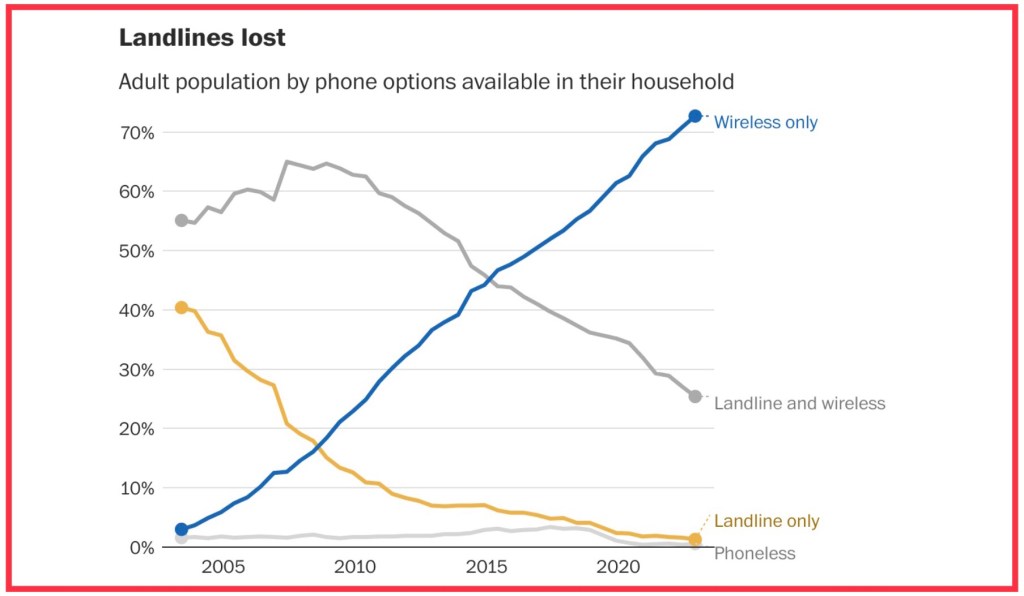
Not surprisingly, more older people still maintained their landlines. There were however, a couple of other interesting statistics:
- Homeowners are more likely than renters to have home phones.
- Hispanics are less likely to have landlines than blacks or whites.
- There are minimal differences between men and women on who has pulled the plug on landline service.
- There are minimal difference based on education level on who has pulled the plug on landline service.
- 1% of Americans have no phones at all (cell or landline)

Researchers also found that phone usage is correlated with health and health issues, often in surprising ways. From a WaPo interview with Mr Blumberg, the head of NCHS, people who abandon landlines and rely only on wireless — “are generally more likely to engage in risky behaviors. They’re more likely to binge drink, more likely to smoke and more likely to go without health insurance.” That’s true even when researchers control for age, sex, race, ethnicity and income. Yep, you read correctly. That friend of yours who smokes cigarettes and binge drinks is also more likely to have only a cell phone.
So why do Cathy and I currently still have our landline? It’s simple really. We live in the country and at our home, cell service has occasionally been sketchy in the past. There are many cell towers across the county. Unfortunately, we have lived in a bit of a semi-dead zone. A few years ago, I put in an amplifier to strengthen the signal which helps, but provides no absolute guarantees. We’ve wanted to make sure that if we have to make an emergency call, we could do so.
I should also mention that about half the time when someone calls one of our cell phones, they don’t ring. Of course some would consider that a blessing. 😉
Maybe it’s time to cut our landline service. With much better internet service now, we also do Wifi calling, which helps from a reliability perspective. Currently, we pay $103.25/month for our landline, so over the course of a year, that’s a chunk of change ($1239 to be exact).
It’s interesting. Sometimes catalysts come from the strangest sources. As I’m typing this, Cathy and I have spoken and decided it’s probably time to give the landline the Heave-Ho. We may wait a month or so to allow some transition time for a few key notifications, but that’ll be it. We may be a bit late to the party, but we’re there now. When you see me smoking more cigars and my alcohol intake increasing, you will know we’ve pulled the trigger. I guess it’s a good thing I’m now on Medicare.

Addendum:
- Here’s a link to the entire WaPo article if you are interested: https://wapo.st/438278B
- Statistical charts in the blog are from the WaPo article.
Discover more from Live Life Exuberantly
Subscribe to get the latest posts sent to your email.
 Live Life Exuberantly
I also have a land line because of the spotty cell service here, we’ve talked about switching to just cell, but my internet is bundled with it for about the same price as you are paying – so for now I guess I’m holding onto the landline, don’t want to drink even more that I do now LOL!
LikeLiked by 1 person
Yes, there are several in the metro DC area that have it bundled like you do. Unfortunately for us, there is no such thing as bundled internet in the rural area where we are.
LikeLike
Frequent moving causes major changes in electronics ownership and types of connectivity. When we moved to Denver from Cincinatti in 2006, we shifted from a hardwired landline (analog) to a set of digital wireless phones tied to a landline. I remember worrying about not having an analog phone for emergencies (harkening to my Signal Corps training) – but it never became an issue. Then in 2013 we moved to Switzerland, and having to abandon nearly all American electronics, and much more, going from a 4500 sq ft house to a 1200 sq ft apartment, and experimenting if cell-phone only was viable. And it was during our 10 year Switzerland adventure. Now back in Dallas a year ago, never gave the landline a thought – knowing that even the telco’s are discouraging them. I’ll keep a close watch on those risky behaviors, as a precaution 🙂 My doctor and dentist already use half a dozen ways to nag us of upcoming appointements, relentlessly – who needs a seventh?
LikeLiked by 1 person
Concur!
LikeLike
Hi! If you want to ease your transition of cutting the cord, before you release your landline you may want to consider a VOIP service like Ooma. Usually you can keep your current landline number and transfer it to Ooma. Yearly cost is minimal from “free, only pay the $7 taxes each month”, to look at me I’m fancy and pay $120 a year to get more features like my home phone simultaneously rings my cell phone and I get voicemails emailed to me.
We’re off grid with no cell service and ATT refuses to put in new landlines in our area (despite out neighbors on either side having ATT). Our only solution was phone service through Hughsnet satellite. Now that we have Starlink Internet, we can use WiFi calling and that works really well, but I didn’t want to give up the “home” number just yet so I transferred the home number to Ooma. (our cell numbers are Washington State, even though it’s not really a ‘thing’ anymore I remember not long ago when businesses wouldn’t call back “non local numbers”. My brain likes having a local 530 area code available).
LikeLike
We kept ours longer than most people we knew, also because of rural living and spotty reception. Eventually, the driving force to abandon it was the fat budget needed to keep something we hardly used, except to record political calls during elections. I know many who keep it because their cable company bundles it with other services, making it cheaper to have a phone than drop it. But we don’t live in an area where there is wired or cable anything. (Other than phone) So we could never take advantage of that. If the phone companies would have ever upgraded lines to provide wired internet to rural America maybe things would have been different.
LikeLiked by 1 person
Ditto!
LikeLike