“Love is the most important thing in the world, but baseball is pretty good, too.” – Yogi Berra.
I’ve loved baseball since I was a kid. Unfortunately, it’s probably going to be a long season for our No Name Gnats this year. Still, I love live baseball and I’m happy Opening Day is finally here this week. A beer and a brat will be a fine way to start the year, and we’ll see what develops.
2019 and the Nats World Series win was eons ago now. Since then, it’s been three straight last place finishes. Many of the heroes of ‘19 are scattered around the league – Scherzer, Turner, Soto and Rendon to name a few. Zim, Baby Shark, Eaton, and Kendrick are all retired. Robles is still here in the outfield, but hasn’t put up great (or even good) numbers. And of course, we still have Strasburg and Corbin here in DC. Those two sure helped us win in ‘19, but have been a disaster ever since. Stras has pitched a total of just over 30 innings since ‘19 and Corbin was the worst pitcher in all of baseball last year.
Posing with the Nats’ 2019 World Series Trophy. Great, but Old Memories Now.
Ownership is up in the air – will they or won’t they sell the team? Or will they bring in another partner? Or do nothing? Nobody knows.
Fans are, well, fans. You can tell the ones that jumped on the bandwagon in 2019 – most of those are long gone … after whining incessantly and displaying their lack of knowledge. Among the real fans, the long term fans, there is grumbling as well. But it’s a different type of grumbling. It comes with an understanding of the ups and downs and the fickleness of baseball. Everyone is unhappy about the ownership situation (will they or won’t they). People understood trading Scherzer two years ago, and even Turner, who had a year left on his contract. Soto? That one hurt.
I remind folk that we’ve been through nothing. You want long term suffering? Be a Cubs or Red Sox fan – they went 80 to 100 years between World Series wins. Cleveland is currently sitting on a 75 year streak with no World Series. Three last place finishes after winning the World Series? No, I’m not happy about it, but please, get some perspective people.
And so we come to the ‘23 season. A probable opening day lineup of players most people outside of DC have never heard of – Thomas, Smith, Menenes, Garcia, Ruiz, Abrams, Robles, Dickerson and Candelario. Pitchers will include the previously mentioned Corbin, along with Gray, Gore and a couple of others TBD. Seriously, how many of those names do you know? Hell, most fans in DC don’t know several of those names either.
It’s generally a young line up, and I’m particularly excited to see what Garcia, Ruiz and Abrams can do in the field, and Gray and Gore on the mound. With luck, we will see a couple of bright spots.
For this year, the team will be what it will be and I’ve made my peace with that. I’m just happy to get back to the park, as sure a sign of spring as anything I know. As the great Hall of Famer and Saint Louis Cardinal 2nd basemen Rogers Hornsby once said – “People ask me what I do in the winter when there is no baseball. I’ll tell you what I do. I stare out the window and wait for spring.”
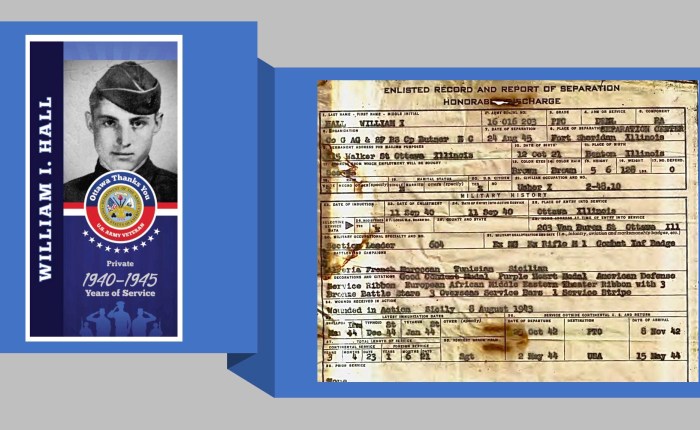
When discharged from the Army on August 24th, 1945, dad was 21 years old and had been in for nearly five years. His WWII service included time in Algeria, Tunisia, French Morocco and lastly, Sicily, where he was wounded. His discharge papers tell the intriguing story of those five years in one page.
This is the second of a two-part blog. Last week, I told the story of how I received dad’s enlistment and discharge paperwork from the National Archives. I then explored several interesting observations from his enlistment form, including the fact that he lied about his age in order to enlist. He claimed he was almost 19 years old, when in fact he was still two months shy of his 17th birthday. You will find a link to the first blog in the Addendum to this one.
Today’s blog explores his discharge paperwork, and briefly tells the story of his five years in the service. Dad was with B Company 1/60th Regimental Combat Team of the 9th Infantry Division from September 1940 until he was wounded and almost died in Sicily in August of 1943. Although his original enlistment in 1940 was for three years, when the war started all enlistments were extended for the duration.
As with his enlistment papers, dad’s discharge paperwork was discolored, creased and yellow, perhaps from the fire at the National Personnel Records Center (NPRC). A few parts were unreadable, but most of it was legible.
Dad’s Honorable Discharge Paperwork – it Suffered in the Fire at the Archives.
I’ll magnify and expand a couple sections to talk about some of the details.
At the top of the form, there are a couple of interesting items.
The Top of the Discharge Form – Magnified
Block 3 confirms his last duty station as Camp Butner, NC. This is where dad returned to the States in 1944 after recovering from his wounds. Camp Butner was both a troop training center, and a Prisoner of War camp. Dad told us stories later about helping train troops there (and about performing KP).
We see in block 4 his actual discharge date is August 24th, 1945. This was two weeks after the atom bomb was dropped on Nagasaki, Japan, and one week before the official surrender of the Japanese on September 2nd. The army was already discharging soldiers as the war was winding down, based on how many “points” they had (more on “points” later).
Block 7 still shows the birth date he lied about to enlist – Oct 12, 1921, as opposed to his real birth date of Oct 22, 1923. And amazingly, dad’s height, 5’ 6” and weight, 128 pounds haven’t changed at all from when he enlisted. Me thinks, someone was probably just copying from other forms to put this info in.
Block 21 shows his civilian employment as “Usher”, so maybe not everything was copied over. His enlistment paperwork showed him as a “Laborer”.
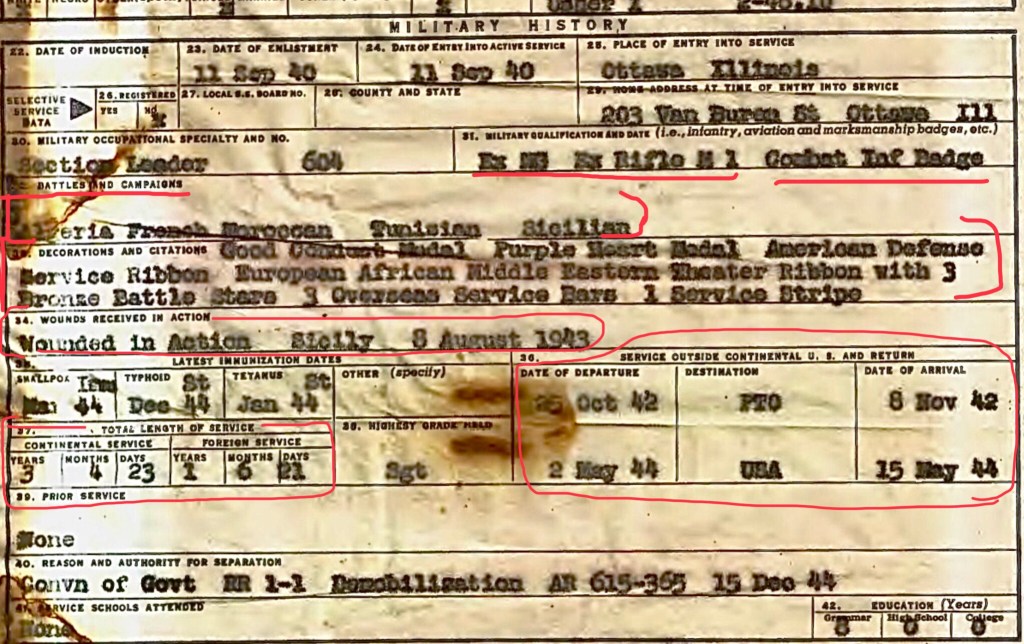
Now we move on to the Middle section of his discharge paper, dad’s “Military History”. This is the meat of the discharge, and paints the real story of his time in the service. I’ve again magnified the view so you can better read the form. In order to tell dad’s history in a linear fashion, I will sometimes go out of order in discussing what is in the blocks in this section.
Dad’s “Military History” in His Discharge Paperwork.
Block 31 shows dad qualified as an expert both on the Machine Gun, and the M1 Garand rifle. It also notes he was awarded the Combat Infantryman Badge. You could only earn the CIB if you were in the Infantry (not in Field Artillery, or Armor, or Signal Corps etc), AND you were in actual active combat with the enemy.
I’m going to skip to block 36 – “Service Outside the Continental United State” for just a minute . Note here that he arrived overseas on November 8th, 1942. What it doesn’t say is he arrived with the 60th Regimental Combat Team of the 9th Infantry Division at around 5AM under gunfire on the beach near Port-Lyautey, French Morocco. This was as a part of Operation Torch, the invasion of North Africa. Torch was (next to D-Day) the second largest amphibious assault ever attempted.
Now back to block 32, where we see in addition to French Morocco, dad also took part in battles in Algeria and Tunisia in North Africa where they defeated Rommel and the Africa Korps. Those battles took place between November 8th of 1942 and May 10th of 1943. Then in July of 1943, dad participated in the invasion of Sicily.
Skipping back down to block 34, we learn dad was wounded on August 8th, 1943. What it doesn’t mention is he was shot three times by the Germans in the mountains of Sicily and it took over a day to evacuate him by hand to an aid station. It also doesn’t say he almost died due to the combination of his wounds and the Malaria he contracted. His time with the 9th Infantry Division ended here.
Returning to block 36, we see dad arrived back in the States on May 15th, 1944, three weeks before D-Day. This was after he recovered from his wounds (he was evacuated to North Africa to fully recover). Due to the severity of those wounds, he didn’t return to combat – the war was over for him, although he remained in the service for another 15 months.
Block 37 “Foreign Service”, shows that of dad’s almost five years in the service, one year, six months and twenty-one days were spent overseas. Approximately eight of those months were in near continuous combat.
Finally, we return to block 33, “Decorations and Citations”. In addition to his Good Conduct Medal and Purple Heart (for being wounded), he was awarded: the American Defense Service Ribbon (awarded to troops on active duty prior to Pearl Harbor); the European African Middle Eastern Theatre Ribbon with three bronze stars (this was for participating in the campaign in French Morocco, and the subsequent campaigns in Algeria, Tunisia and Sicily); three Overseas Service Bars (one for each six month period in a theater of war) and finally a Service Stripe (one for each three year period of service). It’s worth noting dad also earned a Bronze Star (for exemplary conduct in ground combat against an armed enemy), which didn’t catch up with him until after he was already discharged, and is not reflected in this paperwork.
Finally we come to the bottom of the discharge paperwork and block 55. There are three items noted here, although not all are readable.
Block 55 – Points and Other Things
First, dad, along with all other honorably discharged service members, was issued a lapel button to be worn on civilian clothing. At the end of the war, it was particularly useful for those traveling home so they were quickly identified as service members and received priority for buses and trains.
Next we see dad’s ASR score was 95. ASR stood for Adjusted Service Rating and is what was used to determine the priority for discharging soldiers at the end of the war. The rules were simple in principle: “Those who had fought longest and hardest should be returned home and discharged first.” Points were given for length of time in the service, length of time overseas, combat campaigns, combat awards, being wounded and so on. At the time, “the points” required for discharge were 85. Dad, with his nearly five years of service, his 1 1/2 years overseas, his Purple Heart, and his four campaigns was at, or near the top of the heap. His 95 points reflect that, and was why he was discharged so quickly as the war was winding down. If you have ever watched the show “Band of Brothers” there is a great section in the last show focusing on this. Points were on everyone’s mind.
Finally, there’s the cryptic last line “xx days lost under AW 107”. What the hell is that? AW 107 stood for Articles of War (the forerunner of today’s Uniform Code of Military Justice). Article 107 refers to docking the soldier credit for days of active duty that they didn’t earn. Typical examples were for going AWOL, being too drunk to report for duty, or getting in trouble for other minor offenses and confined to the barracks. Since the service member was not performing his or her duties during those periods, they didn’t receive time in grade or retirement credit for those periods. It turns out many/most enlisted soldiers during WWII had AW107 scores higher than zero. During my research, I’ve found cases with numbers from 1 to over 200. I’ve tried like hell to read the smudged number here but can’t quite make it out. It might be a 5? It might be a 3? I don’t think we’ll ever know. What I do know is dad was busted from Sergeant to Private in June of 1943 for getting caught in, and subsequently kicked out of, a walled city twice in one night after missing the last truck back to his unit. Perhaps he was confined for some period of time in conjunction with this “incident”.
After his discharge, dad returned to Ottawa, Illinois in September and lived there for the next 65 years. In Ottawa he met mom, and had us three kids, six grandchildren and 13 great grandchildren. He retired from the railroad in 1985, and passed away in 2010.
For those of you who know me, or who have followed this blog for any length of time, I’m pretty sure you are aware of how much I admired my father. An embodiment of “The Greatest Generation”, dad was always one of my heroes. This was true certainly for his actions during WWII, but also for how he lived his life, and how he took care of our family.
A Banner Honoring Dad in Ottawa, Illinois on Veteran’s Day Last Year.
I’ve probably written more blogs about him than any other subject. The blog last week about his enlistment and this one about his discharge file are special to me. It’s somehow reassuring that his enlistment and discharge paperwork confirm the outline of the oral histories we heard from dad growing up. I wish I had discovered this paperwork while he was still alive, just so we could have one more conversation about it over a coffee or a beer. “Dad, tell me again about the time …”, or “Dad, about those lost AW 107 days…”.
I love him and miss him.
Addendum:
I apologize for the length of this and last week’s blogs, but I was trying to give some context to the cold and straightforward words in the paperwork.
– Here are a selection of other WWII blogs that I’ve alluded to in this blog. There may be some minor discrepancies in them, based on the availability of the new information in his paperwork:
Mar 1943. “Maknassy” – The battle, 79 years ago in March of 1943, was vicious. On the 12th of March, as a part of operations at El Guettar, General Patton detached the 60th Combat Team, Dad’s unit, from the 9th Infantry Division and attached it to […] Continue at: https://mnhallblog.wordpress.com/2019/03/22/the-twenty-days-of-maknassy/
May 1943. It was in May of 1943 in Tunisia, Dad looked at the German soldier and said “Chicago”. The German answered “Chicago?” Dad stared back. “Chicago … Al Capone”. Now the German’s eyes’ widened. Everyone knew who […] continue at: https://mnhallblog.wordpress.com/2022/05/08/dad-and-al-capone/
On the 11th day of September, 1940, just over 14 months before Pearl Harbor, my dad, William Iber Hall, enlisted in the United States Army for a 3 year stint. His enlistment paperwork showed him to be 18 years and 11 months of age. In reality, he was 16 years and 11 months old.
Our family history always said dad lied about his age when he joined the Army. Still, it was pretty cool to receive some official corroboration.
A couple of years ago in the middle of COVID, I was doing some research and learned I could access dad’s military records. The only catch? On July 12th of 1973, a fire occurred at the National Personnel Records Center (NPRC) and destroyed between 16 and 18 million Official Military Personnel Files, including 80% of those who were discharged between 1912 and 1960. I said a prayer, held my breath, and sent a letter to the National Archives, and more specifically, the NPRC, asking for dad’s service and medical records.
Months passed. A year passed. A second year passed, and then I finally received an email from the NPRC. Dad’s records existed, but were located in the area where the worst part of the fire was. They were damaged and incomplete. They did have his enlistment and separation paperwork, but nothing else. Nothing from his medical records, and nothing else about his time in the service. They did forward copies of the enlistment and separation papers.
The NPRC’s Response to My Request for Information About Dad.
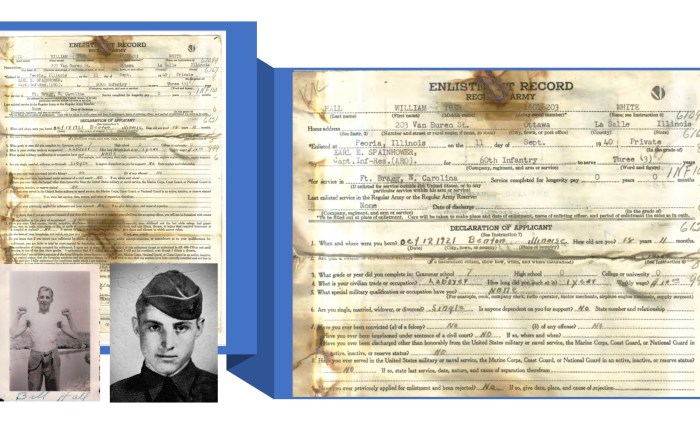
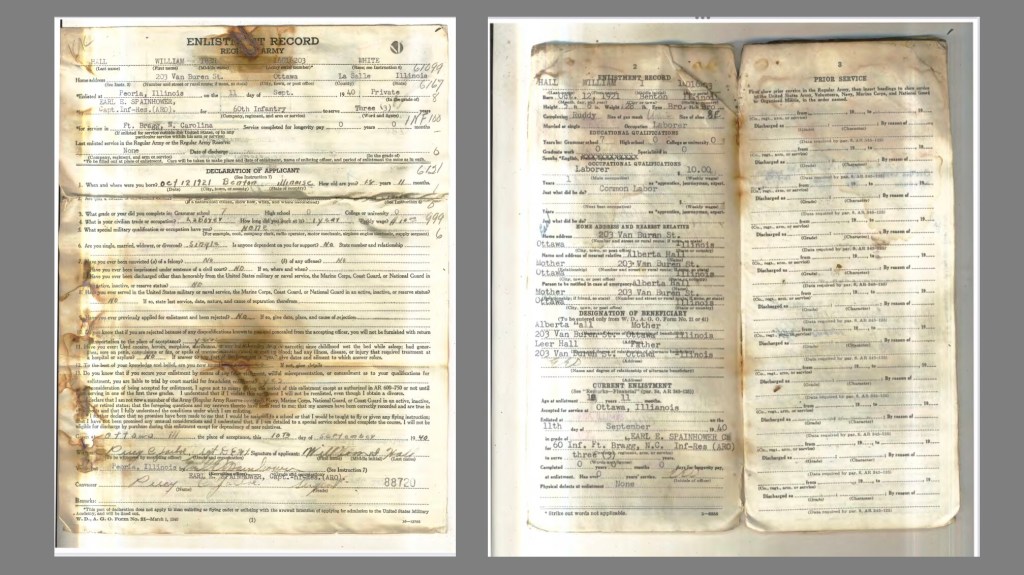
I looked at both documents. They are discolored, scarred and blurry in places. There are brown marks, including outlines of paper clips – perhaps from the heat of the fire. Here’s a photo of the enlistment documents – note there are actually three pages.
Dad’s Enlistment Papers – Apparently Damaged some by the Fire.
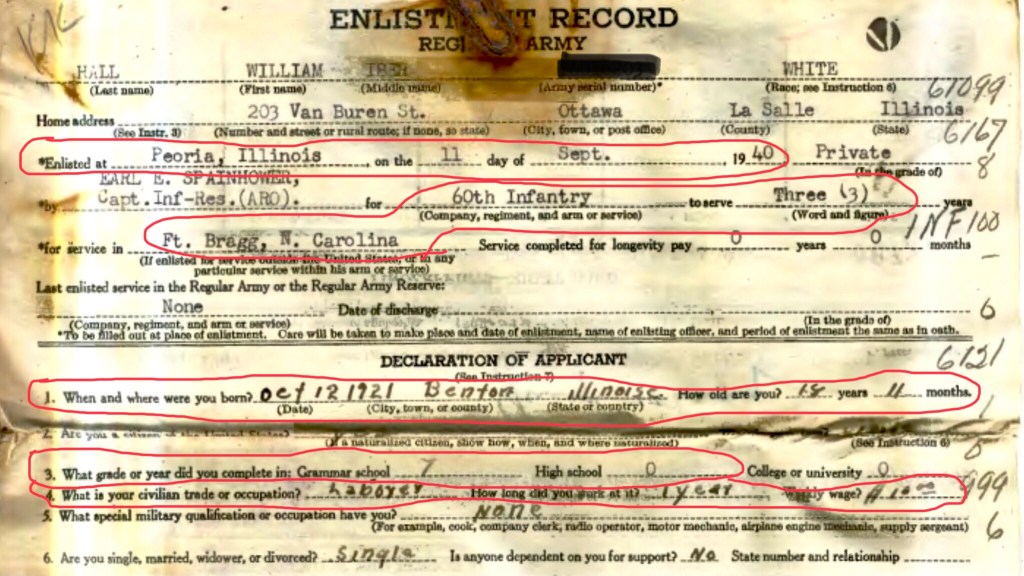
There is some fascinating information, particularly in the top half of the first page of the enlistment form. I’ve blown it up here so you can better read the form.
A Magnified View of the Top of Page One of Dad’s Enlistment, With Some Key Items Circled in Red.
Here are a few items of interest:
Dad enlisted in Peoria, Illinois – I’d always assumed in Ottawa, but there probably wasn’t a recruiting station there yet. His enlistment was for three years, and was directly to the 60th Infantry Regiment of the 9th Infantry Division. Three years later in September of 1943 when his enlistment was originally to end, dad was in a hospital in Sicily, recovering from being shot three times by the Germans. He was still serving with the 60th. By then, all enlistments were for the duration.
We see in his answer to question 1, that yes, dad did lie about his birth date – by over two years. His actual birthday was Oct 22, 1923, which means on the date of his enlistment, Sept 10, 1940, he was actually 16 years and 11 months old. You were required to be 18 years old to join and Dad lied big time, claiming a birth date of Oct 12, 1921, making himself 18 years and 11 months old.
His answer to question 3 shows he completed 7th Grade, and nothing more. This was interesting as well – dad always told us he graduated from 8th grade. (In a side note, Dad did graduate from high school in 2002, when he and other veterans who didn’t graduate were made honorary members and graduates of the OHS class of 2002.)
For question 4, he lists his work as Laborer for the past year, at $10/week. This was at least a partial lie. Dad joined the Civilian Conservation Corps (CCC) for two six month enlistments in 1939 when he was 15 years old (the legal age for the CCCs was 17). He may have worked as a laborer when he returned from the CCCs, but it certainly wasn’t for a year, as he joined the Army not long after his return. My guess is he was probably out of work at the time and didn’t want to admit it.
I’m betting dad didn’t know the “s” in Illinois is silent, as he spelled it Illinoise in his answer to question no. 1. ;-).
Dad in ‘39 or Early ‘40 in the CCCs, and Then Later in Early ‘41 with the 60th Infantry
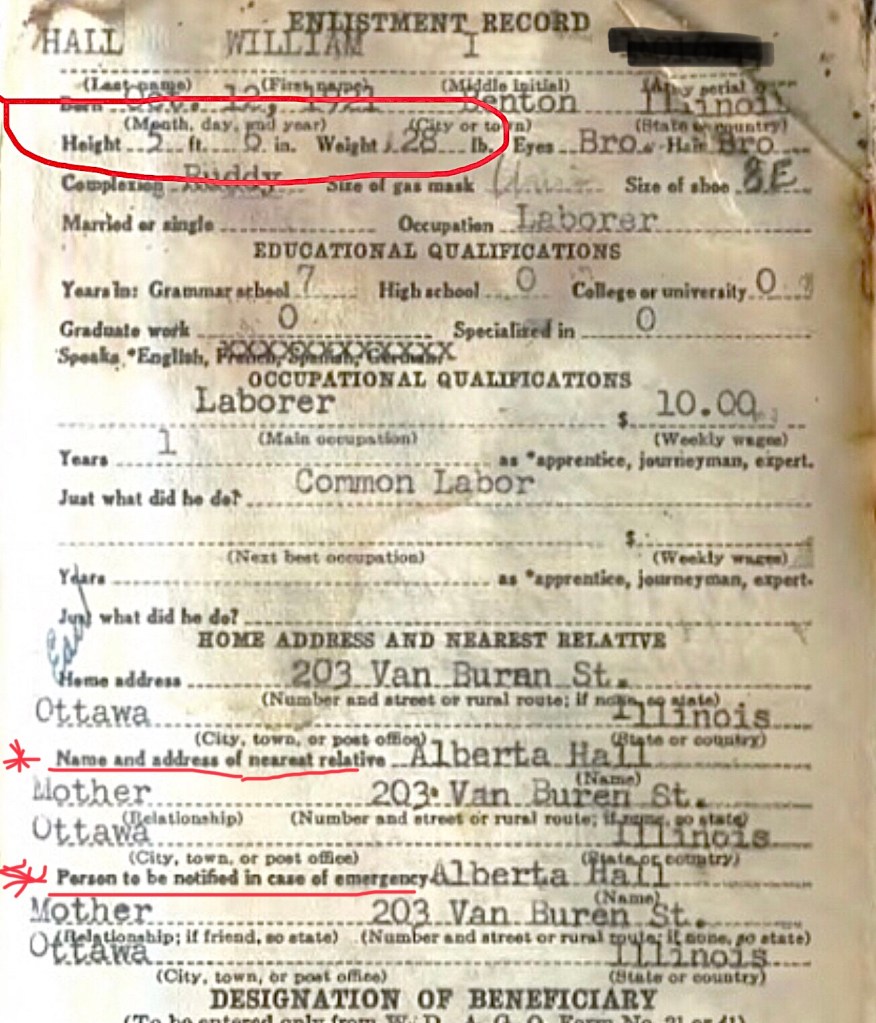
On the second page of his enlistment, there are a couple of additional parts of his life we can confirm from the information provided. First, dad is listed at 5’ 6” and 128 lbs. That corresponds pretty well with the above CCC photo of him. It’s hard to see how the recruiter actually thought he was 18.
Also of interest is that my Grandma, Alberta Hall, is listed as his nearest relative, and the person to be notified in case of emergency. This aligns with other parts of our family history that aren’t always talked about as much. My Grandpa Hall was something of a ne’r-do-well for much of his life, and probably an alcoholic. He sometimes disappeared for days or weeks at a time. Evidently Dad wasn’t taking any chances on him as his emergency point of contact and named Grandma instead. It makes sense to me now that when the telegram came to the family in 1943 informing them of dad’s wounding, it was sent to Grandma, not Grandpa.
A Magnified View of Page 2 of Dad’s Enlistment.
Receiving his enlistment papers was an amazing find to me. I never doubted dad, or any of his stories, but finding actual documents confirming his history is incredible. Knowing how lucky we are they didn’t burn along with the 18 million other military personnel records, only makes the story more fascinating. Luck is sometimes a wonderful thing.
We’d always been told that dad enlisted in 1940, and knew he had to have lied about his age. My Aunt Ellen, his older sister by several years, went to the recruiting station with him to verify his age to the recruiter. Life at that point in time, at the tail end of the depression was tough, or at least tough for the Hall family. Grandma was supporting the family with her work, and Grandpa was only a part time presence at home. There was no money, and probably not many jobs, at least not for a 16 year old. The pay in the Army was $21/month at the time, plus food and housing. I think it looked pretty good to someone who had a fairly rough life to that point.
Today, I’m thinking about 16 year old William Iber Hall going to the recruiting station in Peoria Illinois and signing up to an unknown fate. Unbeknownst to him, Pearl Harbor would happen 14 months later. Thank God for dad, and others like him, who did the right thing and stood by our country in it’s time of need.
— This is the first of two blogs about the documents I received from the NPRC. Next week’s blog will cover dad’s discharge paperwork. It tells the story about his time in the service from 1940 – 1945 in just one page, and is an equally amazing document.
Addendum:
You can read more about dad’s and the CCCs here: It was 1939 and dad and Uncle George were on a train, bound for the CCCs in Wyoming. Growing up in Illinois during the Great Depression was tough. Their family was poor before the Depression, and things got worse […] continue here: https://mnhallblog.wordpress.com/2017/12/13/dad-uncle-george-and-the-cccs-in-1939%EF%BB%BF
Here’s more on the fire at the NPRC from the Archives themselves: “Shortly after midnight on July 12, 1973, a fire was reported at the NPRC’s military personnel records building in St. Louis, MO. Firefighters arrived on the scene only 4 minutes and 20 seconds after the first alarm sounded and entered the building. While they were able to reach the burning sixth floor, the heat and the smoke forced the firefighters to withdraw at 3:15am. In order to combat and contain the flames, firefighters were forced to pour great quantities of water onto the exterior of the building and inside through broken windows. The fire burned out of control for 22 hours; it took two days before firefighters were able to re-enter the building. The blaze was so intense that local Overland residents had to remain indoors, due to the heavy acrid smoke. It was not until July 16, nearly four and a half days after the first reports, that the local fire department called the fire officially out. The fire destroyed approximately 16-18 million Official Military Personnel Files (OMPF). No duplicate copies of these records were ever maintained, nor were microfilm copies produced. Neither were any indexes created prior to the fire. In addition, millions of documents had been lent to the Department of Veterans Affairs before the fire occurred. Therefore, a complete listing of the records that were lost is not available. In terms of loss to the cultural heritage of our nation, the 1973 NPRC Fire was an unparalleled disaster.”
“5:25 … 5:26 … 5:27 … Hall – 5:28 … 5:29 … 5:30 …” I did it! I finished the Plebe indoor mile run in under 5:30! As I slowed, my stomach suddenly double clutched and I ran to a nearby trash can, where I promptly threw up.
During my time at West Point, the Academy frequently talked about developing the “whole man” (with the admission of women in 1976, this changed to the “whole person”). We cadets were always being tested and evaluated. It was true about leadership, about academics, and was certainly true about physical fitness. For most of us, somewhere in all that testing was an Achilles Heel. With some it was a particular academic course, for others, some physical education test or class.
Plebe Year at West Point.
As Plebes, there were four required gym classes: Swimming, Wrestling, Boxing, and Gymnastics. For me, I’d been a swimmer all my life and a lifeguard for a few years, so the swimming class was easy, and I earned the equivalent of an A. Wrestling? I made West Point’s intercollegiate wrestling team as a freshman walk on, so I validated wrestling and took handball as an elective instead. Boxing was a challenge at first, but once I learned the basics, AND learned getting punched in the nose wasn’t a showstopper, I did OK. Gymnastics was a different beast.
The pommel horse, the rings, the vault, parallel bars, the trampoline, mats for tumbling … I forget what other torture devices were there, but it was like I was in a cursed land. My two sisters would tell you I wasn’t particularly coordinated as a kid. As a matter of fact, they would say I was a bit of a klutz. It all came home to roost in Gymnastics class. I was passing, but just barely.
At some point during the class, I learned we would do a timed mile run as a part of the course. Running of course has nothing to do with gymnastics, but those things happened at West Point. Just another chance to excel. Now, I had never been a runner, but since it was wrestling season, I was in great shape. Probably the best shape of my brief life up to that point. I started thinking I might be able to earn a good score on the mile run and improve my overall Gymnastics grade.
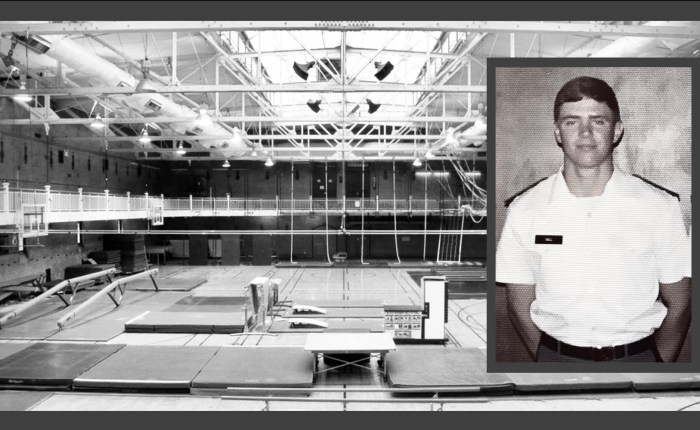
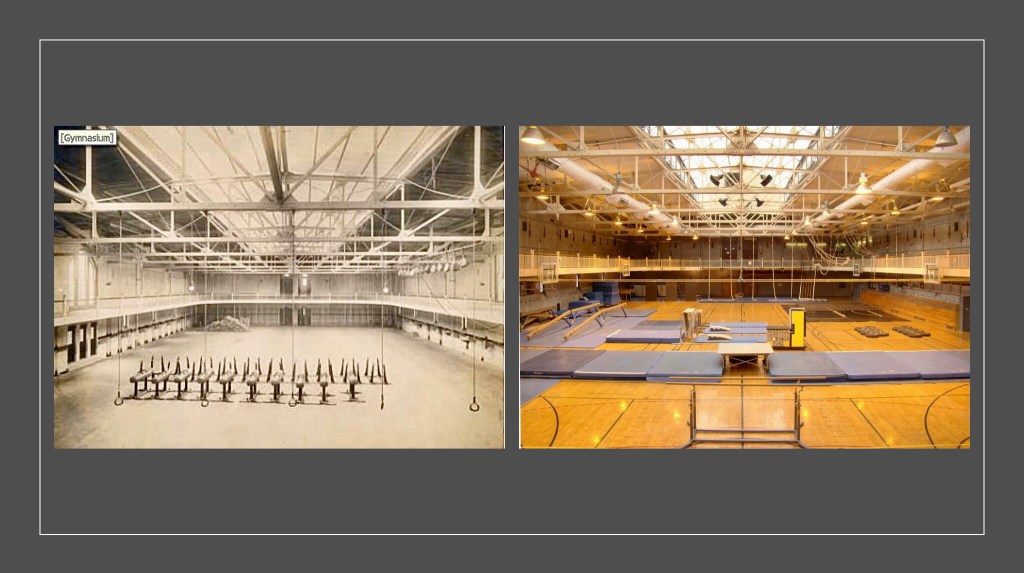
Hayes Gym* is where we practiced Gymnastics. It was “a large open gym with a vaulted ceiling and hardwood floors.” Above the gym floor, an elevated track rings the room. It takes 11.7 laps to run a mile on that track and that’s where we would complete the mile run.
Hayes Gym in 1910, the Year it was Built, and Again in 2009. Note the Elevated Track.
My personal view at the time (and that of at least a few of my classmates) was that many of the instructors in the Department of Physical Education (DPE) had a bit of a sadistic streak in them. One of our instructors was Army’s gymnastic coach, Ned Crossley and some classmates recall his scoring as particularly brutal. Looking back now, I’m pretty sure it wasn’t true. Having said that, all of the DPE instructors had ways of questioning you, challenging you, or prodding you that often seemed to taunt you a bit as well.
The instructor who spoke with us about the mile run was a little like that. To receive a max score, you needed to run under 5:30. The instructor explained what we needed to do to run a 5:30 mile. At 11.7 laps per mile, “all” you needed was to run each lap at a 28 seconds per lap pace, and then run like hell for the last half lap. Simple. Easy Peasy. Any cadet could do it. And so on. Of course the vast majority of us could run no where near that fast.
At the time, I don’t believe I’d ever run a mile (or any other distance) for time. I’d certainly run laps in High School sports, run in formation at West Point for Company morning runs during Beast, and we ran our asses off in wrestling practice. But none of this was ever done for time. That was about to change.
My pea brain went to work. 28 seconds was two seconds less than 30 seconds for each lap. 28 seconds for the first lap… 56 seconds for two laps … 1:24 for three laps … 1:52 for four laps and so on. I’d do the math in my head on the run. As long as I could keep the pace going, I had a shot.
A couple days later, it was my turn to do the run. As I recall, there were a few of us running it at the same time, although I don’t recall exactly how many. What I do remember was taking off when “go” was called. The first lap – 27 seconds! The next couple of laps I was under the pace. After that, I was a bit erratic, with some over and some under, but the average was OK and at the half mile mark, I was on pace. The final few laps? I’m not sure I was really paying attention any longer. The air was stale. The air was acrid. 3/4 of a mile and still on pace. My lungs were burning. I was sucking in as much oxygen as I could. 11 laps done. My legs were lead. It was down to just over half a lap left. I didn’t see anything other than the track in front of me. I don’t know if the other Plebes were in front of me, or behind me. All I know is I ran as hard as could. I rounded the final curve.
“5:25 … 5:26 … 5:27 … Hall – 5:28 … 5:29 … 5:30 …” I did it! I beat 5:30. I slowed down and suddenly my stomach double clutched and I ran to a nearby trash can, where I promptly threw up.
Recovery took me a while. I may have heaved a second time, and certainly had the dry heaves. Eventually I made my way to the shower, and then to whatever my next class was that day.
A couple weeks later, I passed gymnastics with some room to spare.
In my remaining years at West Point, I never ran that fast again. Not even close. We had PT tests on an annual basis with a two mile run next to the Hudson River. I never approached anything close to that time, even when adjusted for a slower time due to the extra distance. The two miler was always a challenge for me and I was always nervous about failing it. The thought of maxing out my run score never entered my head.
Years later, I took up running on my own for fun and to stay in shape. I became a decent runner, and clocked several personal bests – an 11:44 two mile ( a sub six minute/mile pace); a 39:58 10K (a sub 6:30/mile pace) and a 68 minute and change 10 mile race (a sub 7 min/mile pace). I remember all of those. The one I still marvel at? The 5:28 mile on the indoor track at West Point. I had no business running that fast. How the hell did I ever do it?
Addendum:
* Some info on Hayes Gym from the Academy itself: Hayes Gym was built in 1910. The second level of Hayes is what most cadets and USMA graduates think of as “Hayes Gym”. It is a large open gym with a vaulted ceiling, hardwood floor, and elevated track (11.7 laps to a mile) that rings the room. The Department of Physical Education (DPE), teaches applied gymnastics (now called “Military Movement”) in Hayes, taking advantage of its historical and unusual support structures. The gym has eighteen 21′ vertical ropes and two 60′ horizontal ropes (suspended 12′ from the floor). There are also 10 pull-up bars that are each 5′ wide and are suspended from the ceiling with vertical supports in such a manner that they can be “run across” (with proper technique), as is done during the Indoor Obstacle Course. The gym’s floor space is filled with gymnastic’s apparatus and pads, such as vaults, bars, and rings as well as 1″ and 4″ tumbling mats. Nowadays, the military movement equipment remains in place year-round.
The Indoor Obstacle Course is another “fond” memory of Hayes Gym for most West Point Grads, as it was also known to induce retching at it’s completion. I may do a blog on it in the future, but it’s hard to describe to those who haven’t experienced it. To get a flavor for it, here’s a YouTube video of Cadet Elizabeth Bradley completing it just a couple of years ago and breaking the female record while doing so. For all my macho buddies out there, I would love to see you try to beat her time. Good luck on that unlikely event. GO ARMY! https://youtu.be/Dw5rR1yqyp8 .
Thanks to classmates Gus Hellzen and Jerome Butler for their contributions to this blog.










 Live Life Exuberantly