
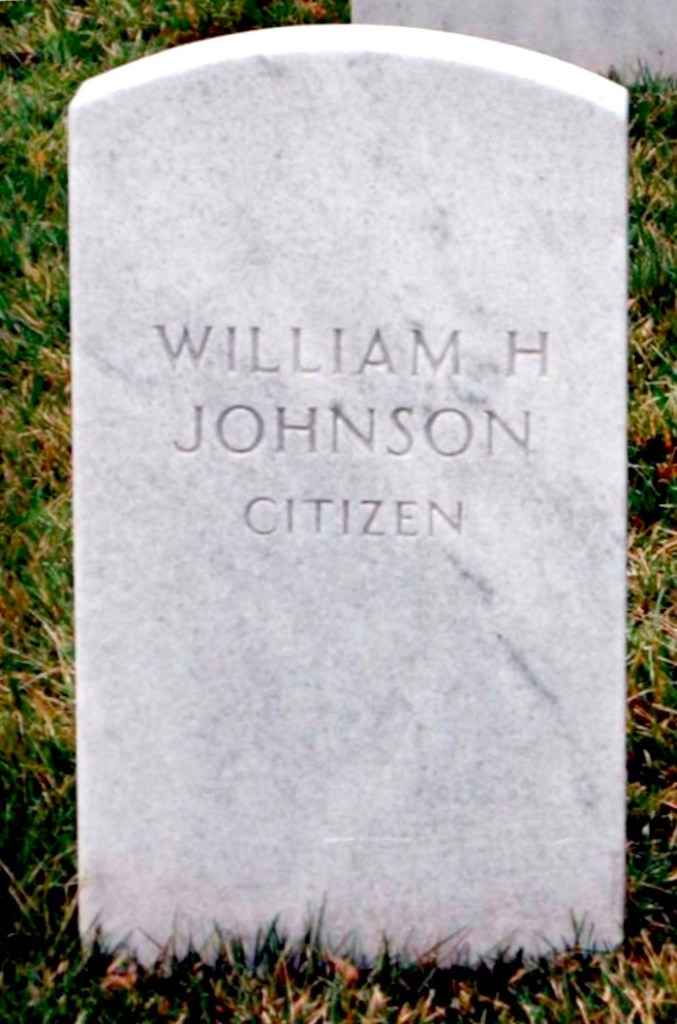
Grave 3346, in Section 27 at Arlington National Cemetery is simple, like those around it. The inscription? William H. Johnson, Citizen. William Johnson, a free African American, was Abraham Lincoln’s valet and and tended the sick president after his Gettysburg speech. This grave might, or might not be his final resting place. As with much of history, the details aren’t exactly clear, but it makes for an interesting story.
When Abraham Lincoln was elected president, he brought William H. Johnson with him to Washington DC in 1861. Johnson had worked as a freedman for Lincoln and his family at least since 1860. Originally employed at the White House as a valet, there was trouble between Johnson and the the other free African Americans who worked there. His skin color was quite dark and the other lighter skinned African Americans harassed him.
Lincoln tried to help solve the problem and wrote a “to whom it may concern” letter: “William Johnson, a colored boy, and bearer of this, has been with me about twelve months; and has been, so far, as I believe, honest, faithful, sober, industrious, and handy as a servant.” There were mixed results from the letter. Over the next three years, Johnson was listed as working for the Navy, a White House fireman, and a Treasury Department employee among other jobs. Throughout it all, he continued to work for Lincoln as a valet. He shaved Lincoln, shined his shoes, and took care of him in other ways, including carrying money for him.
In July of 1863, there was this little battle in Pennsylvania at a place called Gettysburg. You may have heard of it. Four months later, in November, Lincoln travelled by train to the battlefield for the dedication of the cemetery there, and took William with him. Lincoln went on to deliver his famed Gettysburg Address at the dedication. Those 272 words would become the most quoted of his entire presidency, although at the time, they weren’t particularly noticed. The address started – “ Fourscore and seven years ago our fathers brought forth, on this continent, a new nation, conceived in liberty, and dedicated to the proposition that all men are created equal…”. Written almost one year after The Emancipation Proclamation took effect, the wording was not accidental.
Fate then intervened. On the return trip to Washington, Lincoln showed signs of Smallpox and was quite ill. William Johnson is the person who nursed him back to health. Unfortunately, Johnson also caught Smallpox. Was it from Lincoln, or someone else? We’ll never know for sure. What we do know is he continued to worsen, and eventually died around January 28th, 1864.
Lincoln himself settled Johnson’s estate. The president followed his valet’s instructions as to how his pay was to be distributed. As Lincoln explained to a Chicago Tribune reporter,
⁃ “This is something out of my usual line; but a President of the United States has a multiplicity of duties not specified in the Constitution or acts of Congress. This is one of them. This money belongs to a poor negro who is … very bad with the smallpox…. He is now in hospital, and could not draw his pay because he could not sign his name. I have been at considerable trouble to overcome the difficulty and get it for him, and have at length succeeded in cutting red tape….I am now dividing the money and putting by a portion labeled, in an envelope, with my own hands, according to his wishes.”
Lincoln also paid off a loan he co-signed with William, and took responsibility for Johnson’s funeral. In fact, he paid for his coffin, grave marker, and burial.
We know all of this because Lincoln recorded much of the above in his personal papers. The next part becomes a bit murkier. That is, where is William Johnson actually buried? There are at least three different possibilities.
First, most black smallpox victims were buried in the Columbian Harmony Cemetery, in Northeast DC. Unfortunately, the cemetery was razed half a century ago for development.
Second, he may have been buried at the Congressional Cemetery. Although there is no direct record of this, some historians believe it to be the case.
Finally, many believe he may be buried at Arlington National Cemetery. Section 27 contains the graves of Civil War soldiers, a significant number of freedmen who resided in the District of Columbia, and probably formerly enslaved people from the Custis Lee Estate. There is the marker with the correct name and the man buried under the marker died in 1864. Despite this information, there are also doubts raised about the entire claim. The Custis Lee Estate (later Arlington National Cemetery) would not become an official cemetery for another few months. William Johnson was a common enough name at the time. Then there was the interesting epitaph “Citizen”. Was this Lincoln’s way of recognizing Johnson was a freedman? It turns out in the early days of burials at Arlington, civilians were also buried there. “Citizen” merely meant this was the grave for a person who was not a soldier.
I’m not sure why I have this mini-fascination with Mr Johnson, but I do. I first read about him a few years back in a book about the Gettysburg address. Since then, his name has popped up in a couple of other books about Lincoln. It’s always just a couple of paragraphs describing what he did for Lincoln, taking care of Lincoln when he contracted Smallpox, and then Lincoln settling Johnson’s estate when he died. He truly is just a minor footnote in history. And yet….. The Civil War still had well over a year to run. Here was Lincoln, during one of the worst times in our history, taking time out of his life and the national concerns to take care of this man and his affairs. Why? Did Lincoln do this because it was the right thing to do, or was there more to it?
Mary, a friend of mine helped some with my investigation. She is an amateur historian, particularly about slavery and the Civil War period (her ancestors owned enslaved people and she spends time trying to make amends for that). She found Lincoln’s census record for 1860. There was a Johnson living in the Lincoln household, but it indicates a female, 18-years old, and no indication that she (or if mis-stated, he) was Black, and the initial appears to be “M” rather than “W.” Nor was she able to find any William Johnsons in Springfield at that time.

Mary’s guess is that he was a fugitive from slavery and had renamed himself once he reached freedom in Illinois. She also looked on Ancestry.com and cannot find a single person that claims a black William Johnson who worked for Abraham Lincoln as a relation. Her words: “This is really, really strange. I’ve never come across someone that NOBODY claimed in a family tree.”
So, is Johnson buried at Arlington? Sometimes, we aren’t meant to solve mysteries, and I think this is one of those cases. The romantic in me hopes he is at Arlington. There would, perhaps, be some justice in that. No matter where he’s buried, I’m glad I learned about him, and his relationship with Mr. Lincoln.
Addendum:
- Virtually all references to William H. Johnson are from President Lincoln’s own comments, requests, or papers. There is little else known about him.
- Special thanks to my friend Mary Haak. Mary and I have had many thoughtful discussions about politics and race over the past year or two. She is a genuine human being, who quietly goes about doing the “right thing” in many ways. We should all be so dedicated.
- Lincoln gets credit for “freeing the enslaved people”, but he was also a product of his time, and by no means perfect. Here are three examples:
- In August of 1858, in my home town of Ottawa, Illinois at the first Lincoln-Douglas debate, Lincoln said: “I have no purpose to introduce political and social equality between the white and the black races. There is a physical difference between the two, which, in my judgment, will probably forever forbid their living together upon the footing of perfect equality…I have never said anything to the contrary, but I hold that, notwithstanding all this, there is no reason in the world why the negro is not entitled to all the natural rights enumerated in the Declaration of Independence, the right to life, liberty, and the pursuit of happiness.”
- In August of 1862, Lincoln wrote to Horace Greeley, Editor of the New York Times, and famously stated: “If I could save the Union without freeing any slave I would do it, and if I could save it by freeing all the slaves I would do it; and if I could save it by freeing some and leaving others alone I would also do that. What I do about slavery, and the colored race, I do because I believe it helps to save the Union;”
- In January of 1863, under The Emancipation Proclamation, Lincoln did free enslaved people, but not all of them. The Proclamation only freed those slaves who were in States that had seceded from the Union. It did nothing about slaves in the border states that had not seceded. Those slaves were freed by state action, or by the 13th Amendment to the Constitution, ratified in December 1865.
Discover more from Live Life Exuberantly
Subscribe to get the latest posts sent to your email.
 Live Life Exuberantly
Did you see the article in yesterday’s Washington Post? https://www.washingtonpost.com/history/2020/10/11/lincoln-smallpox-valet-died/?fbclid=IwAR2iyH3ELnuLorHRKV7BCR0uVH1QYh-nivR9nyuezSJmHmPhAbmNjcOt9TY
LikeLiked by 1 person
Maybe I was foreshadowing back in January… 🙂
LikeLike
Super interesting piece of history. Thanks! I think you just passed on your obsession to Cameron. Lol!
LikeLiked by 1 person
Haha! Maybe he can do some more digging for information. 😉
LikeLike