
I was one of the first to arrive. I was handed a peeler, offered a beer, and told to head outside. Three or four people were already there, including my buddy Magoo. The pile on the table was huge, and the guys had already started, some with knives, some with peelers. I took a breath, grabbed my first horseradish root, and started peeling. Jim’s 2018 horseradish making party was underway…
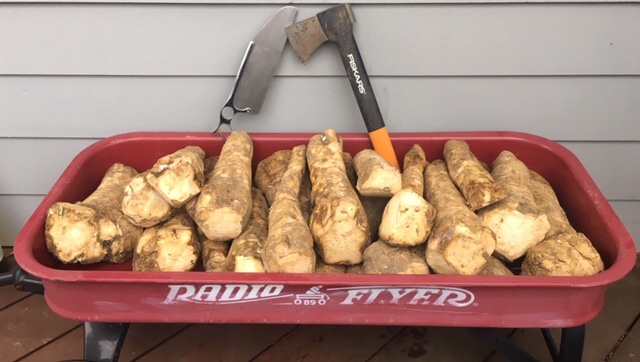
Jim has been making horseradish sauce since the ‘90s. Before marrying his wife Janis, he ground horseradish with her Uncle George, an old Croatian from Pittsburgh. The uncle claimed to have a secret sauce and vowed he would not share the secret with Jim until he married into the family, which Jim did in 1999. It turns out Uncle George’s secret was to drink a lot while preparing the roots.
Jim started hosting his horseradish parties in 2004, and over time, it grew in size. I’d been invited for a couple of years, but always had a conflict and couldn’t make it. This year when I received the invite, I cleared my calendar and vowed I wouldn’t miss it. The date finally arrived last November, and I left home early to ensure I’d arrive on time.
Jim met me at the door and offered a beer. As I was a first-timer, he walked me through the steps required to make horseradish and told me some of the history of the party. He also encouraged me to work all of the stations, so I would understand the process. Originally he only used horseradish he grew at home, but the party became so large, he now supplements it with horseradish roots ordered through his local grocery.
After grabbing the peeler, I went outside, where the first two steps in the process were taking place. I started by peeling as much of the skin off a horseradish root as possible, and also digging out any small brown spots. After finishing, I handed the root to a cutter.

The cutter’s job is to remove any larger brown spots remaining, and to cut the root into smaller chunks. Now with all his years of experience in making horseradish, Jim had acquired a wide range of tools to help with this task, and the team was using most of them. There were large knives, saws, small axes, and other devices I’ve since forgotten. In the past, they have also used power tools, chisels and hammers. This year’s addition was a Khashoggi-style bone saw. The thing is, the horseradish root is tough as hell, and oddly shaped – a 4 inch kitchen knife isn’t going to get the job done. While smiling, Jim told me blood has been lost in the past, but so far, no fingers (just a few finger tips that were added to the grind).
Next, the horseradish chunks are brought indoors. The large chunks are cut into smaller cubes, and everything is washed in the sink. From there, it’s loaded into the food processor. Prior to this step, the horseradish root doesn’t have any of that eye-watering aroma we associate with horseradish sauce. That’s about to change.
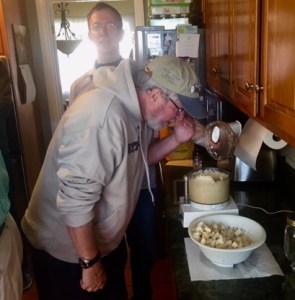
The food processor step is something of a right of passage, and all newcomers are required to work it. After putting the lid on the blender, you pulse the processor a few times, turning the horseradish into a fine grind. Newbies are then encouraged to take the lid off and do a “quality control” check by smelling the horseradish and ensuring it’s OK. When I completed my first QC check, my eyes watered, my sinuses cleared, and I think there was a burn in the back of my throat. There were laughs all around of course.
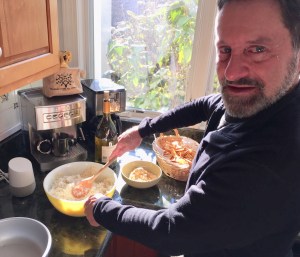
The processed horseradish is then dumped into a bowl and left to rest for five minutes or so. White wine and a bit of vinegar are then added. You want just enough to moisten the ground horseradish, but not enough to make it liquidy. The white vinegar is added as a fixer to keep the grind from turning brown and to help stop the chemical reaction that occurs during the grinding. Jim adds the wine to spike the taste.
Next, you have a choice. The horseradish is ready to “can” now, or you can add some sour cream. If using the sour cream, you add just enough to mix in, but you don’t want any liquid in the bottom of the bowl. I think over the course of the day, maybe 20% of the grind had sour cream added, with the rest just using vinegar and wine.
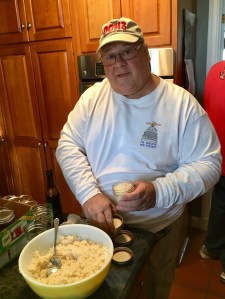
The final step is filling the canning jars and putting lids on them. We filled three or four cases of half-pint jars (24 jars to a case) and probably another case or two of quarter-pint jars. I’m told the creamed horseradish lasts a couple of weeks, and the wine cured a couple of months, if kept in the fridge. We didn’t seal the jars with a water bath or pressure cooker, although that can be done, allowing you to keep it longer.
While all of this processing was going on, the group continued to gather until there were probably 25 or so guys and the party was at a dull roar. Some people were helping to make the horseradish, while many were just standing around, talking, drinking an adult beverage, and having a good time. The event is also a potluck and almost everyone brought a dish to pass. The food items are also known as horseradish delivery devices. There were several traditional foods you think of with horseradish, such as beef, sausages, mashed potatoes, bloody Mary’s and so on, but there were also some nontraditional ones like cheese, apple pie and horseradish infused pickles. From my personal taste testing, I can tell you fresh horseradish sauce is similar to bacon – almost everything is better with it.

I finally had to leave and drive home. As I gathered up my jars of sauce, I thanked Jim for the great afternoon. He knows I enjoy cooking, and asked if I wanted to take a couple of horseradish plants home. Of course I said yes and we went to his garden and dug up a couple of tops. I’m looking forward to growing some of my own horseradish next year.
__________________
Addendum:
1. Jim told me a great story about Billy Horseradish, a distance cousin of Johnny Appleseed’s. Instead of apples, Billy went around the countryside handing out horseradish tops, but It never caught on the same way apples did. Jim promised if I came back next year, he’d share the entire legend of Billy Horseradish. In the meantime, he did recite the Billy Horseradish prayer (sung to the tune of the Johnny Appleseed Prayer):
Oh the Lord is good to me;
And so I thank the Lord
For giving me the things I need;
The bread and the fish and the horseradish;
The Lord is good to me.
The internet is surprisingly sparse on information about Billy Horseradish, so I’m really looking forward to next year’s party. ;-).
2. Janis’ uncle came to a couple of the early parties and Jim used to call him during later parties to let him join in on a bit of what he started. Uncle George died last year two months shy of his 100th birthday. Jim gave him his last jar shortly after his 99th birthday and George pronounced it the best ever.
3. Jim explained to me the reason the party is guys only is a reaction to his wife Janis’ lady craft nights– the women got together, made crafts and drank some amount of wine. Jim was expelled from the house on craft night…
****
Special thanks to Jim Overdahl for hosting the party, reviewing this blog for accuracy (so that’s what the vinegar is for!), and providing some of the photos.
Discover more from Live Life Exuberantly
Subscribe to get the latest posts sent to your email.
 Live Life Exuberantly
One thought on “Making Horseradish Sauce”